Flutter vs React Native: Statistics, Market Share, Jobs & Adoption (2026)

Flutter vs React Native is one of the most common comparisons in mobile development—and one of the most frequently misrepresented.
GitHub stars are presented as market share. npm downloads are treated as unique developers. A 2023 survey statistic is repeatedly relabelled as 2025 or 2026 data. Lists of well-known applications rarely explain whether the entire app or only a few screens use the framework.
The same scrutiny is necessary when evaluating properly attributed business and SaaS benchmarks, where labels, sources, and measurement choices can materially change the conclusion.
This report takes a stricter approach.
We compare Flutter vs React Native using current GitHub API data, official package-download activity, Stack Overflow developer surveys, Stack Overflow community data and Appfigures SDK-detection estimates.
All live figures were collected on July 22, 2026, unless another date is specified.
Key Flutter vs React Native statistics
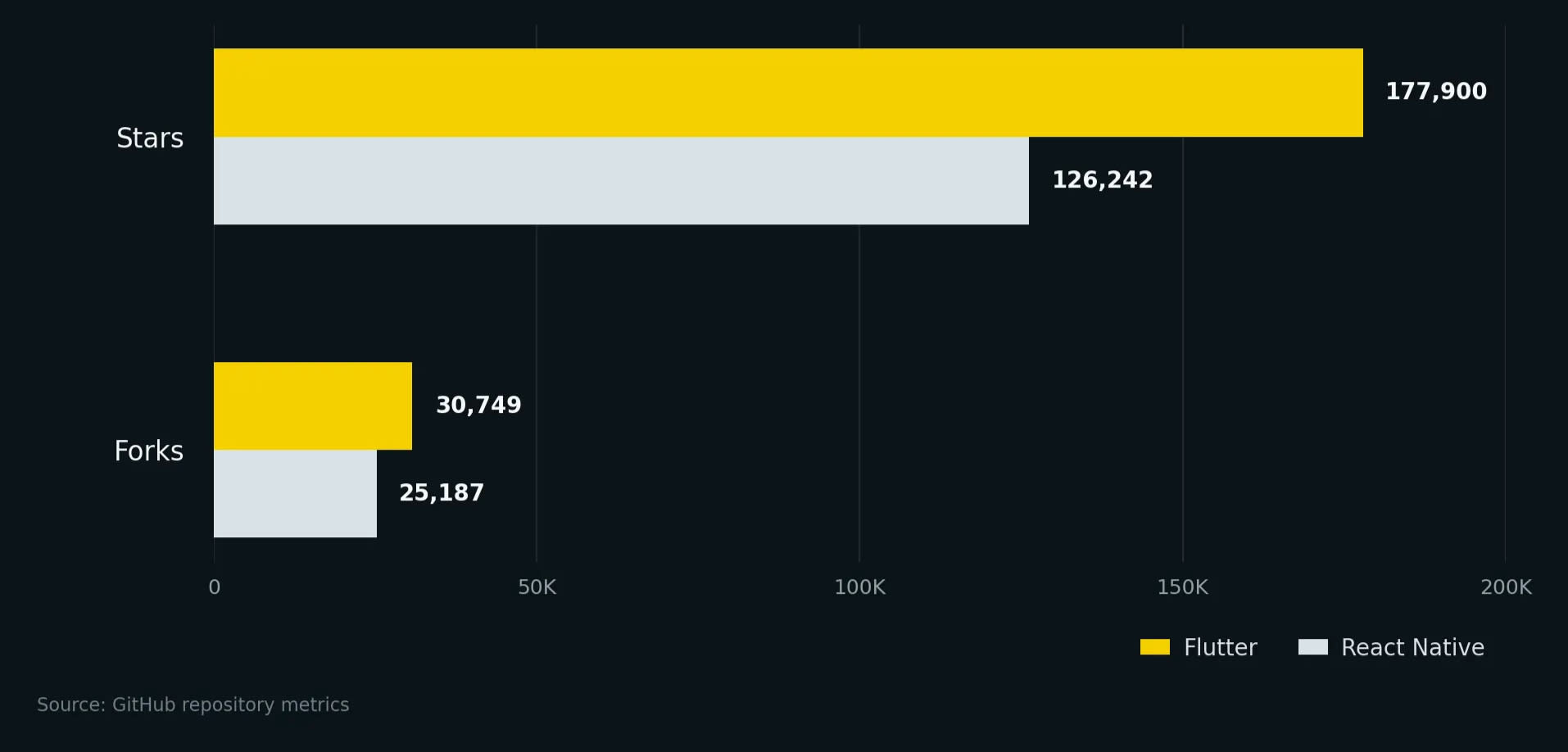
Flutter had approximately 177,900 GitHub stars, compared with 126,242 for React Native.
React Native had more lifetime GitHub contributors: approximately 4,227, compared with 2,363 for Flutter.
The
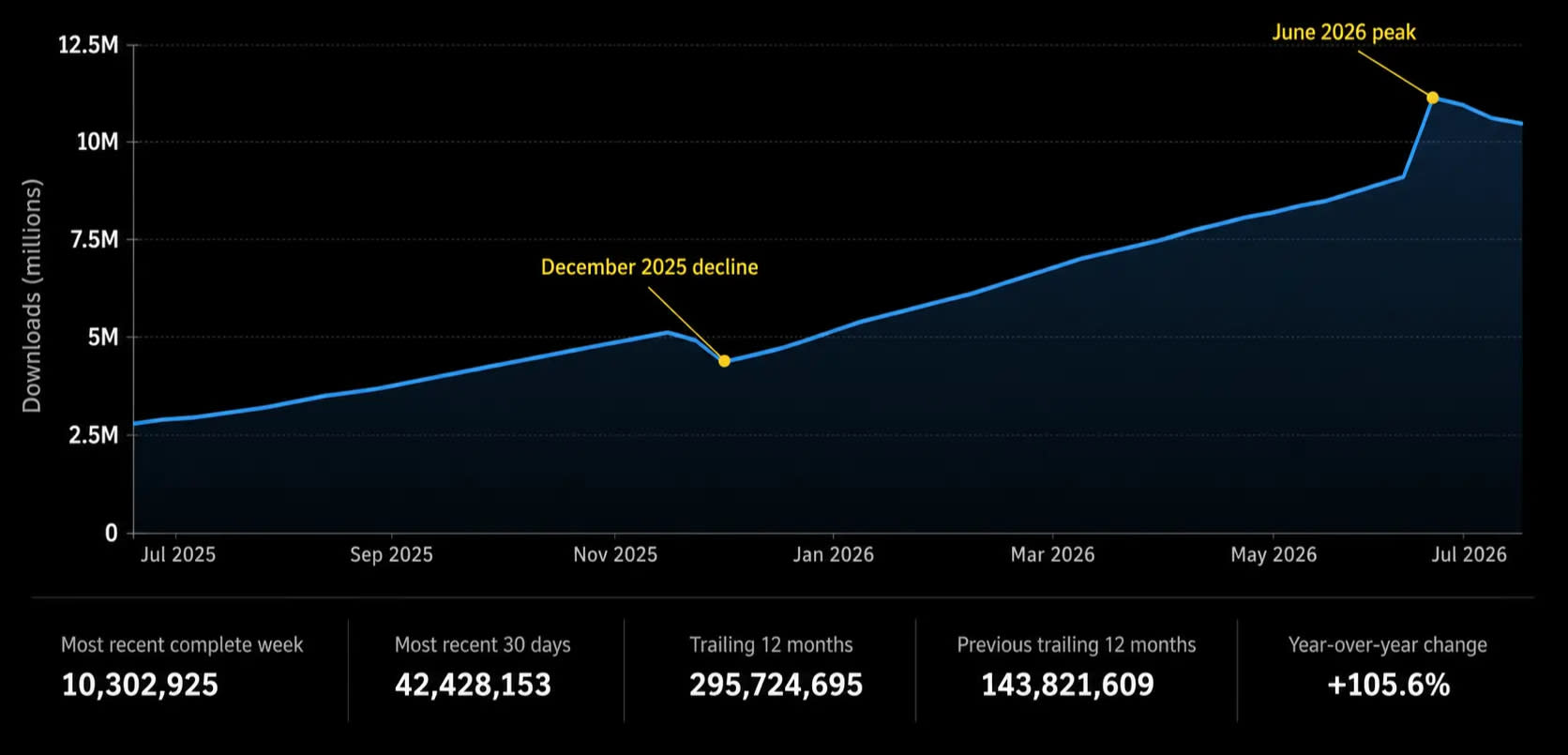
react-nativenpm package recorded approximately 10.3 million downloads in one week and 42.4 million over 30 days.React Native npm downloads increased by approximately 105.6% year over year.
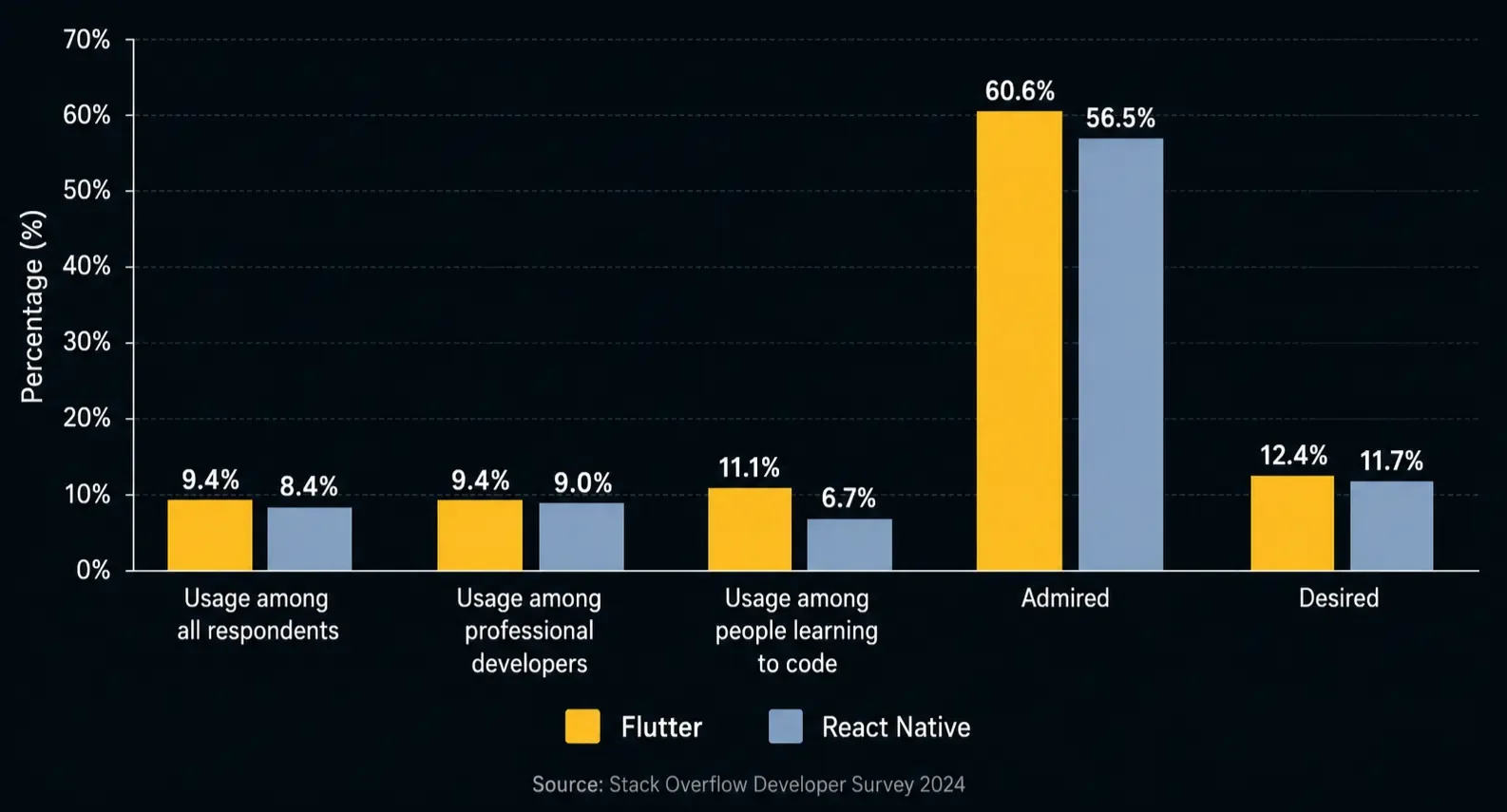
In the 2024 Stack Overflow Developer Survey, Flutter usage was 9.4%, compared with 8.4% for React Native.
Among people learning to code, Flutter usage was 11.1%, compared with 6.7% for React Native.
Appfigures detected React Native in 1,350 of the top 10,000 non-game iOS apps, compared with 1,184 for Flutter, in December 2025.
A separate Appfigures study detected Flutter in approximately 11.07% of newly released apps and games, compared with 6.75% for React Native, during January–October 2024.
Estimated 30-day app revenue was nearly equal at approximately $287 million for React Native and $283 million for Flutter.
React Native had 173 apps earning more than $1 million per month, compared with 37 Flutter apps.
The widely cited 46% Flutter versus 35% React Native statistic comes from a
2023 Statista survey, not a 2024 or 2025 Stack Overflow survey.
The 2025 Stack Overflow Developer Survey did not provide a valid Flutter vs React Native framework comparison.

Get the Mobile Testing Playbook Used by 800+ QA Teams
Discover 50+ battle-tested strategies to catch critical bugs before production and ship 5-star apps faster.
Flutter vs React Native at a Glance
Metric | Flutter | React Native | Stronger signal |
GitHub stars | 177,900 | 126,242 | Flutter |
GitHub forks | 30,749 | 25,187 | Flutter |
Lifetime GitHub contributors | 2,363 | 4,227 | React Native |
Stack Overflow 2024 usage | 9.4% | 8.4% | Flutter |
Professional-developer usage | 9.4% | 9.0% | Nearly tied |
Stack Overflow admired score | 60.6% | 56.5% | Flutter |
Top-10,000 iOS apps detected | 1,184 | 1,350 | React Native |
New-release SDK presence | 11.07% | 6.75% | Flutter |
Apps earning $1M+/month | 37 | 173 | React Native |
Core framework package downloads | No equivalent metric | 10.3M/week | Not comparable |
Is Flutter or React Native more popular in 2026?
There is no single defensible winner.
Flutter leads several public developer-interest indicators. It has more GitHub stars and forks, more cumulative Stack Overflow questions, and slightly higher usage and admiration in the most recent Stack Overflow survey that measured both frameworks properly.
React Native leads several commercial-maturity indicators. Its npm package records more than 10 million weekly downloads, it appears in more of Appfigures’ top 10,000 non-game iOS apps, and it has substantially more applications in the highest revenue bracket.
Flutter also appears stronger among newly released applications in a separate Appfigures dataset.
The most accurate conclusion is:
Flutter currently leads several developer-interest and new-release signals. React Native remains stronger in top-app presence, high-revenue applications and measurable npm activity.
That is more useful than declaring one framework the universal winner.
Flutter vs React Native GitHub statistics
GitHub provides the simplest public comparison of Flutter vs React Native popularity, although repository metrics should not be confused with production adoption.
As of July 22, 2026:Flutter had about 51.9k more GitHub stars than React Native based on the rounded public counts available at the time of writing. That is not small. It suggests Flutter continues to command unusually strong open source attention for a mobile framework.
React Native is still massive. Its GitHub and npm footprint show a mature project with years of production usage behind it. But if the only question is “Which project has more visible GitHub interest in 2026?”, Flutter is ahead.
Stack Overflow Activity: Flutter Has More Public Developer Questions
Stack Overflow question volume is useful because it shows where developers are learning, debugging, asking for help and running into implementation problems.
As of June 30, 2026:
GitHub metric | Flutter | React Native |
Stars | 177,900 | 126,242 |
Forks | 30,749 | 25,187 |
Lifetime contributors | 2,363 | 4,227 |
Trailing 52-week commits | 6,147 | 2,986 |
Latest stable version | 3.44.7 | 0.86.0 |
Flutter had approximately 41% more GitHub stars than React Native.
That is a meaningful popularity signal. Developers may star a repository because they actively use it, plan to evaluate it, are learning the technology or simply want to follow its development.
It is not a market-share measurement.
React Native had more lifetime contributors, with approximately 4,227, compared with 2,363 for Flutter. Flutter recorded more raw commits during the previous 52 weeks, but commit totals also require caution.
The Flutter monorepository includes automated engine-roll and dependency-update commits. Repository structure, bots and project-management practices can materially affect raw commit counts.
The data supports four limited conclusions:
Flutter has stronger visible GitHub popularity.
React Native has had more lifetime contributors.
Flutter has more recent raw commits.
None of these figures independently measures production usage or framework quality.
React Native’s canonical repository is now react/react-native. Older links using facebook/react-native redirect to the current repository.
We excluded open issue totals from the comparison because GitHub’s standard field combines issues and pull requests. Issue counts are also heavily affected by triage and bot-closing policies, making them a poor framework-health metric.
React Native npm download statistics
The react-native package recorded the following npm activity when checked on July 22, 2026:
npm metric | Downloads |
Most recent complete week | 10,302,925 |
Most recent 30 days | 42,428,153 |
Trailing 12 months | 295,724,695 |
Previous trailing 12 months | 143,821,609 |
Year-over-year change | +105.6% |
Weekly downloads increased from approximately 3.35 million in late July 2025 to approximately 10.3 million in July 2026.
The package reached a weekly peak of approximately 10.53 million downloads in June 2026. Its lowest week—approximately 2.28 million—occurred during late December 2025.
npm downloads are not developer counts
The npm total can include:
Local installations
CI/CD pipelines
Dependency reinstalls
Docker and environment rebuilds
Registry mirrors
Automated tests
Multiple installations by the same developer
The late-December decline illustrates how workplace activity and automated builds materially influence package-download figures.
The year-over-year increase remains a strong signal of React Native ecosystem momentum. It should not be converted into an estimate of unique React Native developers.
The increase coincides with wider Expo adoption and React Native’s New Architecture rollout, but npm data alone cannot establish what caused the growth.
Flutter download and package statistics
Flutter does not have a directly equivalent npm metric.
React Native is distributed through a core npm package. Flutter is installed as an SDK, while Dart and Flutter libraries are distributed separately through pub.dev.
Representative pub.dev activity during the 30 days ending July 22, 2026 included:
Package | Type | 30-day downloads |
| Dart package commonly used with Flutter | 9,475,081 |
| Flutter plugin | 5,423,220 |
| Dart package commonly used with Flutter | 3,572,787 |
| Flutter package | 1,703,702 |
| Flutter package | 1,100,142 |
These figures should not be added together to estimate Flutter developers or applications.
A single application may use several packages, while the same package may be downloaded repeatedly by CI systems, automated analysis tools and local development environments.
Like npm, pub.dev measures package-retrieval activity rather than unique people or apps.
Can Flutter and React Native downloads be compared directly?
No.
The two ecosystems use different:
Distribution models
Package structures
Installation workflows
Automation patterns
Caching behaviour
A comparison between react-native npm downloads and an npm package called flutter is especially misleading. The npm package named flutter is unrelated to Google’s Flutter SDK.
There is currently no honest “Flutter downloads versus React Native downloads” scoreboard.
Flutter vs React Native developer survey data
The most recent Stack Overflow Developer Survey that listed both Flutter and React Native as standard framework options was the 2024 survey.
Stack Overflow 2024 metric | Flutter | React Native |
Usage among all respondents | 9.4% | 8.4% |
Usage among professional developers | 9.4% | 9.0% |
Usage among people learning to code | 11.1% | 6.7% |
Admired | 60.6% | 56.5% |
Desired | 12.4% | 11.7% |
Flutter’s strongest advantage appeared among people learning to code.
Usage within that group was 11.1% for Flutter, compared with 6.7% for React Native. Among professional developers, the difference narrowed to 9.4% versus 9.0%.
This suggests Flutter had a stronger learner and newcomer signal, while professional usage was almost tied.
Flutter also led modestly in the admired and desired measurements.
Why there is no valid 2025 comparison
The 2025 Stack Overflow Developer Survey retained a “Web frameworks and technologies” category but removed the broader “Other frameworks and libraries” category where Flutter and React Native had previously appeared.
Neither framework was included as a standard option in a directly comparable category.
The 2025 survey therefore does not provide a valid Flutter vs React Native usage, admired or desired comparison.
The latest clean head-to-head remains the 2024 survey. Stack Overflow’s 2026 survey was still open when this report was compiled, with results pending.
Historical Stack Overflow usage
Survey year | Flutter | React Native |
2021 | 13.55% | 14.51% |
2022 | 12.64% | 12.57% |
2023 | 9.12% | 8.43% |
2024 | 9.4% | 8.4% |
2025 | Not comparably measured | Not comparably measured |
React Native led in 2021. Flutter moved narrowly ahead in 2022 and retained that lead through the 2024 survey.
These figures should not be treated as a perfectly consistent adoption trend. Stack Overflow changed question structures, answer options, categories and denominators between editions.
Comparisons within the same survey year are more reliable than comparing absolute percentages across the full period.
Flutter vs React Native market share: explaining the 46% vs 35% statistic
One statistic appears in almost every Flutter vs React Native comparison:
Flutter: 46%
React Native: 35%
These figures come from a 2023 Statista survey of cross-platform mobile-framework usage.
They do not come from the 2024 or 2025 Stack Overflow Developer Survey.
Framework | 2019 | 2020 | 2021 | 2022 | 2023 |
Flutter | 30% | 39% | 42% | 46% | 46% |
React Native | 42% | 42% | 38% | 32% | 35% |
The correct interpretation is:
In Statista’s 2023 survey, 46% of surveyed cross-platform developers reported using Flutter and 35% reported using React Native.
These percentages should not be described as market share.
Developers could report using more than one framework, so the numbers are not mutually exclusive shares of a fixed market. They also should not be relabelled as 2024, 2025 or 2026 data.
This distinction matters because “framework usage among surveyed developers” and “share of production mobile applications” are entirely different measurements.
Flutter vs React Native Stack Overflow activity
As of June 30, 2026:
Stack Overflow tag | Total questions |
| 200,475 |
| 140,743 |
Flutter had approximately 42% more cumulative tagged questions.
That indicates a larger accumulated volume of public discussion and technical knowledge. It does not automatically mean Flutter has a healthier developer community.
Higher question volume can reflect:
More developers
More beginners
More framework complexity
Better Stack Overflow participation
Poorer documentation
Greater developer friction
Cumulative totals also describe historical activity more than current momentum. Stack Overflow question creation has declined across software development following the rise of AI coding assistants.
Annual new-question volume is therefore a more useful measure of current activity than lifetime totals. The figures above should be read as accumulated public knowledge, not active-developer headcount.
Flutter vs React Native app adoption
When comparing cross-platform adoption, Android vs iOS market share provides platform context for interpreting where framework deployment priorities may differ.
Neither Apple nor Google requires mobile apps to disclose which development framework they use.
Third-party mobile-intelligence platforms instead inspect app bundles for detectable framework components. This produces useful estimates, but detection does not prove that an entire application was built with one framework.
A detected SDK may power:
The complete application
Only one platform
A group of screens
Shared business logic
A legacy feature still included in the bundle
Appfigures provides two useful but distinct datasets for understanding Flutter vs React Native adoption.
React Native leads among top iOS apps
In December 2025, Appfigures analysed the top 10,000 non-game iOS apps by monthly downloads.
Framework | Apps detected | Share of downloads | Share of revenue |
React Native | 1,350 | 47% | 41% |
Flutter | 1,184 | 38% | 32% |
Kotlin Multiplatform | 218 | 14% | 27% |
The download and revenue percentages refer only to the three frameworks included in the analysis—not the entire App Store.
React Native had greater SDK presence within this top-10,000 sample and accounted for more estimated downloads and revenue than Flutter.
Appfigures defines an application as “using” a framework when the framework is detected in the app bundle. It does not claim that the entire app was built with it.
Kotlin Multiplatform is also becoming difficult to ignore. Although it appeared in fewer apps, it accounted for 27% of estimated revenue within Appfigures’ three-framework sample.
Flutter leads among newly released apps
A separate Appfigures analysis examined newly released apps and games between January and October 2024.
It detected:
Flutter in approximately 11.07% of releases
React Native in approximately 6.75%
A non-native framework in approximately 15% of new releases overall
Flutter therefore led React Native among newly released applications in this dataset.
However, this result cannot be combined directly with the top-10,000 iOS analysis as though the datasets form one adoption funnel. They cover different periods, platforms, app populations, game categories and ranking criteria.
The defensible conclusion is narrower:
Flutter led React Native in Appfigures’ new-release dataset. React Native led Flutter in Appfigures’ separate top-10,000 non-game iOS dataset.
Flutter vs React Native app revenue
Appfigures also grouped applications by estimated monthly net revenue in October 2024.
Monthly net revenue | React Native apps | Flutter apps |
$10,000–$100,000 | 790 | 727 |
$100,000–$1 million | 255 | 241 |
More than $1 million | 173 | 37 |
Estimated total 30-day revenue was almost equal:
React Native: approximately $287 million
Flutter: approximately $283 million
The highest revenue bracket showed a much larger difference.
React Native had approximately 4.7 times as many applications earning more than $1 million per month as Flutter.
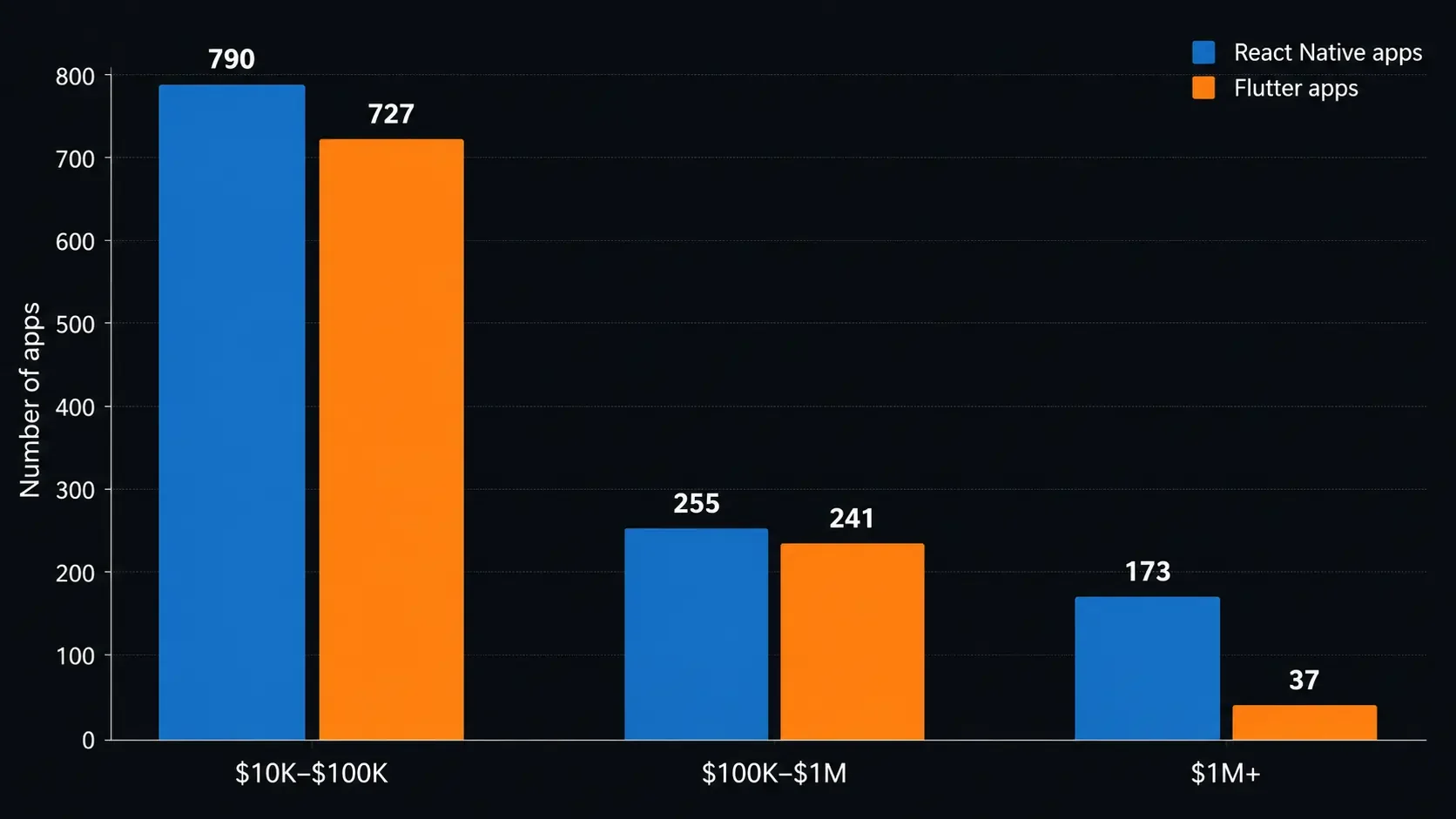
The accurate interpretation is:
Total estimated revenue was nearly tied, while React Native had substantially more applications in the highest monthly-revenue tier.
That is a stronger commercial-maturity signal than simply comparing total estimated revenue.
Flutter vs React Native jobs
Job-board totals are among the least reliable statistics in Flutter vs React Native comparisons.
Results change based on:
Exact query wording
Country or city
Search date
Personalisation
Duplicate listings
Recruiter reposts
Broad keyword matching
Whether unrelated React web roles are included
React Native generally produces a stronger hiring signal across major commercial markets, particularly where React and TypeScript skills are already common.
However, public job-board totals are too volatile to support a permanent global ratio such as “React Native has five times more jobs.”
The practical hiring difference is broader than job counts.
React Native allows teams to recruit from the wider JavaScript, TypeScript and React ecosystem. That does not make every JavaScript developer a qualified React Native engineer, but it can reduce the cost of onboarding developers who already understand the language, component model and supporting tooling.
Flutter requires Dart expertise, although its strong learner adoption and growing developer community can make hiring easier in markets where Flutter is already established.
The useful conclusion is:
React Native currently has a stronger directional hiring signal in many commercial markets, while Flutter’s hiring availability depends more heavily on region and local ecosystem maturity.
Teams should run their own matched job searches in the markets where they actually plan to recruit.
Flutter vs React Native comparison: what the data means for mobile teams
The statistics do not identify one framework that is universally better.
Flutter may be a stronger fit when:
The team wants highly consistent UI across platforms.
The product is being built as a new cross-platform application.
The organisation is comfortable standardising on Dart.
A controlled rendering layer is more important than following every native UI convention.
Flutter talent is readily available in the target market.
React Native may be a stronger fit when:
The organisation already has React or TypeScript expertise.
Native platform integration is strategically important.
Expo and the broader React ecosystem are useful to the product.
The team already has React Native production experience.
Commercial maturity and adoption among top applications matter to the decision.
Framework popularity should be one input—not the final decision.
Teams must also evaluate native-module requirements, accessibility, app performance, third-party SDK compatibility, release cadence, engineering skills, testing strategy and long-term maintenance cost.
What Flutter vs React Native means for QA teams
A shared codebase does not create identical behaviour across Android and iOS.
Flutter and React Native apps can still fail differently because of:
Permissions
System dialogs
Keyboards
Deep links
Push notifications
Screen sizes
OS versions
Background execution
Native integrations
App-store build configurations
Flutter can introduce automation challenges when rendered widgets do not map cleanly to conventional native UI elements.
React Native uses native components more directly, but teams can still encounter unstable selectors, asynchronous rendering, native-module boundaries and platform-specific implementation differences.
Cross-platform applications therefore continue to require:
Real-device testing
Android and iOS regression coverage
API and database validation
Visual checks
Release-candidate testing
Platform-specific edge cases
Quash tests Flutter and React Native applications through real user journeys on Android and iOS devices. Teams describe the flow they want to validate in plain language rather than maintaining a separate locator-heavy script for every interface change.
Explore Quash test execution or compare the broader category in our guide to mobile testing tools.
Methodology
This report combines first-party API data, official surveys and clearly labelled third-party estimates.
GitHub: Repository data was collected through the GitHub REST API on July 22, 2026. Flutter releases were taken from Flutter’s official release archive because the project does not consistently use GitHub Releases for its current stable history.
npm: React Native downloads were collected through the official npm downloads API using weekly, 30-day and two trailing 12-month ranges.
pub.dev: Package data was collected through the official pub.dev API using the downloadCount30Days field. Dart-wide packages and Flutter-specific packages are identified separately.
Stack Overflow: Framework figures come from official Stack Overflow Developer Surveys. The 2024 edition is used as the latest clean Flutter vs React Native comparison. Tag totals were checked on June 30, 2026.
Appfigures: App-adoption and revenue figures are third-party SDK-detection and revenue estimates from analyses published in October 2024 and December 2025.
Jobs: Job-board results are treated as directional signals rather than employment censuses because counts vary by date, query and platform.
Live figures such as GitHub stars, npm downloads and job listings should always be cited with their collection date.
Frequently asked questions
Is Flutter more popular than React Native in 2026?
Flutter leads by GitHub stars, cumulative Stack Overflow questions and several results in the latest comparable Stack Overflow Developer Survey.
React Native leads in npm activity, presence among Appfigures’ top 10,000 non-game iOS apps and the highest app-revenue bracket.
Neither framework leads every meaningful metric.
Flutter vs React Native: which is better?
Flutter may be better for teams prioritising consistent cross-platform UI and a controlled rendering stack.
React Native may be better for teams with existing React and TypeScript expertise or a strong need to integrate with native platform components.
The better choice depends on the product, team, integrations, hiring market and long-term maintenance strategy.
Does Flutter have more GitHub stars than React Native?
Yes. Flutter had approximately 177,900 GitHub stars, compared with approximately 126,242 for React Native, on July 22, 2026.
GitHub stars measure repository interest—not production market share.
Does React Native have more downloads than Flutter?
React Native’s core npm package recorded approximately 10.3 million weekly downloads in July 2026.
Flutter is distributed as an SDK rather than through one directly equivalent package. npm and pub.dev downloads therefore cannot be compared head-to-head.
Does Flutter have more Stack Overflow questions?
Yes. Flutter had approximately 200,475 tagged questions, compared with 140,743 for React Native, when checked on June 30, 2026.
This measures accumulated public discussion rather than current developer headcount.
Which has more jobs: Flutter or React Native?
React Native generally shows a stronger hiring signal in major commercial markets because of its maturity and access to the wider React and TypeScript ecosystem.
Exact job-board counts vary too frequently to support one permanent global ratio.
Is Flutter replacing React Native?
The available evidence does not prove that Flutter is replacing React Native.
Flutter led Appfigures’ newly released app dataset, while React Native led its separate analysis of the top 10,000 non-game iOS apps and the highest revenue tier.
What is the Flutter vs React Native market share?
There is no authoritative census measuring the total production market share of both frameworks.
The frequently cited 46% Flutter and 35% React Native figures represent usage reported by surveyed cross-platform developers in 2023. They are not mutually exclusive app-market shares.
Which framework is better for startups?
Flutter may suit startups that want consistent cross-platform UI and are comfortable building around Dart.
React Native may suit teams that already have React and TypeScript expertise or expect to rely heavily on native integrations.
The right choice depends on the startup’s team, application requirements, hiring market and ability to maintain the codebase.
Final takeaway
Flutter and React Native remain mature, active and production-proven mobile development frameworks in 2026.
Flutter currently leads in public GitHub popularity, cumulative Stack Overflow activity, learner usage, developer admiration and Appfigures’ newly released application dataset.
React Native currently leads in lifetime GitHub contributors, measurable npm activity, top-10,000 iOS app presence, the highest app-revenue tier and directional commercial hiring demand.
Flutter has exceptional public momentum and strong representation among newer releases.
React Native has a deeper top-app footprint and remains heavily embedded in commercially successful mobile applications.
The best framework is not simply the one with the highest number in one table. It is the one a team can build, test, maintain and release reliably.
Continue reading
More articles from the Quash editorial desk.