BrowserStack Alternatives in 2026: The Complete Guide for Mobile-First and Cross-Platform QA Teams


TL;DR
There is no single "best" BrowserStack alternative. The right choice depends on where your QA bottleneck actually is the infrastructure cost, mobile-first architecture, compliance, or test authoring and maintenance.
Here's the shortlist, categorized by the problem they solve:
Rank | Alternative | Best for | Starting price (2026) |
1 | Quash | Mobile-first teams. AI-native, intent-driven testing on real Android + iOS devices. Web testing on roadmap. | Free tier · Flexible paid tiers · Custom enterprise |
2 | LambdaTest (with TestMu AI) | Direct like-for-like BrowserStack swap at lower cost | Free tier · Paid plans available |
3 | Sauce Labs | Regulated industries needing SOC 2, HIPAA, FedRAMP | Custom · Enterprise-led |
4 | Katalon | Codeless hybrid web + mobile with AI self-healing | Free tier · Paid plans available |
5 | Kobiton | Mobile-only real device cloud with on-prem option | Custom or quote-based |
6 | HeadSpin | Real-world performance and network analytics | Enterprise-quoted |
7 | Perfecto (Perforce) | Enterprise Selenium/Appium shops already inside Perforce | Enterprise-quoted |
8 | Playwright / Appium (self-hosted) | Zero-licensing, maximum control, DevOps capacity available | Free (infra + eng time) |
The one-line verdict: If mobile is your primary surface or the surface where releases actually get delayed, Quash is the alternative built for that reality. If you need a cheaper device cloud, LambdaTest is the closest swap. If compliance is procurement's blocker, Sauce Labs.
Everything below unpacks why.
For teams comparing mobile QA infrastructure, Explore BrowserStack alternatives for mobile QA teams. to assess adjacent platform options.
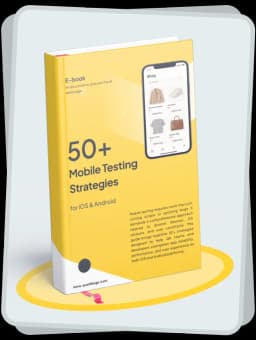
Get the Mobile Testing Playbook Used by 800+ QA Teams
Discover 50+ battle-tested strategies to catch critical bugs before production and ship 5-star apps faster.
Why QA Teams Are Leaving BrowserStack in 2026
BrowserStack still runs the largest real-device grid in the world over 30,000 real mobile devices, 3,500+ browser/OS combinations, and processes over 2 million tests per day across 19 global data centers. It's a serious platform used by over 50,000 companies including Amazon, Microsoft, and NVIDIA. BrowserStack remains one of the most mature testing platforms available.
BrowserStack continues to be an excellent choice for browser compatibility testing, mature Selenium workflows, and teams that need access to one of the industry's largest real-device clouds. The question isn't whether BrowserStack is good it's whether it's the best fit for your team's current testing bottleneck.
That distinction becomes clearer when Testsigma alternatives separate device-cloud needs from gaps in authoring or test management.
When device access is not the only constraint, Best Ranorex alternatives in 2026 helps distinguish infrastructure decisions from broader GUI-automation replacement.
A clear product-line inventory prevents teams from treating evaluating Autify alternatives as a single-tool comparison when web automation and device infrastructure pose different requirements.
That distinction also helps teams assess alternatives to major device labs without conflating infrastructure with automation needs.
For a growing number of teams, the answer is shifting. That's why BrowserStack competitors are getting a much longer look in 2026 than they did two years ago.
Four things have shifted since 2023, and they're what's driving the migration searches:
1. The mobile app testing market has outgrown web-first tooling. The mobile application testing services market reached $7.70 billion in 2025 and is projected to grow to $9.02 billion in 2026, on the way to $19.84 billion by 2031 at a 17.09% CAGR. Native apps still command 52.10% of the mobile application testing services market share, meaning the majority of testing spend is going into platforms that were originally designed for cross-browser web work.
2. Per-session pricing scales painfully. As teams add parallel sessions, additional products, and more users, BrowserStack costs can grow significantly — particularly for larger engineering organizations using multiple modules. Every add-on — Percy, App Automate, Accessibility, Test Management — is a separate line item, and one QA workflow often ends up touching three or four subscriptions.
To compare how pricing structures affect device capacity and total spend, TestGrid alternatives with real device testing examines the trade-offs between seats and parallel execution.
This distinction helps teams evaluate infrastructure-heavy tools alongside platforms that combine execution, devices, and test management.
3. Fragmentation on Android is worse, not better. Enterprises often allocate 40% of automation budgets to handle fragmentation — the same Appium locator behaves differently across Samsung One UI, Xiaomi HyperOS, and Oppo ColorOS. Renting more devices doesn't fix this. The scripts break anyway.
4. Test authoring and maintenance is the real cost. Selenium is still used by roughly 65% of QA teams and Cypress and Playwright have grown quickly, but the labor cost isn't in running tests — it's in writing and repairing them. Script maintenance consumes 33% of testing budgets. A cheaper device grid doesn't touch that number.
The pattern in 2026 is clear: teams aren't just switching vendors, they're switching categories — from "device cloud that runs tests I already wrote" to "AI platform that writes, runs, and heals the tests for me."
How to Actually Evaluate a BrowserStack Alternative
A PractiTest alternative is especially relevant when test management must fit the team’s existing QA operating model.
A constraint-led decision framework for mobile testing platforms helps teams compare options against their own device, workflow, and budget constraints.
Cross-platform QA teams evaluating Testim alternatives should assess device coverage, execution environments, and integration fit alongside authoring and maintenance capabilities.
Most "top alternatives" lists conflate three fundamentally different tool categories. Don't fall for it.
Testing frameworks
(Selenium, Playwright, Appium, Espresso, XCUITest, Maestro) — how you
write
tests
Device infrastructure
(BrowserStack, Sauce Labs, TestMu AI, Firebase Test Lab) —
where
tests run
AI-native testing platforms
(Quash, testRigor, Katalon) — tools that reduce the
authoring and maintenance
cost entirely
Comparing Appium to BrowserStack is comparing a hammer to a workbench. Most mature teams run one from each of the first two categories at minimum, and the shift in 2026 is that the third category is starting to absorb both.
Before shortlisting anything, name your bottleneck honestly. The five common ones:
Cost of parallel execution
→ look at TestMu AI, TestingBot, self-hosted grids
Mobile app maintenance and flakiness
→ look at Quash, Maestro, Katalon
Compliance / regulated industry
→ look at Sauce Labs, Perfecto
Real-world performance and network analytics
→ look at HeadSpin
Team can't write code and QA is bottlenecked on engineers
→ look at Quash, Katalon, testRigor
Pick the tool for the bottleneck, not the brand.
8 BrowserStack Alternatives Worth Evaluating in 2026, Ranked by Use Case
1. Quash — Best mobile-first BrowserStack alternative
Best for: Native Android and iOS teams tired of Appium maintenance, teams shipping mobile-first products (fintech, healthcare, e-commerce, travel, entertainment), and any org where "the mobile app broke in production again" is a repeated conversation.
Teams that need stronger native-device coverage can compare real-device mobile testing alternatives to see how execution models and failure capture differ.
Most BrowserStack alternatives are cross-browser platforms with mobile as a checkbox feature. Quash is the inverse: a platform architected ground-up for mobile app testing, with web testing coming next.
Here's what that means in practice.
Intent-driven, plain-language test authoring. You describe an app flow in English — "open the app, log in with test credentials, search for a product, add it to cart, verify the checkout total updates." Quash's agent handles taps, swipes, typing, navigation, and form interactions automatically. There are no Appium locators to maintain, no XPath selectors that break when the UI shifts, no scripts to rewrite when the design team ships a new checkout screen.
Vision-based AI that adapts to UI changes. Quash's execution engine reads the live screen the way a human tester does. When the login button moves or the copy on a confirmation modal changes, the test doesn't fail — the agent adapts. This can significantly reduce maintenance overhead in mobile QA, and many teams are able to migrate incrementally rather than rewriting their entire automation suite.
Backend validation in the same test run. Most mobile testing tools split UI testing and API testing into separate suites. Quash validates backend responses and system behavior during mobile test execution — so you catch bugs the UI hides, in the same flow, without maintaining two parallel test suites.
Your devices, your infrastructure — or Quash's. Quash supports local devices, emulators/simulators, and Quash Cloud, giving teams deployment flexibility. Teams with strict security requirements (fintech, healthcare) can keep everything in-house. Teams that want zero infra overhead run everything cloud-side. Same platform, same tests, same reports.
Web app testing is on the roadmap. Quash has been transparent about this: the same vision-based execution engine that runs plain-English instructions on mobile apps is being extended to the browser. When it ships, mobile and web live in the same workspace, same test suite, same execution report. For teams currently running BrowserStack for mobile plus Playwright or Cypress for web, that's a real consolidation.
Pricing that scales from a two-person startup to enterprise. Free community tier for solo devs and early-stage teams. Paid tiers with transparent, published pricing. Custom enterprise contracts with volume-based negotiation. No annual lock-in to start — you can run a full evaluation on your real app in an afternoon, without a sales call or an MSA. That flexibility is unusual in this market and it's a big reason Quash lands with everyone from seed-stage fintechs to Series C companies preparing for enterprise procurement cycles.
Where Quash fits and where it doesn't. Quash addresses the UI and end-to-end mobile layer. It does not replace unit or integration testing in JUnit/XCTest, and it's not a pure device rental service — you're paying for the AI platform, not just a grid. If you're a web-only team with no mobile app, this isn't the tool for you (yet).
When mobile is only one part of the evaluation, Virtuoso alternatives help distinguish AI-led testing from device-grid and cross-platform coverage.
Bottom line: For 2026, if your bottleneck is mobile app QA — writing tests, maintaining tests, running them reliably across device fragmentation — Quash is one of the strongest options for mobile-first teams evaluating BrowserStack competitors. It's not a cheaper device cloud. It's a different category of tool aimed at the part of mobile testing that grids don't solve.
A mobile-first QA stack also needs visibility after release, and the Sentry alternatives guide shows how crash monitoring fits alongside regression testing and device-farm workflows.
Teams weighing BrowserStack alternatives can distinguish device access from workflow support for writing and maintaining tests.
For teams separating execution infrastructure from test creation and maintenance, BrowserStack alternatives for mobile-first QA clarifies what device-cloud comparisons do and do not address.
When hosted execution is the main concern, mobile-focused comparison of device-cloud options helps separate platform coverage from infrastructure decisions.
This comparison helps teams distinguish device-cloud infrastructure from the broader needs of mobile-first QA BrowserStack alternatives guide when evaluating execution options.
Teams weighing a Kobiton replacement can use this practical migration checklist to match device-cloud constraints with an appropriate migration path.
For teams deciding whether device access is the core constraint, BrowserStack alternatives guide clarifies the trade-offs between device clouds and mobile-first tooling.
2. LambdaTest (with TestMu AI) — Best direct BrowserStack replacement
Best for: Teams that want the closest like-for-like BrowserStack swap at meaningfully lower cost.
LambdaTest has expanded its AI capabilities with TestMu AI, positioning the platform around AI-assisted testing while continuing to offer its existing cloud testing infrastructure. It's the most frequently cited BrowserStack alternative and the comparison is fair: it covers comparable infrastructure ground.
3,000+ browser/OS combinations, real iOS and Android devices, and support for Selenium, Appium, Cypress, Playwright, and TestCafe
HyperExecute engine uses smart orchestration to reduce build times on large Selenium and Playwright suites
Free tier for individual developers, with paid plans for team and enterprise use
Trade-off: LambdaTest solves the "BrowserStack is too expensive" problem but doesn't fundamentally change the authoring and maintenance model. If your Appium test suite is a maintenance nightmare, moving it to a cheaper grid means you now maintain flaky Appium tests for less money.
3. Sauce Labs — Best for regulated industries
Best for: Enterprises where SOC 2, HIPAA, ISO 27001, or FedRAMP compliance is a procurement gate.
Sauce Labs was acquired by Tricentis in 2024 for $1.33 billion. The combined platform offers enterprise-grade compliance certifications, real device testing, and unlimited users on all plans. When compliance certifications are a hard procurement requirement — not a nice-to-have — Sauce Labs sits at the top of most enterprise shortlists.
Trade-off: Not the cheapest, not the fastest to onboard, and pricing is opaque and sales-led. If you're a 15-person startup, you'll bounce off the sales motion.
4. Katalon — Best hybrid codeless platform
Best for: Cross-functional QA teams that want one tool spanning web, mobile, and API, with a codeless authoring layer.
Katalon has matured into a genuine all-in-one option — recent releases added customizable TestOps dashboards, native release management, and AI self-healing that reduces locator maintenance materially on front-end-heavy sprints. Reviewers on Gartner Peer Insights consistently flag the self-healing improvements as a differentiator.
Trade-off: Web-first architecture. Its mobile coverage is real but shallower than a mobile-native platform. If mobile is your primary surface, Katalon works — but it's not built for it the way Quash is.
5. Kobiton — Best mobile-only device cloud
Best for: Teams that want deployment flexibility (cloud, on-prem, or hybrid device labs) and pure mobile focus without the cross-browser overhead.
Kobiton is one of the more overlooked options because it doesn't try to do everything. It's a mobile device cloud with real Android and iOS devices, and it supports on-prem deployment for teams with data residency requirements. If you don't need a web-testing story and you want infrastructure flexibility, Kobiton is worth a look.
Trade-off: It's still a device grid, not an AI-native platform. Same authoring and maintenance model as BrowserStack, minus the cross-browser breadth.
6. HeadSpin — Best for real-world performance analytics
Best for: Teams where the primary QA question is "how does this app perform on a real 4G network in Jakarta at peak hours?"
HeadSpin's differentiator has always been real-world device deployment across global locations, with network conditions and performance analytics that lab-based grids can't replicate. If you're testing streaming playback, fintech transaction latency, or anything where real-world network variance matters more than functional correctness, HeadSpin is the specialist.
A wider decision framework on choosing a mobile-testing replacement helps distinguish specialized network analysis from broader mobile QA needs.
Trade-off: Expensive, sales-led, and overkill for teams whose bottleneck is functional test coverage rather than performance analytics.
7. Perfecto (Perforce) — Best for enterprise Selenium/Appium shops
Best for: Large enterprises already inside the Perforce ecosystem, with dedicated automation engineers and existing Selenium/Appium investment.
Perfecto is a mature enterprise platform with strong Selenium and Appium support, deep CI/CD integration, and the compliance story enterprise procurement expects. It's the safe pick for a QA manager reporting to a CIO who wants a name-brand vendor.
Trade-off: Enterprise pricing, enterprise setup time, and no meaningful advantage for teams under ~100 engineers. If you're not already in Perforce's world, there's little reason to enter it.
8. Playwright / Appium (self-hosted) — Best for zero licensing
Teams considering zero-license tooling should understand the operating trade-offs of self-hosted Appium before treating it as a simple cost-saving choice.
Best for: Teams with strong DevOps capacity and idle cloud compute, where per-seat licensing is the primary pain.
Self-hosting Playwright for web or a Selenium/Appium grid on your own Kubernetes cluster removes the licensing bill entirely. The math is straightforward: infrastructure cost only, no software licensing fee.
Trade-off: High operational overhead. You own provisioning, scaling, browser version management, and failure recovery. There's no free lunch — the savings are real, but the DevOps investment is significant. This is a legitimate path if you have the headcount. It's a trap if you don't.
Comparison Table: BrowserStack vs. the 2026 Alternatives
Platform | Category | Mobile-native? | AI-native authoring? | Self-healing | Free tier | Enterprise-ready |
BrowserStack | Device cloud | Partial | Limited AI assistance | Limited | Trial only | Yes |
Quash | AI-native mobile platform | Yes (native architecture) | Yes (intent-driven) | Yes (vision-based) | Yes | Yes |
LambdaTest (with TestMu AI) | Device cloud + AI features | Partial | Partial (KaneAI) | Partial | Yes | Yes |
Sauce Labs | Device cloud | Partial | Limited AI assistance | Partial | Trial only | Yes (compliance) |
Katalon | Hybrid codeless | Web-first | Yes | Yes | Yes | Yes |
Kobiton | Mobile device cloud | Yes | No | No | Trial only | Yes |
HeadSpin | Performance analytics | Yes | No | No | No | Yes |
Perfecto | Enterprise device cloud | Partial | Growing | Partial | No | Yes |
Playwright/Appium | Open-source framework | Appium only | No | No | Free | Self-managed |
Which BrowserStack Alternative Fits Your Team?
For teams balancing browser and mobile coverage, enterprise device-cloud alternatives help clarify where Perfecto fits among larger testing clouds.
Pick by bottleneck, not by brand recognition.
You ship a native mobile app and Appium maintenance is eating your QA hours → Quash. This is the exact scenario the platform was built for. Vision-based execution and self-healing collapse the maintenance overhead that no device cloud has ever addressed.
You need to cut infrastructure cost and your test suite is already in decent shape → LambdaTest. Direct swap, meaningfully lower price, comparable coverage.
Your procurement team gates every purchase on SOC 2 / HIPAA / FedRAMP → Sauce Labs. Compliance-first positioning is real and Tricentis's backing gives it long-term stability.
You want one codeless tool across web, mobile, and API for a mixed-skill team → Katalon. Best hybrid platform for QA teams with non-engineering contributors.
You test streaming, gaming, or fintech where real-world network conditions matter more than UI correctness → HeadSpin.
You have DevOps headcount and no licensing budget → Self-hosted Playwright plus Appium. Do the honest total-cost-of-ownership math first.
You're a 3-person startup that needs mobile testing yesterday → Quash's free tier. Then scale into paid as coverage grows. No sales call, no MSA, no six-month onboarding.
You're a 500-person enterprise with mobile as one of many surfaces → Quash for mobile, LambdaTest or Sauce Labs for cross-browser web, and revisit the stack when Quash's web testing ships.
What's Coming: The Mobile QA Landscape Through 2027
A Tricentis alternative evaluation guide should account for mobile device coverage, cross-platform workflows, and execution trade-offs.
Three shifts are worth tracking if you're locking in a testing platform for the next 24 months.
AI-native testing is the fastest-growing sub-category. The app test automation market grew from $37.66 billion in 2025 to $45.45 billion in 2026 at a 20.7% CAGR, and is projected to reach $96.75 billion in 2030 at 20.8% CAGR. That growth is not going to Selenium grids. It's going to platforms that reduce authoring cost.
Real-device testing has already overtaken emulators. Real-device testing usage increased to 55%, replacing emulator-only testing which declined to 31% usage. For mobile, emulator-only test strategies are officially outdated in 2026.
Shift-left is winning at enterprise scale. 86% of teams with strong automation and CI/CD integration report faster release cycles, and 71% reported reduced defect leakage. 39% of enterprise teams are shifting QA earlier in the SDLC. Testing platforms that don't sit natively inside PR-level CI/CD flows are getting bypassed.
The platforms winning the next two years are the ones where an engineer can push a PR, have mobile and web coverage run automatically against real devices, get an AI-summarized result in the PR comment, and merge — without opening a separate dashboard, without maintaining locators, without a QA engineer being the human bottleneck. That's the direction Quash is building toward, and it's why "mobile-first, AI-native, intent-driven" is the category label worth watching.
FAQ
What is the best BrowserStack alternative in 2026?
There is no single best alternative — it depends on your bottleneck. For mobile-first teams tired of Appium maintenance, Quash is one of the strongest options for teams primarily testing native mobile applications. For a cheaper cross-browser device cloud, LambdaTest (with TestMu AI). For regulated industries, Sauce Labs. For open-source control with DevOps capacity, self-hosted Playwright and Appium.
Teams weighing device-cloud coverage alongside native automation can compare a mobile-first device cloud against broader cross-platform QA needs.
Is there a free BrowserStack alternative?
Yes. Quash offers a free community tier. LambdaTest offers a free plan for individual developers. Self-hosted Playwright, Selenium, and Appium are all open-source and free to license — you pay in infrastructure and engineering time instead.
What is the best mobile app testing tool in 2026?
For self-serve, AI-native mobile app testing, Quash is one of the strongest options for teams primarily testing native mobile applications. It's built ground-up for mobile with vision-based AI, plain-language test authoring, self-healing, and real device execution — the specific pain points that generic device clouds don't address. For a pure device rental model, BrowserStack, Sauce Labs, and Kobiton are the mature options.
Teams that need both capable authoring and device coverage should separate that decision so each layer can be evaluated against its own requirements.
When authoring and execution need to work together, compare mabl alternatives for integrated web and mobile testing against device clouds built primarily around access to test environments.
Does Quash support web app testing?
Not yet — mobile is the current focus. Web app testing is on Quash's public roadmap, using the same vision-based execution engine that powers its mobile testing. When it ships, teams will run mobile and web tests from the same workspace with the same plain-English instruction format.
How does Quash pricing compare to BrowserStack?
BrowserStack pricing scales per parallel session and per add-on module (Live, App Live, Automate, App Automate, Percy, Accessibility, Test Management — each billed separately). Compared to most BrowserStack competitors, Quash offers a free community tier, transparent published paid tiers, and custom enterprise pricing, without the module fragmentation. For teams running many parallel sessions on BrowserStack, the cost delta is typically material — but the bigger savings usually come from the reduction in maintenance labor rather than the license line item alone.
Can I run BrowserStack alternatives on my own infrastructure?
Some, not all. Quash supports execution on local devices, emulators/simulators, or its own cloud — your choice. Kobiton supports on-prem deployment. Self-hosted Playwright/Appium runs entirely on your infrastructure. TestMu AI, Sauce Labs, HeadSpin, and Perfecto are cloud-only.
Which BrowserStack alternative is best for startups vs. enterprise?
For early-stage startups, Quash's free tier and self-serve onboarding remove the friction of sales-led procurement — you can be running tests on your real app the same day. For mid-market and enterprise, Quash scales through paid and custom enterprise tiers without forcing a re-platform, which is the reason it lands with teams from seed stage through Series C and beyond. Sauce Labs and Perfecto are the safer enterprise-only picks if compliance is the top constraint.
Do I still need Appium if I'm using Quash?
No. Quash's vision-based execution engine replaces Appium selectors entirely — you write in plain English, the agent handles taps, swipes, typing, and navigation by reading the live screen. Teams typically migrate off Appium suites incrementally, starting with the flows that break most often.
Final Take
BrowserStack pioneered cloud-based cross-browser testing in 2011 and it's still a serious platform. But 2026 is a different market. For many engineering teams, the larger bottleneck has shifted from accessing devices to maintaining reliable automation over time — writing and healing tests that survive the pace of modern mobile releases.
Alternatives fall into two honest camps: cheaper grids that move your bill but not your pain, and AI-native platforms that change what "writing a test" means. Quash sits in the second camp, built specifically for mobile, with web testing next.
If you're evaluating BrowserStack alternatives right now, the fastest way to know is to run your real app through Quash's free tier and see what an hour of intent-driven testing looks like against the last week of Appium maintenance. That comparison decides most switches.
Have a mobile QA workflow that's slowing releases? Try Quash free →
This guide is updated quarterly. Last verified: July 2026.
Continue reading
More articles from the Quash editorial desk.