New AI Testing Tools in 2026: 23 AI QA Platforms Beyond BrowserStack and LambdaTest

Why we wrote this
Search for “AI testing tools” or “best AI QA tools” and you’ll see the same names again and again: BrowserStack, LambdaTest, Sauce Labs, Mabl, Testim, Applitools, Perfecto, Kobiton. Those lists are useful if you’re mapping the established testing market. They are much less useful if you’re trying to understand what is actually new.
A current platform roundup can help distinguish newer approaches from the established testing market and clarify what has changed.
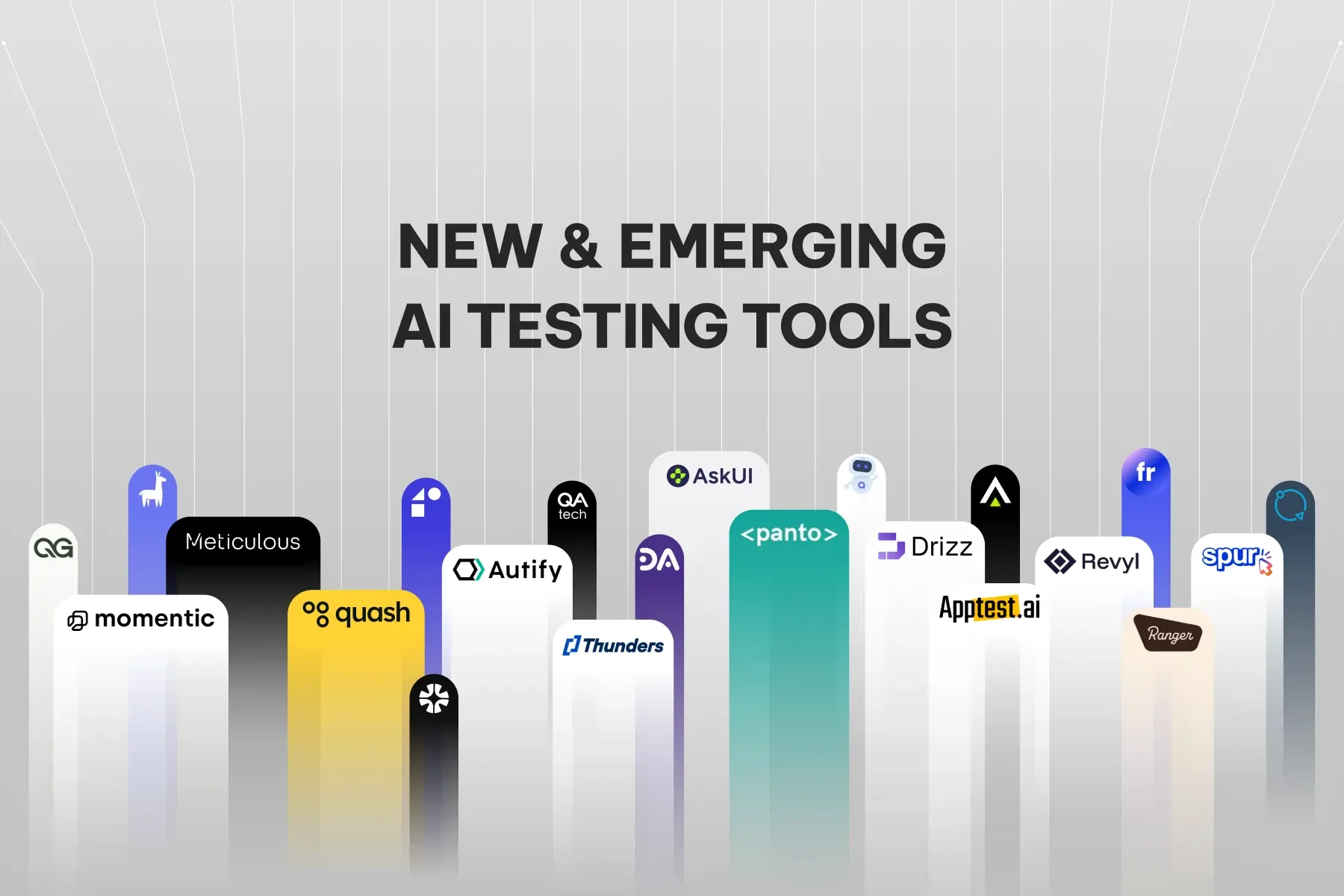
A different wave has emerged over the last 18–24 months: mobile-first AI QA agents, AI-native browser testing platforms, open-source testing agents, CLI-first mobile test runners, and tools built specifically to verify software created by AI coding assistants.
This expanding landscape makes new wave of AI QA tools useful for distinguishing platforms by the autonomy and control they support.
That evolution builds on the 2025 mobile QA trends that set the stage, which reshaped how teams approached device coverage, release speed, and automation.
For more detail, see AI testing market forecasts and maturity gaps.
That newer wave is harder to find. Many of the companies are early. Some are YC-backed. Some are European seed-stage startups. Some are open-source projects with tiny teams. Some are mobile-first tools that will never show up in generic “web testing tools” roundups. But they matter because they show where QA automation is going next.
So we built the list we wanted to read.
We evaluated 34 tools across the AI-native QA and software quality space, then narrowed the main list to 23 tools worth knowing about. We grouped them by platform focus: mobile-first, web-first, and cross-platform.
Disclosure: this article is published by Quash, and Quash is one of the tools covered below. We included ourselves because we are building in this exact category, but we used the same format for Quash as every other product: what it does, who it fits, what is interesting, and what buyers should still verify. Quash appears first in the mobile section because this article is published by Quash. That is not a ranking.

Get the Mobile Testing Playbook Used by 800+ QA Teams
Discover 50+ battle-tested strategies to catch critical bugs before production and ship 5-star apps faster.
How we picked these tools
This is not a “best tools” list. The word “best” usually hides the real question: best for whom?
Instead, this is a market map of new and emerging AI QA tools. We included tools that met at least one of these filters:
Real product, not just a waitlist. We looked for public product pages, docs, demos, pricing, GitHub repos, customer examples, or accessible trials.
AI-native or AI-first direction. Not every tool here is purely autonomous, but each one has a meaningful AI testing angle: natural-language authoring, vision-based execution, autonomous test discovery, self-healing, AI-generated test cases, or AI-assisted verification.
Some signal of traction or novelty. Funding, public customers, open-source activity, recent product launches, unusual architecture, or a clear point of view on the future of QA.
We excluded mature visual testing, test management, and observability-first tools from the main list unless they had a clear connection to the new AI QA wave. This article focuses on tools that help create, execute, maintain, or reason through tests — not every product in the broader software quality stack.
At the end, we’ve added a short adjacent-tools section for products like Embrace, Testomat.io, and Applitools that matter to software quality teams but are not part of the core “new AI QA tools” list.
What counts as an AI testing tool in 2026?
An AI testing tool is any QA platform that uses AI to create, execute, maintain, analyze, or prioritize software tests. In 2026, that can mean natural-language test creation, AI test automation, autonomous app exploration, visual UI understanding, self-healing workflows, or AI agents that interact with apps like human testers.
The distinction matters because how agentic mobile test automation works shows whether a platform can turn those capabilities into purposeful mobile QA actions.
This list focuses on AI testing tools that go beyond traditional scripted automation. Some are mobile-first, some are web-first, and some work across platforms. The common thread is that they reduce the manual effort required to create and maintain useful test coverage.
For teams turning that record into operational coverage, AI QA platforms help compare options that reduce test-maintenance work.
For LLM features, the right AI QA Platforms can extend coverage to model-specific failure modes without adding avoidable maintenance work.
Quick comparison: the 23 tools in this list
Tool | Category | Platform focus | Best for | Maturity signal |
Mobile AI testing | Mobile + PC apps | Enterprise mobile teams, especially APAC | Established startup | |
Mobile-first AI QA | Mobile only | Teams wanting deterministic Appium/Maestro output | Early-stage | |
Mobile no-code testing | Mobile-first + limited web | Non-technical mobile QA teams | Established startup | |
Mobile-first AI QA | Mobile-first; web on enterprise request; macOS + Windows desktop apps | QA-led mobile teams | Early-stage, funded | |
Vision AI mobile testing | Mobile only | Teams moving away from locators/selectors | Funded startup | |
AI-native mobile E2E | Mobile only | Developer-led mobile teams | YC-backed startup | |
AI mobile QA agent | Mobile-first | Consumer mobile teams scaling QA | YC-backed startup | |
Open-source mobile testing CLI | Mobile only | Developer-led teams using tests-as-code | Early, open-source | |
Codeless mobile testing | Mobile only | Tricentis ecosystem / enterprise mobile teams | Acquired, established | |
Coding-agent verification and E2E testing | Web only | Teams using coding agents that need verification built into development | Established product with public customer adoption | |
No-code AI web testing | Web-first | Manual QA and product teams testing web apps | Acquired by SmartBear | |
AI regression testing | Web only | Frontend teams wanting auto-generated regression coverage | Funded startup | |
Managed AI QA | Web only | Teams without dedicated QA | Funded / service-led | |
AI QA for websites | Web-first, with mobile capability | Product and QA teams testing web/e-commerce flows | YC-backed, seed-funded | |
AI + human QA | Web-first | AI-native teams wanting managed feature review | Funded startup | |
AI testing platform | Web, API, enterprise apps | Teams testing apps and AI agents | Established platform | |
AI-native test automation | Web-first + mobile | Engineering teams validating AI-generated velocity | YC-backed, Series A | |
AI-powered no-code testing | Web + mobile | Enterprise/APAC QA teams | Established, funded | |
Vision-first agentic testing | Web, mobile, desktop, embedded | Regulated / non-DOM environments | Funded startup | |
Open-source agentic testing | Web + mobile | Teams wanting self-hostable AI testing | Open-source, funded | |
Autonomous AI testing | Web + mobile | European enterprise/product teams | Seed-funded | |
Multi-agent test orchestration | Web, API, mobile, visual | Teams generating tests from PRDs/Figma/code changes | Pre-seed funded | |
AI QA agents | Web + mobile | European SaaS teams wanting autonomous QA | Funded startup |
The shift driving this wave
A few honest reasons explain why so many AI QA tools launched between 2024 and 2026.
LLM and vision models crossed a practical threshold
That threshold explains why AI testing became practical in 2025, turning capabilities into usable QA workflows.
Before 2023, “AI testing” mostly meant smarter selector recovery, flaky-test analysis, or visual diffing. Now, models can interpret UI screenshots, reason through flows, and execute plain-English instructions with enough reliability to make new product architectures possible. That does not make AI testing magically deterministic, but it does make it usable in places where older automation approaches struggled.
Mobile-first teams have been underserved
BrowserStack, LambdaTest, Sauce Labs, and other testing-cloud incumbents are powerful, but their heritage is broad infrastructure: browsers, devices, manual testing sessions, cross-browser validation, enterprise test execution. Mobile-first product teams still deal with a different problem: native flows, gestures, camera permissions, device fragmentation, push notifications, biometric auth, WebViews, flaky device states, and Appium maintenance. That is why so many new companies in this list are mobile-first.
AI-assisted development increased verification pressure
Tools like Cursor, Copilot, Claude Code, and other coding agents let engineers ship faster. But faster code generation creates a second-order problem: someone still has to verify the software. Several companies in this list position themselves as the “verification layer” for AI-assisted development, including Momentic, which announced a $15M Series A in November 2025 around that framing.
Funding moved into the category
You can see the wave in specific rounds and accelerator batches: Momentic from YC W24, Revyl from YC F24, QualGent from YC X25, Thunders’ $9M seed round, DevAssure’s pre-seed led by Eximius Ventures, and several India- and Europe-based startups entering the market with AI-native testing as their core thesis.
That is the context. Now the tools.
Mobile-first AI testing tools
Mobile is the hot zone for new AI QA tools because the old playbook is weakest here. Web automation has a DOM. Mobile automation has native UI trees, WebViews, gestures, permissions, device states, and platform-specific behavior. Locator-based approaches can work, but they often become expensive to maintain as apps change.
The tools below were either built specifically for mobile testing or have a mobile-first heritage. This is the most important section if your main product surface is an Android or iOS app.
1. AppTest.ai
AppTest.ai is an AI-powered testing platform for mobile and PC apps, with autonomous exploratory testing and scenario-based testing on real devices.
Platform focus: Mobile and PC apps, with a mobile-heavy positioning.
Where they are: Publicly active since at least 2018, with presence in Seoul and San Jose.
Maturity signal: Established startup, public customers and case references.
Best for: Enterprise mobile teams that want autonomous exploration plus scripted scenario validation.
What’s interesting: AppTest.ai appears to split the mobile testing problem into two useful modes: autonomous crawling/exploration for stability issues, and scenario testing for critical user flows. That combination is useful because not every test should be a scripted regression case. Some bugs only show up when an app is explored broadly.
The product’s emphasis on real-device execution also fits enterprise teams that cannot rely only on emulators or simulators.
What to watch for: Regional strength and enterprise orientation can be an advantage, but also means smaller teams should verify pricing, onboarding effort, and self-serve flexibility. Also confirm device and OS coverage against your actual support matrix.
Best fit: If you are an enterprise mobile team in APAC or a real-device-heavy environment, AppTest.ai is worth evaluating.
2. Panto AI
Panto AI is an AI mobile QA platform that turns plain-English mobile flows into deterministic tests, with support for Appium, Maestro, device farms, and CI workflows.
Platform focus: Mobile only.
Where they are: Built by Pantomax Technologies, India.
Maturity signal: Early-stage, publicly shipping, visible product surface.
Best for: Mobile teams that want AI-assisted authoring but still want portable, deterministic test outputs.
What’s interesting: Panto’s strongest architectural idea is the separation between AI authoring and deterministic execution. Instead of relying on an LLM to decide every action at runtime, the product emphasizes stable tests that run the same way every time. That is attractive for teams that like AI but are nervous about probabilistic behavior inside CI.
The product also leans into compatibility with existing mobile automation ecosystems like Appium and Maestro, which may make adoption easier for teams that already have automation infrastructure.
What to watch for: Like most new tools in this category, the real test is not the demo app. Evaluate it on your hardest native flow: authentication, OTP, permissions, deep links, payment, or anything involving multiple app states.
Best fit: If you want AI help creating and maintaining mobile tests, but you still care about standard formats and deterministic execution, Panto AI is worth a look.
A broader view of new AI QA platforms helps place these LLM evaluation frameworks alongside the testing stack they support.
3. Repeato
Repeato is a no-code mobile UI testing tool that uses computer vision and record-and-playback workflows to help teams create tests for iOS, Android, and some web scenarios.
Platform focus: Mobile-first, with web support.
Where they are: Austria-based product with an established public presence.
Maturity signal: More established than most new AI-native entrants.
Best for: Teams that want non-technical testers to create and run mobile tests without writing code.
What’s interesting: Repeato predates much of the current “AI QA agent” wave. Its strength is accessibility: mirror a device, record interactions, and build repeatable mobile tests without forcing QA teams into a code-heavy workflow.
That makes it useful for teams with manual testers who want to automate stable regression flows without immediately moving to Appium, XCTest, Espresso, or Maestro.
What to watch for: Repeato is not as aggressively agentic as newer entrants. If you are looking for an autonomous mobile QA agent that reasons through flows dynamically, compare it carefully against newer vision-first tools.
Best fit: If your priority is no-code mobile test creation by non-technical QA team members, Repeato remains a practical option.
4. Quash
Quash is a mobile-first AI QA platform that lets QA teams create and run functional and visual tests from plain-English descriptions, with step-level evidence across real device runs.
Platform focus: Mobile-first. Android and iOS are both supported, with iOS now shipped at parity with Android. Quash is delivered through general-availability desktop apps for macOS and Windows. Web testing is available for enterprise customers on request, but it is not the main marketed product surface.
Where they are: Founded in 2023. Pre-seed funded. Bengaluru, India.
Maturity signal: Early-stage, funded, actively shipping.
Best for: QA-led mobile teams where manual regression, Appium maintenance, or limited QA bandwidth is slowing down release velocity.
What’s interesting: Most AI testing tools in this category are still developer-first: they ask QA teams to adapt to code-heavy workflows, CLI-first setups, or engineering-owned automation pipelines. Quash inverts that. It is built around QA teams as the primary users — letting them describe flows in plain English, execute them on real mobile devices, and review evidence without needing to own brittle automation scripts.
The platform supports real cloud devices for enterprise customers through a major device-lab partnership, along with local-device workflows through its desktop apps. That combination matters because mobile QA teams often need both: local debugging during development and real-device coverage for release confidence. Quash also extends to web testing for enterprise customers on request, but the core wedge remains mobile-first QA automation.
For a quick view of the platform's natural-language workflow, try the live Quash Web Playground before deciding whether it suits your mobile QA process.
What to watch for: Quash is earlier-stage than companies like Momentic, Autify, or SmartBear-backed Reflect, so some enterprise-procurement capabilities are still maturing compared to older vendors. If you need advanced SSO, audit controls, custom procurement workflows, or a dedicated CSM motion, ask what is currently available.
Quash has also not published broad public benchmarks against every competitor in this list yet. The right evaluation is hands-on: ask for access on your own app, especially on the flows your current test stack struggles with.
Best fit: If your QA team owns mobile release confidence and needs AI-assisted testing that works around their workflow — not just developer-owned scripts — Quash should be on your shortlist.
To make those capabilities dependable, pair them with LLMOps practices that define how model-driven work is evaluated and maintained.
5. Drizz
Drizz is a vision AI mobile testing agent that lets teams write plain-English tests for iOS and Android and run them on real devices.
Platform focus: Mobile only ,Android and iOS, with mobile web/API support mentioned in product materials.
Where they are: Bengaluru-based, publicly launched as a Vision AI mobile testing platform.
Maturity signal: Funded startup, recent launch, active product marketing.
Best for: Mobile teams interested in exploring vision-based test execution as an alternative to locator-based frameworks.
What's interesting: Drizz represents the vision-first approach to mobile test automation: plain-English test steps, vision-based element detection, and real-device execution. The pitch is squarely against selector and locator brittleness, which resonates with teams burned by Appium maintenance. The company publishes actively around mobile regression and no-code testing.
What to watch for: Vision-based execution trades one set of maintenance problems for another — locator fragility goes down, but runtime speed, assertion precision, and flakiness under UI variation can become concerns. Ask to see execution times and pass/fail stability on your app across multiple consecutive runs, not a curated demo. Confirm whether iOS and Android feature parity is fully shipped or still in progress, and whether CI/CD integration is production-grade or early. Also clarify the device coverage model: cloud lab, local, or both.
Best fit: If your primary automation pain is locator maintenance and you want to evaluate what a vision-first approach looks like in practice, Drizz is worth a look.
6. Revyl
Revyl is an AI-native mobile E2E testing platform that runs natural-language workflows on iOS and Android environments and produces replayable reports.
Platform focus: Mobile only — iOS and Android.
Where they are: YC F24 company, founded by Landseer Enga and Anam Hira.
Maturity signal: YC-backed startup, active product surface.
Best for: Developer-led mobile teams that want CLI-friendly mobile E2E testing and CI integration.
What’s interesting: Revyl’s positioning is strongly aligned with modern engineering workflows: CLI usage, CI integration, replayable reports, natural-language test definitions, and AI-powered mobile execution. The product is framed not just as test automation, but as a “mobile reliability platform,” which gives it room to expand into release confidence and regression triage.
The team also emphasizes real iOS and Android environments, which matters in a category where “mobile support” can sometimes mean only simulators or shallow browser-based mobile testing.
What to watch for: The product is still young. If your QA team is non-technical or prefers UI-first authoring, verify whether Revyl’s developer-centric workflow fits your team. Also ask about real-device versus simulator/emulator coverage for your use case.
Best fit: If your mobile engineering team already lives in GitHub, CI, and CLI workflows, Revyl is one of the more natural fits in this category.
7. QualGent
QualGent is an AI mobile QA agent that mimics human testing behavior to help teams catch bugs in mobile apps without scaling manual QA headcount linearly.
Platform focus: Mobile-first — iOS and Android, with broader app-quality positioning.
Where they are: YC X25 company, founded by ex-Google engineers.
Maturity signal: YC-backed, fast-moving, public product positioning.
Best for: Consumer mobile teams that need broader QA coverage but do not want to build or hire a large internal QA function.
What’s interesting: QualGent is very direct about the labor-market angle: scale QA without hiring more QA testers. That is a strong wedge because many mobile teams feel the pain exactly that way — engineering velocity increases, but the QA team does not.
The company’s public messaging also emphasizes human-like testing and self-healing agentic QA. That puts it directly in the mobile AI QA agent category rather than the older no-code testing category.
What to watch for: The “AI QA workforce” framing is powerful, but buyers should dig into the details: how tests are created, how the agent handles uncertainty, what evidence is produced, how pricing works, and where human review enters the loop if at all.
Best fit: If you are a fast-growing mobile company trying to avoid a large manual QA hiring plan, QualGent is built for that conversation.
8. FinalRun
FinalRun is an open-source AI-driven CLI for mobile app testing, where plain-English YAML tests run against Android and iOS apps using vision-capable models.
Platform focus: Mobile only — Android and iOS.
Where they are: Publicly launched in 2025/2026 by a small team; open-source agent available on GitHub.
Maturity signal: Early-stage, open-source activity.
Best for: Developer-led mobile teams that want tests living close to the codebase rather than inside a closed SaaS workflow.
What’s interesting: FinalRun’s most interesting choice is architectural: tests live as plain-English YAML in the repo, and the CLI executes them using AI vision and device automation. That makes it feel closer to “testing infrastructure for AI coding agents” than a traditional QA dashboard.
The open-source angle is also important. In a category dominated by closed SaaS products, an inspectable CLI gives developers a different adoption path.
What to watch for: This is very early. A small open-source project can move fast, but enterprise readiness, support, compliance, and hosted execution maturity will not match larger vendors. Treat it as promising infrastructure, not a guaranteed enterprise platform.
Best fit: If you are a small mobile engineering team using AI coding agents and you want test specs version-controlled in your app repo, FinalRun is one of the most interesting tools here.
9. Waldo
Waldo is a codeless mobile test automation platform for iOS and Android that was acquired by Tricentis in 2023 and folded into the broader Tricentis mobile testing portfolio.
Platform focus: Mobile only.
Where they are: Founded in 2018. Acquired by Tricentis in July 2023.
Maturity signal: Acquired, established.
Best for: Enterprise teams already evaluating or using Tricentis mobile testing products.
What’s interesting: Waldo is not “new and upcoming” in the same way as Drizz, Revyl, QualGent, or FinalRun. It is included here because it is historically important: it helped prove that no-code mobile testing was a real category before the current AI-agent wave.
The acquisition also tells you something about the market. Incumbent testing suites are not ignoring mobile no-code/AI-native testing; they are acquiring or integrating it.
What to watch for: Waldo’s future is now tied to Tricentis. That may be good for enterprise buyers, but teams that want a lightweight startup-style product should verify what the current buying and onboarding experience looks like.
Best fit: If you are already in the Tricentis ecosystem and want mobile codeless testing under that umbrella, Waldo is still relevant.
Web-first AI testing tools
Web testing is more mature than mobile testing, but that does not mean it is solved. Selenium, Cypress, and Playwright gave teams powerful automation primitives. The new wave is trying to reduce the human work around those primitives: writing tests, maintaining selectors, deciding what to test, and reviewing failures.
The tools below are primarily web-first. Some now show mobile capability, but their strongest current fit is still browser-based testing.
10. Shiplight
Shiplight is the verification platform for AI-native development. It gives coding agents a real browser to verify UI changes as they build, then turns those verified flows into maintained end-to-end tests.
Platform focus: Web only.
Where they are: Shiplight is publicly available through a free self-serve product, with hosted and enterprise deployment options.
Maturity signal: Established product with public customer adoption across fast-growing software companies and enterprise teams.
Best for: Teams using coding agents that need verification built directly into their development workflow.
What’s interesting: Shiplight connects directly to coding agents through a browser MCP server and Skills. The same agent that changes the code can open the application, exercise the affected workflow, and confirm that the feature works before code review. Those verified flows can then become readable, intent-based YAML tests stored in the team’s Git repository.
The workflow continues after test creation. Tests run locally, on Shiplight-hosted runners, or in the team’s own CI. Routine UI changes self-heal from the original user intent. When the application behavior or test intent needs to change, the update can be returned as a normal code diff for review. Structured failure output also lets the coding agent reproduce and diagnose regressions instead of handing every failure back to a person.
Shiplight supports more than one authoring path. Coding agents can create coverage from live browser exploration, plain-language instructions, tickets, specifications, and test plans. The Product Surface Recorder also lets QA, product, support, and other contributors record important workflows without writing test code.
The tests are built on Playwright and can be ejected to standard Playwright files, so teams have no lock-in to a proprietary test format or execution environment.
What to watch for: Shiplight focuses on web E2E testing rather than native iOS or Android applications. Teams building primarily native mobile products should evaluate the mobile-first tools in this guide. Its strongest fit is an engineering organization already using coding agents, although non-technical contributors can still participate through recorded workflows.
Best fit: If your team uses Claude Code, Cursor, Codex, GitHub Copilot, or another coding agent to build web software, Shiplight is the strongest fit for bringing browser verification, test creation, continuous execution, maintenance, and regression diagnosis into the same development loop.
11. Reflect
Reflect is a no-code web testing tool, now part of SmartBear, that uses AI to turn plain-English steps into automated browser actions and assertions.
Platform focus: Web-first, with SmartBear also expanding Reflect into mobile testing.
Where they are: Founded in 2019. Acquired by SmartBear.
Maturity signal: Acquired, established.
Best for: Teams that want manual QA, product managers, or support teams to create web E2E tests without writing code.
What’s interesting: Reflect sits at the intersection of no-code test authoring and AI-assisted test creation. The product’s strongest idea is simple: write what you want the test to do in plain English, and let the tool map that into executable browser actions.
Because it is now part of SmartBear, Reflect also benefits from a larger testing ecosystem around QMetry, ReadyAPI, TestComplete, and SmartBear’s broader quality platform.
What to watch for: The SmartBear ecosystem may be a positive for enterprise teams, but smaller teams should make sure the buying motion and product packaging still fit their needs. Also verify how much of your testing can truly be maintained by non-engineers after the first few flows.
Best fit: If you want AI-assisted no-code web testing with enterprise backing, Reflect is one of the safer options.
12. Meticulous
Meticulous is an AI-driven regression testing tool that records user sessions and replays them as frontend tests to catch UI regressions without hand-writing test suites.
Platform focus: Web only.
Where they are: Founded in 2021. YC W22. Seed-funded.
Maturity signal: Funded startup, focused product surface.
Best for: Frontend engineering teams that want regression coverage without writing and maintaining large numbers of manual tests.
What’s interesting: Meticulous is architecturally different from most tools in this list. Instead of starting with a human-written test case, it observes user or developer sessions and turns those into replayable regression coverage. That makes sense for frontend teams where the biggest pain is not “we don’t know how to write Playwright,” but “we will never write enough tests to cover the product.”
Its positioning around zero-effort frontend testing is especially relevant for React-heavy teams.
What to watch for: Session-derived tests are only as good as the sessions they observe. Rare edge cases, admin flows, and unusual permissions may still need intentional coverage. Meticulous is also web-only, so mobile-first teams should look elsewhere.
Best fit: If your frontend team under-tests because nobody wants to maintain E2E suites, Meticulous is one of the most interesting web-first options.
13. Bug0
Bug0 is a managed AI QA product for browser testing where AI agents create and maintain tests while human QA engineers verify results.
Platform focus: Web only.
Where they are: Founded by the Hashnode cofounders; backed by visible startup investors according to public company materials.
Maturity signal: Funded startup, service-plus-product model.
Best for: Web SaaS teams that do not have a dedicated QA function and want a managed QA outcome instead of another tool to configure.
What’s interesting: Bug0’s wedge is unusually clear: it does not only sell testing software; it sells an AI QA engineer model. The public pricing page positions the product around a managed QA service from $2,500/month, with AI agents plus a forward-deployed QA engineer reviewing results.
That hybrid model is sensible. Pure AI can move fast, but human review can prevent hallucinated test logic, false positives, and silent failures from reaching production decisions.
What to watch for: This is not the right fit if you want to fully own your internal testing stack or if mobile is your main surface. It is also a service-led model, so compare it against hiring, outsourcing, and traditional QA services — not only SaaS tools.
Best fit: If you are a Series A/B web SaaS team without dedicated QA and want QA coverage quickly, Bug0 is worth evaluating.
14. Spur
Spur is an AI QA platform for websites that uses vision-first agents to run natural-language tests without relying on CSS selectors.
Platform focus: Web-first, with mobile capability now visible in the product documentation.
Where they are: YC S24. Raised $4.5M in seed funding in April 2025, led by First Round Capital, with participation from Pear VC and others.
Maturity signal: YC-backed, seed-funded, active documentation and public product surface.
Best for: Product, QA, and e-commerce teams that want AI agents to test user flows on websites without writing Playwright, Selenium, or CSS-selector-heavy tests.
What’s interesting: Spur is one of the strongest web-first additions to this list because its wedge is clear: AI agents that emulate real users navigating a website. The product is vision-first and natural-language-driven, which makes it more accessible to product and QA teams than traditional browser automation.
Spur’s documentation now includes a Mobile Prompting Guideˀq alongside its Web Prompting Guide, and public docs reference mobile-oriented test creation. That suggests mobile is real, not just roadmap language. Still, the company’s core public positioning remains website QA, especially for e-commerce and web product teams.
What to watch for: Mobile appears newer and secondary to the web product. If you are a mobile-first company, evaluate Spur’s mobile depth carefully: real devices versus emulators, native app support, iOS/Android parity, gestures, permissions, WebViews, and mobile CI workflows.
Best fit: If your main surface is a website or e-commerce flow and you want AI-native QA without selector-heavy test maintenance, Spur is one of the strongest newer tools to evaluate.
15. Ranger
Ranger is an AI-powered QA platform for web products that combines AI-generated tests with human review, positioned for teams shipping fast with coding agents.
Platform focus: Web-first.
Where they are: San Francisco-based startup with public customer logos including AI-native product companies.
Maturity signal: Funded startup, managed/human-in-the-loop model.
Best for: AI-native software teams that want feature review and QA to keep up with coding-agent velocity.
What’s interesting: Ranger’s framing is very aligned with the current AI development workflow: if coding agents write features faster, QA has to verify them faster too. The product’s “AI plus humans” model is a practical hedge against one of the biggest problems in AI testing: the model may confidently perform the wrong check.
Ranger also appears to have credibility with fast-moving AI product teams, which is important in this market.
What to watch for: Ranger is more of a managed QA partner than a pure self-serve automation tool. That may be a strength or a mismatch depending on your team. Also, mobile support is not the main story, so mobile-first teams should not treat it as a direct replacement for mobile QA infrastructure.
Best fit: If your web product team is using coding agents heavily and wants QA review to match that pace, Ranger fits the moment.
16. ContextQA
ContextQA is an AI testing platform that combines AI-generated test scenarios, self-healing automation, enterprise app testing, API testing, and AI-agent validation workflows.
Platform focus: Web, API, enterprise apps, and AI-agent testing.
Where they are: Established public platform with enterprise case study visibility.
Maturity signal: Established platform, broader QA coverage than most early startups.
Best for: Teams that need a broader testing platform covering web apps, APIs, enterprise workflows, and increasingly AI-agent behavior.
What’s interesting: ContextQA is broader than a simple web E2E tool. Its current positioning includes two problems: conventional software test automation and testing AI agents themselves. That second angle is important because many teams are now shipping AI features and need regression tests for model behavior, tool calls, multi-turn workflows, and hallucination boundaries.
The IBM case study visibility also gives ContextQA more enterprise credibility than many small tools in this list.
What to watch for: Breadth can create complexity. If your need is narrow — for example, only mobile app testing or only frontend visual regression — a specialist may fit better. Ask for a demo focused on your exact application type.
Best fit: If you want one AI testing platform for web, API, enterprise automation, and AI-agent validation, ContextQA deserves a look.
Cross-platform AI testing tools
Cross-platform AI testing tools make an ambitious promise: one testing layer across web, mobile, desktop, embedded, APIs, or other surfaces. That breadth is attractive, especially for enterprises. The tradeoff is depth. A tool that works everywhere may not handle mobile edge cases as deeply as a mobile-only product.
The tools below are cross-platform either by current product support or by public roadmap/positioning.
17. Momentic
Momentic is an AI-native test automation platform that explores applications, generates tests, and keeps them updated, with web as the core surface and mobile support recently added.
Platform focus: Web-first, with mobile support.
Where they are: Founded in 2023. YC W24. Announced a $15M Series A in November 2025 led by Standard Capital, with participation from Dropbox Ventures and others.
Maturity signal: YC-backed, Series A, public enterprise/customer momentum.
Best for: Fast-growing web software teams that need a verification layer for AI-assisted development.
What’s interesting: Momentic has one of the strongest narratives in this category: as developers ship faster with AI coding tools, testing becomes the bottleneck. The company explicitly positions itself as a verification layer for modern software teams.
Its public materials emphasize AI exploration, test generation, self-maintenance, and customer usage at significant scale. Compared with many earlier-stage tools, Momentic appears to have stronger funding and customer validation.
What to watch for: Web is still the center of gravity. If you are evaluating Momentic for mobile, ask for current mobile demos, platform coverage, device support, and limitations. Also expect enterprise-style pricing rather than lightweight self-serve startup pricing.
Best fit: If you are a web-first engineering team using AI coding tools heavily and you want AI-native regression coverage, Momentic should be on the first shortlist.
18. Autify
Autify is an AI-powered no-code software testing platform for web and mobile, with products for test design, creation, execution, and maintenance.
Platform focus: Web and mobile.
Where they are: Founded in 2016. Tokyo and San Francisco presence. Established, venture-backed company.
Maturity signal: Established, public enterprise/customer visibility.
Best for: Mid-market and enterprise teams, especially in Japan/APAC, that want no-code testing with AI assistance and vendor stability.
What’s interesting: Autify is older than most companies in this list, but that is exactly why it belongs here. It has had time to build trust, enterprise support, and cross-platform workflow depth. The company’s newer AI work, including Autify Genesis for GenAI-powered test case/test code generation, keeps it relevant to the AI-native testing conversation.
What to watch for: Autify is likely less “bleeding-edge agentic” than newer startups, and pricing may skew toward larger teams. If your priority is autonomous agents reasoning through mobile screens, compare it against newer mobile-first tools.
Best fit: If you want a more mature cross-platform no-code testing vendor with AI features, especially in APAC, Autify is a safer choice than many early startups.
19. AskUI
AskUI is a vision-first agentic automation platform that can test and automate across web, mobile, desktop, HMI, embedded, and other screen-based interfaces.
Platform focus: Cross-platform — web, mobile, desktop, embedded/HMI.
Where they are: Germany-based company with open-source SDK activity and enterprise positioning.
Maturity signal: Funded startup, open-source SDK, enterprise-ready positioning.
Best for: Teams testing environments where DOM- or API-level automation does not work well: desktop apps, virtualized systems, embedded interfaces, automotive, industrial, healthcare, and regulated workflows.
What’s interesting: AskUI is not just another web/mobile testing tool. Its real strength is that it treats the screen as the interface. That matters in environments where traditional automation cannot reliably access underlying UI elements — desktop apps, Citrix, SAP, HMI, embedded devices, and hardware-in-the-loop workflows.
The vision-first architecture makes AskUI one of the more technically distinct tools in the broader AI testing space.
What to watch for: Breadth can dilute depth. If your only problem is mobile app regression testing, a mobile-first specialist may be more efficient. Vision-based execution can also be slower than selector-based automation, so runtime and cost need evaluation.
Best fit: If your testing problem spans beyond standard web and mobile apps, AskUI is one of the few tools genuinely built for that scope.
20. Autonoma
Autonoma is an open-source AI testing platform where agents navigate web and mobile apps end-to-end and catch regressions on pull requests without hand-written test code.
Platform focus: Web and mobile — iOS and Android mentioned in docs.
Where they are: Founded in 2022; public open-source and managed cloud presence.
Maturity signal: Open-source, public customers/partner logos, active product surface.
Best for: Engineering teams that want AI testing with an open-source or self-hostable path.
What’s interesting: Autonoma’s most important differentiator is openness. In a category where many tools are closed, managed SaaS products, Autonoma offers a more inspectable and self-hostable route. That matters for teams with data concerns, compliance needs, or strong engineering cultures.
It also positions around agents testing real browsers and devices, not just generating static test cases.
What to watch for: Open-source projects vary widely in polish, support, and enterprise features. Before adopting, check maturity around SSO, audit logs, reporting, CI integration, flaky-test handling, and mobile depth.
Best fit: If your team wants agentic testing but dislikes black-box SaaS, Autonoma is one of the most credible open-source options.
21. Thunders
Thunders is an AI-driven autonomous testing platform, formerly known as Thunder Code, that uses AI agents and role-based testing personas to automate QA workflows.
Platform focus: Web and mobile, with autonomous testing positioning.
Where they are: Paris/Tunis footprint. Raised a $9M seed round in 2025 led by Silicon Badia, with participation from Janngo Capital and Titan Seed Fund, according to public announcements.
Maturity signal: Seed-funded, recently rebranded/expanded.
Best for: European and MENA-region teams that want autonomous testing accessible beyond engineering.
What’s interesting: Thunders has one of the larger early rounds in this newer AI testing wave. Its “intelligent personas” framing is also different from the default “one AI agent tests everything” pitch. Role-specific agents for QA, product, business, accessibility, or security could make sense in larger organizations where testing is not owned by one team alone.
What to watch for: The product is still relatively new, and the rebrand means buyers should check what is shipping today versus roadmap. Ask for concrete examples: supported app types, mobile depth, CI integration, test evidence, and failure review workflows.
Best fit: If you are a European or MENA-region organization looking for an autonomous testing platform with strong funding momentum, Thunders is worth tracking.
22. DevAssure
DevAssure is a multi-agent test orchestration platform that generates and validates tests from code changes, Figma designs, PRDs, Jira tickets, and other product artifacts.
Platform focus: Web, API, mobile, visual, accessibility.
Where they are: Founded in 2024. Pre-seed funded by Eximius Ventures, according to public funding announcements.
Maturity signal: Pre-seed funded, early customer visibility, active docs.
Best for: Teams that want testing to start from product artifacts — Figma, PRDs, Jira, and pull requests — rather than only from a running app.
What’s interesting: DevAssure’s strongest angle is artifact-to-test generation. Many AI testing tools begin with a live product. DevAssure can start earlier in the lifecycle by generating test cases from Figma mockups, requirements, and code changes.
That is a meaningful workflow difference: quality moves closer to planning and design, not just post-build execution.
What to watch for: DevAssure covers many surfaces: web, API, mobile, visual, accessibility. That breadth is useful, but buyers should verify depth in their priority area. If mobile is the primary problem, compare it against mobile-only specialists.
Best fit: If your team wants AI-generated tests from Figma, PRDs, Jira, or GitHub PRs, DevAssure is one of the more relevant tools to evaluate.
23. QA.tech
QA.tech is an AI-driven QA platform that uses autonomous agents for E2E, regression, exploratory, PR, web, and mobile release validation.
Platform focus: Web and mobile, with web/E2E testing as the strongest public signal.
Where they are: Founded in Sweden in 2023. Raised a €3M seed round led by PROfounders, after an earlier €1M pre-seed from byFounders and angels.
Maturity signal: Funded startup, European customer case studies, SOC 2 positioning.
Best for: European SaaS and B2B teams that want autonomous QA agents integrated into PR-to-production workflows.
What’s interesting: QA.tech’s strongest positioning is continuous validation: agents run through PRs, deployments, regression checks, and scheduled exploratory testing. The public Upsales case study claims significant manual QA time saved, which makes the product’s value proposition concrete.
Its European base and SOC 2 messaging may also matter to buyers with procurement and data governance requirements.
What to watch for: Although QA.tech mentions mobile, buyers should verify mobile depth carefully. Ask whether mobile tests run on real devices, emulators/simulators, or browser-like environments, and whether native gestures, permissions, WebViews, and push notifications are supported.
Best fit: If you are a European B2B SaaS team looking for AI QA agents that plug into the development workflow, QA.tech is one of the strongest regional options.
Adjacent tools worth knowing about
These tools are relevant to quality teams, but they are not part of the core “new AI QA tools” list above.
Embrace
Embrace is a mobile and web observability platform focused on real user monitoring, crashes, ANRs, network issues, performance metrics, and session-level debugging. It is not a pre-release testing platform, but mobile teams evaluating QA stacks will often encounter it because it solves the “what broke in production?” side of mobile quality.
Use Embrace alongside testing tools, not instead of them. Testing tools try to catch issues before release. Observability tools help you prioritize and debug issues that real users already experienced.
Testomat.io
Testomat.io is an AI-augmented test management platform for managing automated and manual tests, reports, Jira workflows, and QA collaboration. It is useful around the testing process, but it is not the same as an AI agent that executes app flows.
testomat.io →
Applitools, Percy, and Chromatic
Visual AI and visual regression tools remain important. Applitools is one of the best-known AI visual testing platforms; Percy and Chromatic are also widely used in frontend visual validation workflows. We did not include these in the main list because the visual-testing category is already well documented elsewhere, and this article is focused on newer AI QA execution and automation platforms.
How to evaluate this new wave of AI QA tools
When assessing autonomous testing agents, a RAG testing and evaluation workflow helps distinguish reliable evidence from impressive demonstrations.
Use this structured comparison of AI-powered and no-code mobile testing platforms to examine how authoring approaches align with the workflows your team actually needs.
If you are considering any of the tools in this list, ask every vendor these questions before signing anything.
1. Does the AI actually do what it claims, or is it a wrapper?
Ask for a live demo on your app, not theirs. A polished demo on a vendor’s sample app tells you very little. Watch what happens when an unexpected modal appears, an element loads slowly, the network fails, or the app lands in a different state than expected.
The best AI QA tools can explain what they are doing and recover from normal product messiness. Weak tools only work on happy paths.
2. What happens when the AI is wrong?
Self-healing sounds great in marketing. In practice, it can be dangerous if it silently adapts to a real regression and still passes the test.
Ask how the tool distinguishes between:
“The UI changed, but the user intent is still valid.”
“The app is broken.”
“The AI guessed, and a human should review this.”
A good AI QA tool should surface uncertainty. Silent confidence is not good enough.
3. Can your QA team adopt it, or only your developers?
This is the deal-killer many teams miss. Some AI testing tools are really developer tools. That may be fine if developers own quality. But if your QA team owns release confidence, the product needs to work for them too.
Look at who can create tests, edit them, understand failures, review reports, and maintain coverage. A tool that technically works but alienates QA will not survive internal adoption.
4. What is the real pricing model?
Per-seat, per-test, usage-based, managed service, flat monthly fee, annual enterprise contract — each model creates different incentives.
Per-seat pricing can punish broad QA adoption.
Per-test pricing can discourage coverage.
Usage-based pricing aligns cost with execution, but needs forecasting.
Managed service pricing may be predictable, but less self-serve.
Enterprise pricing may work for larger teams and kill smaller-team adoption.
Ask for a realistic bill based on your expected test volume, not the cheapest plan on the website.
5. How mobile-deep is it, really?
If you are a mobile-first company, “we also support mobile” is not enough.
Ask specifically about:
Android and iOS parity
real devices vs. emulators/simulators
gestures, scrolls, drag/drop, long-press, permissions
native + WebView flows
push notifications
OTP/auth flows
biometric auth
deep links
crash/log collection
CI/CD execution
screenshots, videos, logs, and step-level evidence
Many cross-platform tools can run simple mobile flows. Far fewer can handle the messy ones.
6. Can it produce evidence your team trusts?
A test result is not useful if your team cannot understand it. The best tools produce evidence: screenshots, logs, videos, step-by-step traces, API responses, database validation, and clear failure explanations.
This matters even more with AI testing. If the AI says “failed,” your team needs to know whether the app failed, the device failed, the environment failed, or the AI misunderstood the task.
Closing
We wrote this because we wished it existed when we were trying to understand the AI QA landscape. The category is moving quickly, and most public lists still repeat the same mature testing vendors.
The truth is messier and more interesting: mobile-first agents, open-source CLIs, managed AI QA teams, cross-platform vision agents, and tools built specifically for the AI-coding era are all emerging at the same time.
Some of these companies will become major platforms. Some will get acquired. Some will stay niche. Some will disappear. But together, they show the direction of QA: less hand-written automation, more AI-assisted verification, and a bigger focus on evidence that teams can actually trust.
If you think we missed a tool that genuinely belongs here, or if you work at one of the companies listed and we got something wrong, tell us. We’ll keep updating this list as the market changes.
Quash builds an AI agent for mobile app testing. We have no commercial relationship with the other tools mentioned here, beyond normal category competition.
Continue reading
More articles from the Quash editorial desk.