Appium Statistics & Usage Data 2026: Downloads, Adoption, Jobs, and Market Share

Appium is still one of the most widely referenced names in mobile test automation. It appears in QA job descriptions, mobile testing tool comparisons, engineering blogs, test automation tutorials, and enterprise QA strategy discussions.
But there is a problem: Appium statistics are scattered.
Some articles cite old GitHub star counts. Some use npm downloads as if they represent total users. Some quote market-share numbers without explaining the source. Others say Appium is “still dominant” without showing the data behind that claim.
This page brings the numbers together.
Below is a sourced roundup of Appium testing statistics for 2026, covering GitHub activity, npm downloads, PyPI downloads, NuGet data, Stack Overflow questions, market-share estimates, company usage signals, survey data, and job demand.
The goal is simple: give QA leaders, engineering teams, and writers a clean reference page they can cite when they need current Appium usage data.
Key Appium statistics for 2026
As of June 2026:
Metric | 2026 figure | What it indicates |
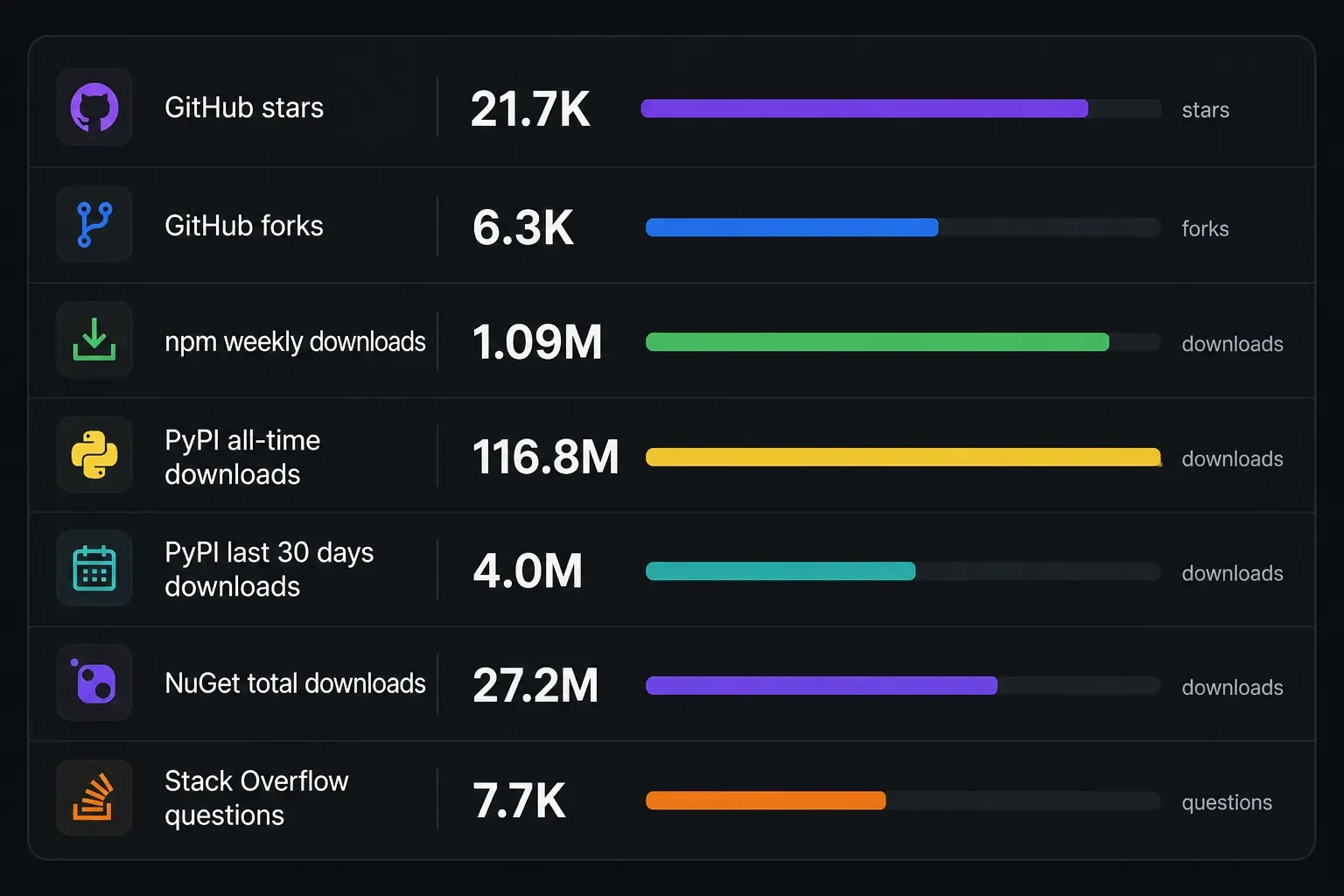
GitHub stars | ~21.7k | Open-source popularity and developer awareness |
GitHub forks | ~6.3k | Reuse, contribution interest, and ecosystem depth |
npm weekly downloads | ~1.09M | Appium server install activity |
Snyk popularity rating | Key ecosystem project | Strong package-level usage signal |
PyPI Appium Python Client downloads | 116.8M all-time | Large Python-client footprint |
PyPI last 30 days | ~4.0M downloads | Current Python ecosystem activity |
NuGet Appium.WebDriver downloads | ~27.2M total | Active C#/.NET ecosystem usage |
Stack Overflow Appium questions | ~7.7k | Long-running developer support footprint |
6sense market share estimate | ~4.6% of Testing and QA | Directional technographic estimate |
TheirStack company/user estimate | ~23k+ companies/users | Broad job-posting and technology-signal estimate |
LinkedIn Appium jobs in the US | ~360+ active listings | Hiring demand for Appium skills |
LinkedIn Appium mobile testing jobs in Bengaluru | ~130+ active listings | India-specific mobile QA hiring signal |
ZipRecruiter Appium job range | ~$29–$65/hr | Public compensation signal for Appium-related roles |

Get the Mobile Testing Playbook Used by 800+ QA Teams
Discover 50+ battle-tested strategies to catch critical bugs before production and ship 5-star apps faster.
What is Appium?
Appium is an open-source automation framework for native, hybrid, mobile web, desktop, and IoT applications. In mobile app testing, it is most commonly used to automate Android and iOS apps through the WebDriver protocol.
Appium’s main value is cross-platform automation. Teams can write tests in languages such as Java, Python, JavaScript, Ruby, or C#, then run those tests against mobile apps using platform drivers like UiAutomator2 for Android and XCUITest for iOS.
That flexibility is why Appium became the default reference point for mobile test automation. Even when teams evaluate newer Appium alternatives, Appium is usually the baseline they compare against.
GitHub statistics: Appium remains an active open-source project
The official Appium GitHub organization shows that the main appium/appium repository has roughly 21.7k stars and 6.3k forks in June 2026.
GitHub/Appium metric | 2026 value |
Main repository stars | ~21.7k |
Main repository forks | ~6.3k |
Open issues, per Snyk | 69 |
Open pull requests, per Snyk | 12 |
Contributors, per Snyk | 350 |
Latest npm version observed | 3.5.2 |
License | Apache-2.0 |
Primary language | TypeScript |
These numbers matter because mobile automation frameworks become risky when they stop keeping up with Android, iOS, Xcode, WebDriverAgent, driver changes, device-cloud behavior, and platform APIs.
Appium is not a dormant framework. The project is still maintained, still releasing, and still receiving community activity.
That said, GitHub stars are not the same as production usage. They measure developer awareness and open-source popularity, not how many companies run Appium in CI every day.
A better interpretation is:
Appium’s GitHub data shows strong open-source visibility and continued maintenance, but it should be combined with package downloads, job demand, and market-share estimates before making adoption claims.
Appium download statistics
Appium download data is useful, but it needs careful interpretation.
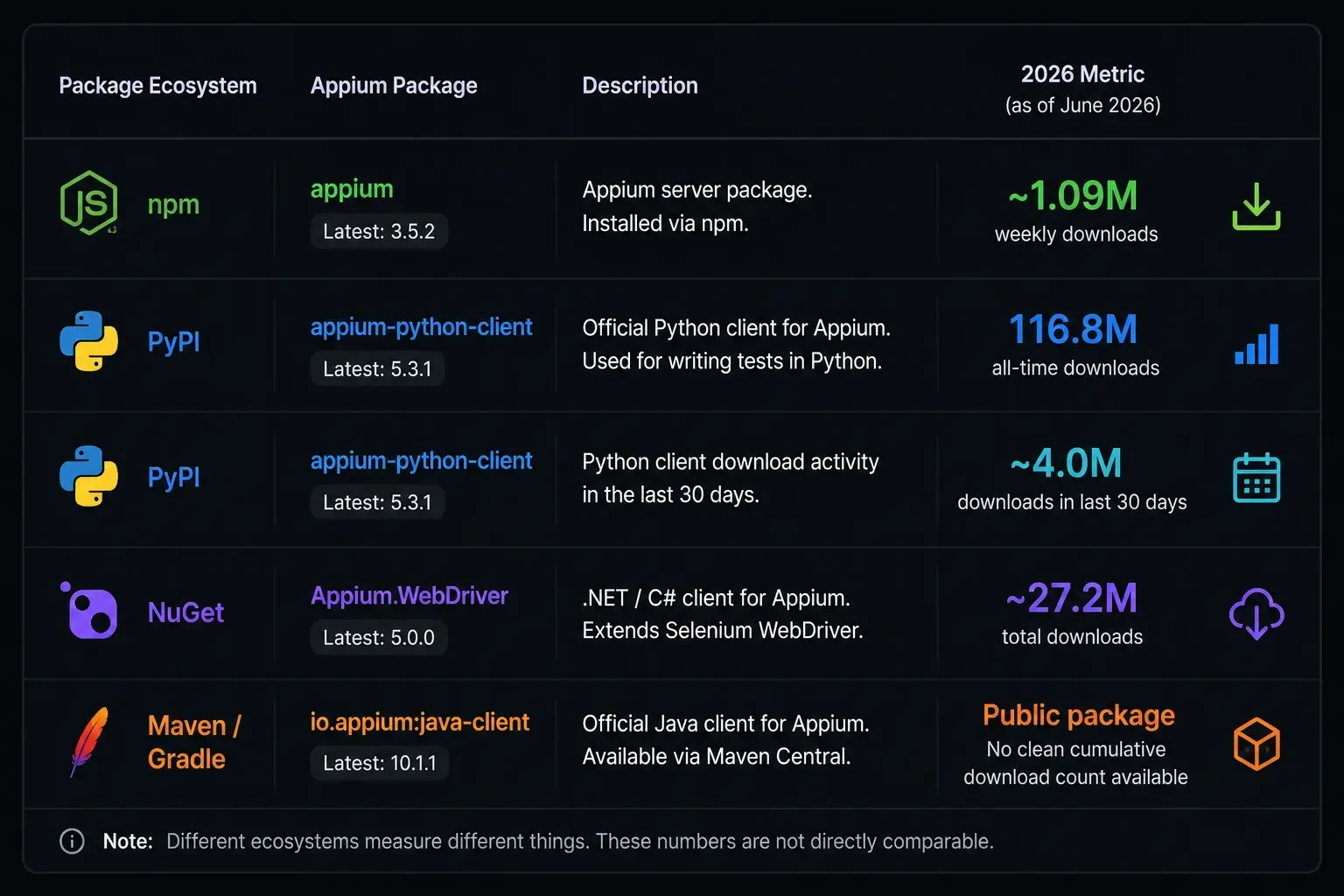
There is no single “Appium downloads” number because Appium is used across several package ecosystems:
npm for the Appium server
PyPI for the Python client
NuGet for the .NET client
Maven/Gradle for the Java client
RubyGems for Ruby clients
WebdriverIO and other JavaScript tooling for JS/TS users
So npm alone does not measure total Appium usage.
npm Appium server downloads
The npm appium package represents the Appium server. In June 2026, the npm package page showed roughly 1.09M weekly downloads for Appium version 3.5.2.
Snyk also listed the Appium npm package as a “Key ecosystem project”, with roughly 1.1M weekly downloads, 21.7k GitHub stars, 6.3k forks, and 350 contributors.
This is a strong signal, but it is not a unique-user count.
npm downloads can include:
local developer installs,
repeated CI installs,
cache misses,
Docker image builds,
ephemeral test environments,
and automated setup scripts.
The safe claim is:
The Appium npm package sees roughly 1.09M weekly downloads, showing strong server install activity, but npm downloads should not be treated as active user counts.
PyPI Appium Python Client downloads
The Appium Python Client is one of the strongest package-level indicators for Appium usage.
Pepy reports that appium-python-client has been downloaded 116,764,475 times on PyPI, including 4,011,390 downloads in the last 30 days and 87.4k downloads in the last 24 hours.
PyPI metric | 2026 value |
All-time downloads | 116,764,475 |
Last 30 days | 4,011,390 |
Last 24 hours | 87.4k |
This matters because many QA automation teams use Python for mobile automation testing, test orchestration, internal QA frameworks, and CI workflows.
That context makes how to interpret broader programming language statistics for mobile QA especially useful when evaluating whether broad rankings reflect automation-specific work.
Again, downloads are not users. But 116.8M all-time downloads and roughly 4M downloads in the last 30 days show that the Appium Python ecosystem remains active.
NuGet Appium.WebDriver downloads
The Appium .NET client is distributed through NuGet as Appium.WebDriver. NuGet lists the Appium profile at roughly 27.2M total package downloads, with Appium.WebDriver as the main package.
This is an important enterprise signal. Appium is not only used by JavaScript or Python teams. It also has a meaningful C#/.NET footprint, especially in larger QA organizations.
Maven and Java client usage
Java remains one of the most common languages for enterprise test automation. The official Appium docs list Java as one of the maintained Appium clients, with io.appium:java-client available for Maven and Gradle users.
Unlike npm and PyPI, Maven Central does not expose a clean, public all-time download number in the same way. So Java usage should be discussed through package availability, version activity, and enterprise adoption rather than a single cumulative download figure.
Chart suggestion: Use three separate bars for npm weekly downloads, PyPI all-time downloads, and NuGet total downloads. Add a visible caveat: “Different ecosystems measure different things; these are not directly comparable.”
Appium client ecosystem
Appium’s usage is spread across multiple official and community-maintained clients.
The official Appium docs list maintained clients for:
Client | Language |
Java Client | Java |
Python Client | Python |
Ruby Core Client | Ruby |
Ruby Client | Ruby |
.NET Client | C# |
The same docs also list other compatible clients and integrations, including WebdriverIO, Nightwatch.js, Robot Framework AppiumLibrary, and SwiftAppium.
This is one reason Appium has remained relevant. A team using Java, Python, JavaScript, Ruby, or C# can usually integrate Appium into its existing test automation framework instead of switching the entire QA stack.
For deeper setup and architecture details, see our full Appium mobile testing guide.
Stack Overflow Appium statistics
Stack Overflow showed roughly 7.7k questions tagged with appium in June 2026.
That is a useful community signal, but it should not be overread.
Stack Overflow questions do not equal users. They measure developer discussion, troubleshooting volume, and the amount of searchable community knowledge around a tool.
For Appium, that support footprint includes issues around:
Android setup,
iOS simulator setup,
real-device execution,
WebDriverAgent,
UiAutomator2,
XCUITest,
locator strategies,
WebView automation,
app permissions,
scrolling and gestures,
flaky waits,
CI setup,
and Appium client compatibility.
This cuts both ways.
The positive interpretation: Appium has years of accumulated debugging knowledge.
The negative interpretation: Appium has a large troubleshooting surface. The same flexibility that makes it powerful also makes it easier for teams to run into setup, locator, timing, and device-specific failures.
For teams struggling with this side of mobile automation, see our guide on how to fix flaky tests in mobile test automation.
Appium market share estimates
Market-share data for Appium should be treated as directional, not definitive.
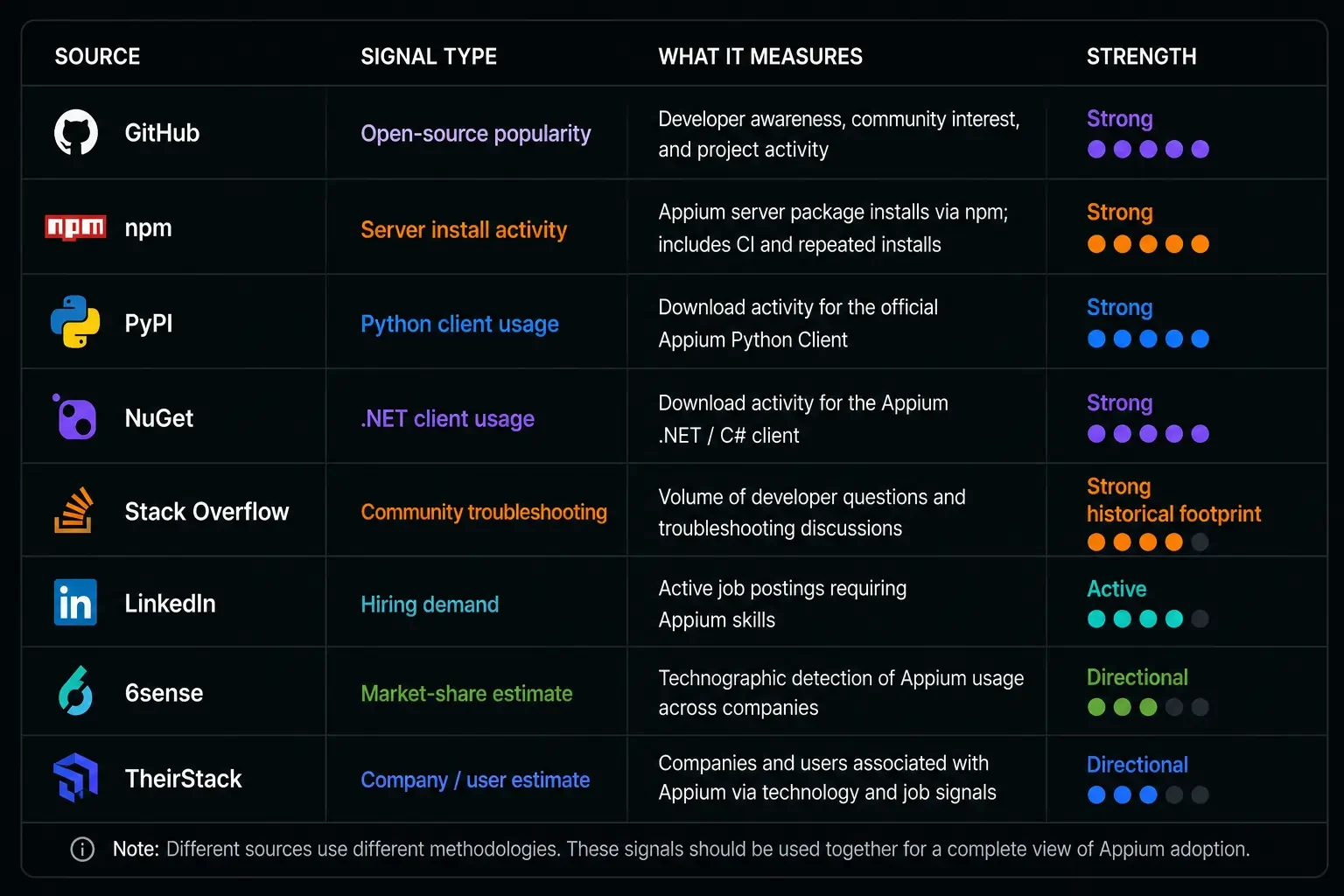
6sense estimates that Appium has roughly 4.6% market share in the broader Testing and QA category. TheirStack reports data on roughly 23k+ companies and users associated with Appium.
Source | 2026 Appium estimate | What it likely measures |
6sense | ~4.6% Testing and QA market share | Technographic detection across companies |
TheirStack | ~23k+ companies/users | Broad technology and job-posting signals |
Job boards | Hundreds to thousands of listings | Hiring demand, not installed usage |
Package registries | Millions of downloads | Install activity, not unique users |
The big caveat: these sources use different methodologies.
A company-count estimate from a technographic tool is not the same as a job-posting signal. A package download is not the same as an active test suite. A GitHub star is not the same as a production deployment.
So the credible claim is:
Appium continues to show strong adoption signals across market-share tools, package registries, developer communities, and job boards, but there is no single authoritative public count of Appium users or companies.
This is exactly why Appium statistics need to be presented as a sourced roundup rather than one headline number.
How many companies use Appium?
There is no definitive public count of companies using Appium.
Different data providers produce different estimates because they define “using Appium” differently.
A company may be counted if:
Appium appears in its job descriptions,
Appium is detected in public code or documentation,
employees mention Appium in profiles,
Appium appears in public technology datasets,
or the company is inferred through technographic scanning.
TheirStack reports data on more than 23k companies and users associated with Appium. 6sense reports Appium as a meaningful tool in the Testing and QA category, with roughly 4.6% market share.
But these are estimates.
The more defensible way to write this is:
Thousands of companies show Appium usage signals across public datasets, but exact company counts vary by source and methodology.
That sentence is less flashy, but it is much safer — and more useful for a page designed to earn links.
Appium job market data
Appium still appears regularly in QA automation, SDET, and mobile automation job descriptions.
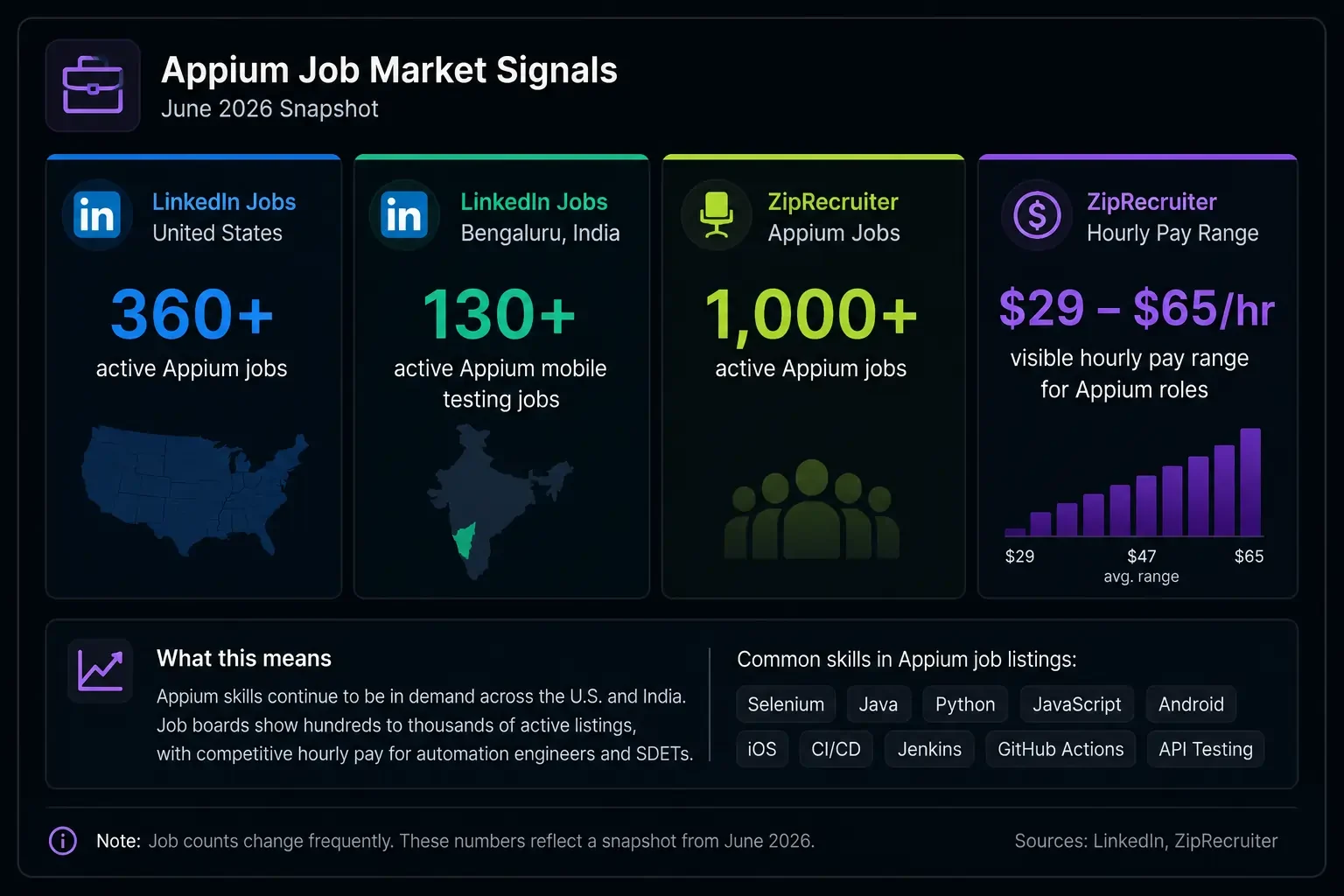
In June 2026, LinkedIn showed roughly 360+ Appium jobs in the United States. LinkedIn also showed roughly 130+ Appium mobile testing jobs in Bengaluru, which is a useful signal for India-based mobile QA hiring.
ZipRecruiter listed 1,000+ Appium jobs with a visible hourly range of roughly $29–$65/hr. A separate Appium testing salary page showed an average hourly pay figure around $38/hr for Appium testing roles in the United States.
Common skills paired with Appium in job descriptions include:
Selenium
Java
Python
JavaScript
WebdriverIO
Android
iOS
XCUITest
Espresso
CI/CD
Jenkins
GitHub Actions
BrowserStack
Sauce Labs
API testing
test automation framework design
The job-market signal is straightforward: Appium is still a practical skill for mobile QA engineers, SDETs, and automation engineers in 2026.
For broader tooling context, see our guide to the best test automation tools in 2026.
Is Appium still used in 2026?
Yes. Appium is still used in 2026.
The evidence is visible across multiple sources:
The official GitHub repository has ~21.7k stars and ~6.3k forks.
The npm package sees roughly 1.09M weekly downloads.
The Appium Python Client has passed 116M all-time PyPI downloads.
The Appium .NET client has crossed roughly 27M NuGet downloads.
Stack Overflow has thousands of Appium-tagged questions.
LinkedIn and ZipRecruiter show active Appium job demand.
6sense and TheirStack continue to detect Appium usage across companies.
But “still used” does not mean “best for every team.”
Appium is strongest when teams need:
cross-platform Android and iOS automation,
language flexibility,
WebDriver compatibility,
mature automation engineering,
custom framework control,
and broad mobile app testing coverage.
It becomes harder when teams lack automation engineering capacity or expect low-maintenance test automation without investing in locator strategy, device coverage, CI reliability, and flaky test debugging.
That is the real Appium tradeoff in 2026: adoption is still strong, but maintenance remains the ceiling.
Appium testing vs newer mobile testing tools
Appium remains a major mobile testing framework, but the mobile testing tools market has changed.
Teams now compare Appium against:
Espresso for Android-native testing,
XCUITest for iOS-native testing,
Detox for React Native,
Maestro for simpler mobile flows,
Playwright for web and mobile web testing,
BrowserStack and Sauce Labs for cloud device execution,
and AI-native mobile testing tools for scriptless or agentic test creation.
This does not mean Appium is being replaced everywhere. In many teams, Appium is still the core regression automation layer.
But newer tools are growing because they target Appium’s hardest problem: maintenance.
Mobile UI automation is fragile because apps change constantly. Tests fail because of locator changes, permissions, device states, keyboard behavior, network variation, animations, OS differences, WebViews, popups, and timing issues.
That is why many teams now split their approach:
Keep Appium for mature regression suites.
Use Espresso or XCUITest for platform-specific coverage.
Use modern mobile testing tools for faster authoring and lower maintenance.
Use AI-native tools for exploratory flows, smoke tests, and non-scripted automation.
If you are comparing options, start with our Appium alternatives guide or the broader mobile testing tools guide.
Android vs iOS Appium usage
Appium supports both Android and iOS, but the practical testing problems differ by platform.
On Android, Appium teams commonly deal with:
device fragmentation,
emulator and real-device differences,
permission handling,
OEM-specific behavior,
Android version coverage,
UiAutomator2 driver setup,
and app state management.
On iOS, teams commonly deal with:
Xcode compatibility,
simulator behavior,
real-device signing,
WebDriverAgent,
XCUITest constraints,
iOS permissions,
and slower debugging loops.
This is why Appium testing is not only a tooling question. It is also a mobile platform strategy question.
For a deeper breakdown, read our guide on iOS vs Android testing.
How to interpret Appium statistics correctly
Tool-selection discussions should also account for The missing QA metric for AI-generated code when generated code reaches mobile testing and release workflows.
The biggest mistake in Appium statistics is mixing different kinds of metrics.
Here is the clean interpretation:
Metric | Good for measuring | Bad for measuring |
GitHub stars | Awareness and open-source popularity | Real production usage |
GitHub forks | Developer interest and reuse | Active deployments |
npm downloads | Appium server install activity | Unique users |
PyPI downloads | Python-client demand | Number of companies |
NuGet downloads | .NET-client demand | Active test suites |
Stack Overflow questions | Community footprint and troubleshooting | Market share |
Job postings | Hiring demand | Installed base |
Market-share tools | Directional company adoption | Exact usage |
Surveys | Practitioner preference in a sample | Global adoption |
So avoid claims like:
Appium has 1M users because npm shows 1M weekly downloads.
That is not accurate.
A better claim is:
The Appium npm package sees roughly 1.09M weekly downloads, while the Appium Python Client has passed 116M all-time PyPI downloads. Together, these show continued activity across Appium’s server and client ecosystems.
That is much more defensible.
Methodology
This roundup uses public data from:
GitHub repository and organization pages,
npm package data,
Snyk package intelligence,
Pepy/PyPI download data,
NuGet package data,
Appium official documentation,
Stack Overflow tag pages,
LinkedIn job search pages,
ZipRecruiter job and salary pages,
6sense market-share data,
TheirStack company technology data,
and previously collected Appium research notes.
All numbers are date-stamped snapshots from June 2026. GitHub stars, package downloads, job counts, and market-share estimates change continuously.
When citing this page, cite the observation month along with the stat.
Example:
“As of June 2026, the Appium npm package showed roughly 1.09M weekly downloads, while the Appium Python Client had passed 116M all-time PyPI downloads.”
Caveats
Appium statistics are useful, but they are easy to misuse.
Keep these caveats in mind:
Downloads are not users. npm, PyPI, and NuGet downloads include CI installs, cache behavior, repeated builds, and automated environments.
GitHub stars are not adoption. Stars measure visibility and interest, not production test execution.
Market-share tools are estimates. 6sense, TheirStack, Enlyft, and similar tools use different detection methods. Their numbers should not be merged into one “true” company count.
Job postings measure demand, not installed base. A company hiring for Appium may be expanding, migrating, maintaining legacy suites, or replacing old automation.
Stack Overflow questions measure troubleshooting footprint. They are useful for community context, not market share.
Appium is an ecosystem now. Since Appium 2, drivers and plugins have made Appium more modular. Appium usage is not captured by one package or one repository.
FAQ
How many people use Appium?
There is no reliable public count of individual Appium users. The best public proxies are GitHub stars, package downloads, Stack Overflow questions, job postings, surveys, and technographic company estimates.
How many companies use Appium?
There is no single authoritative company count. 6sense estimates Appium at roughly 4.6% of the Testing and QA category, while TheirStack reports more than 23k companies and users associated with Appium. These should be treated as directional estimates, not exact counts.
How many GitHub stars does Appium have?
The main Appium GitHub repository has roughly 21.7k stars as of June 2026.
How many downloads does Appium have?
The npm Appium server package sees roughly 1.09M weekly downloads. The Appium Python Client has passed 116.8M all-time downloads on PyPI. The Appium .NET client has roughly 27.2M downloads on NuGet.
Is Appium still used in 2026?
Yes. Appium is still actively used in 2026. The evidence includes GitHub activity, npm downloads, PyPI downloads, NuGet downloads, Stack Overflow questions, market-share estimates, and active job listings.
Is Appium still maintained?
Yes. Appium is still maintained. The current npm package version observed in June 2026 was Appium 3.5.2, and the project continues to show active repository and package activity.
Is Appium worth learning in 2026?
Yes, especially for QA engineers, SDETs, and mobile automation engineers. Appium still appears in job descriptions and remains a common skill for mobile automation testing roles.
Is Appium better than Espresso or XCUITest?
Not always. Appium is better when teams need cross-platform mobile testing and language flexibility. Espresso is usually stronger for Android-native testing, while XCUITest is stronger for iOS-native testing.
What is the biggest problem with Appium testing?
The biggest problem is maintenance. Appium can automate complex mobile flows, but teams still need to manage locators, waits, device states, permissions, CI reliability, app data, and flaky tests.
What are the best Appium alternatives?
Common Appium alternatives include Espresso, XCUITest, Detox, Maestro, Playwright for mobile web, and AI-native mobile testing platforms. See our full guide to Appium alternatives.
Conclusion
Appium is not dead.
The 2026 data shows a framework that is still widely referenced, actively maintained, heavily downloaded, and visible in the job market. Appium remains one of the most important tools in mobile automation testing.
But the data also explains why teams keep evaluating alternatives.
Appium’s strength is reach. It supports cross-platform mobile testing, multiple programming languages, and a mature WebDriver-based ecosystem.
Appium’s weakness is maintenance. Large mobile test suites still break because of locator changes, OS differences, device fragmentation, WebViews, permissions, timing, and flaky execution environments.
So the right conclusion is not “Appium is dead” or “Appium is unbeatable.”
The right conclusion is:
Appium is still widely used and still worth understanding in 2026, but teams should be honest about the maintenance cost before building their entire mobile testing strategy around it.
If your team is deciding whether to stay with Appium, modernize your Appium suite, or move toward a lower-maintenance mobile testing workflow, start with this comparison: Quash vs Appium for mobile app testing.
For hands-on execution workflows, see Quash test execution.
Sources
Continue reading
More articles from the Quash editorial desk.