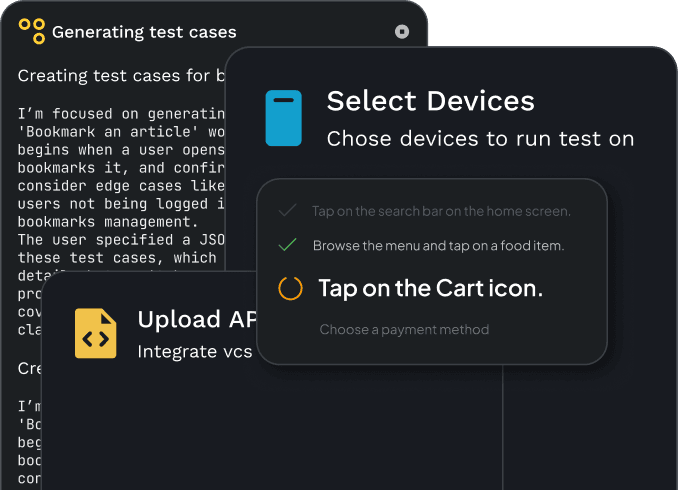
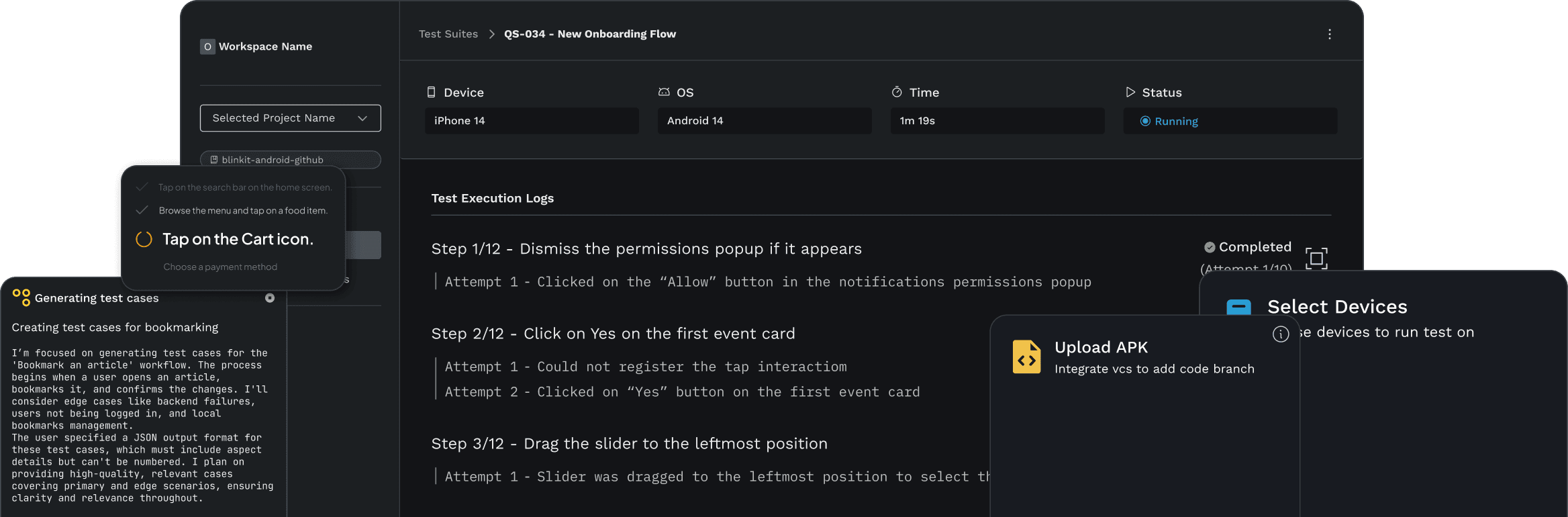
AI on the first run. Muscle memory on the rest.
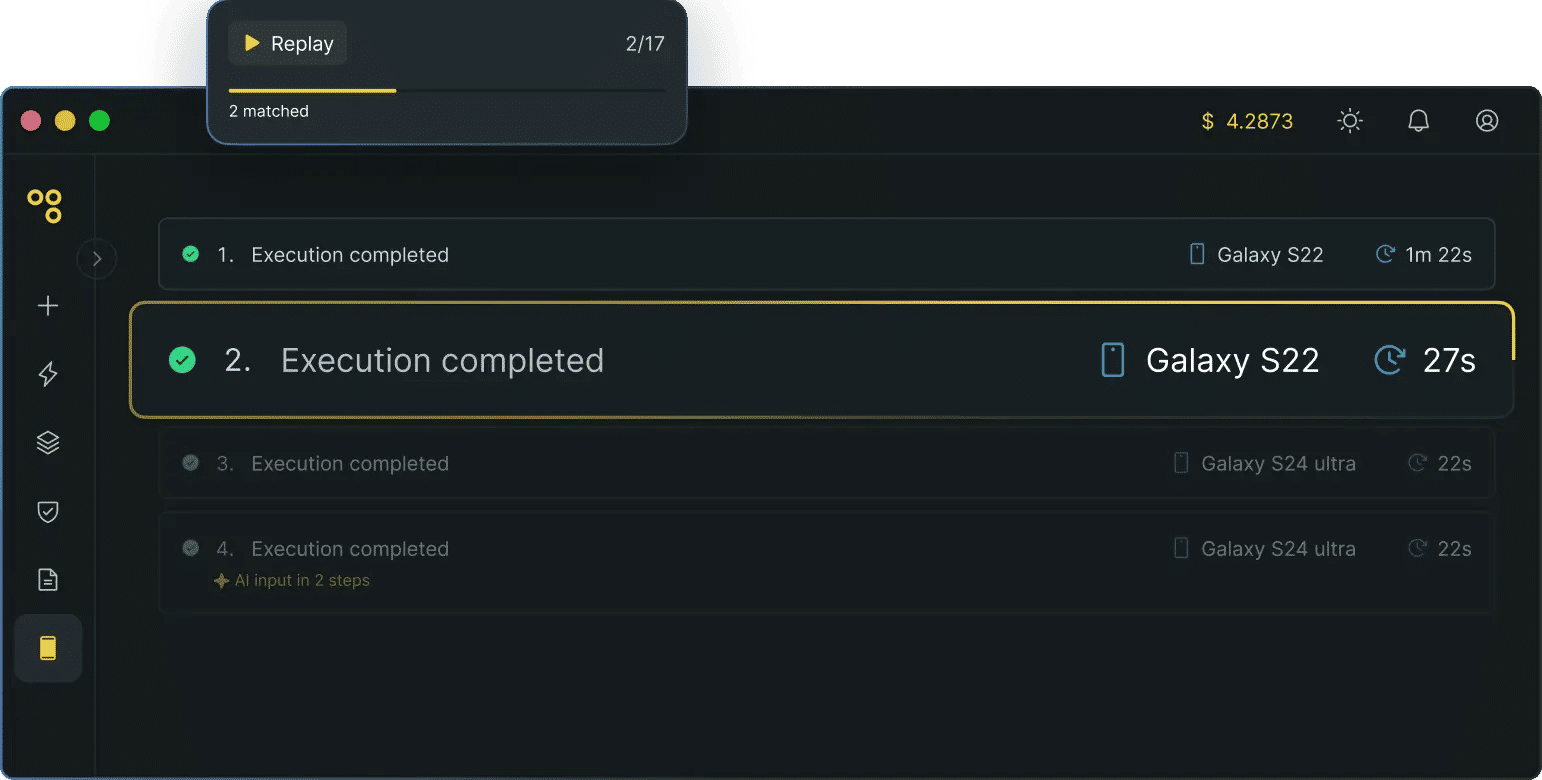
1/20th the cost. 3× the speed. The first time Quash runs a mobile test, the agent saves a Test Path. Reruns replay the path deterministically, with AI stepping back in only when the UI changes — and only on the step that changed.
Test Paths. AI's intelligence at a script's speed.
Test Paths. AI's intelligence at a script's speed.
A Test Path is a stored execution map our agent builds on a successful run. Every run after follows it directly instead of re-reasoning — cutting LLM calls by up to 90%.
Memory-driven test execution
Quash stores a structured description of every successful flow as a Test Path — not a recording, not selectors. This path is available on every subsequent run, cutting execution time by up to 3× on stable flows.

Adapts when the UI changes
When the app changes between runs, Mahoraga detects the mismatch and reasons through it instead of failing. The test keeps moving. The path gets updated.
Selective AI inference
LLM inference is invoked only where the app has deviated from the known path. A 30-step flow might need just 2–3 calls instead of 30+. Cost drops with every run.
Zero configuration overhead
Smart Test Paths are not a setting you enable. They activate automatically after the first successful run. No YAML flags, no retry policies to configure, no test runner requirements. If you've run a test in Quash once, you're already using Test Paths.
The first run builds memory. Every run after uses it.
The first run builds memory. Every run after uses it.
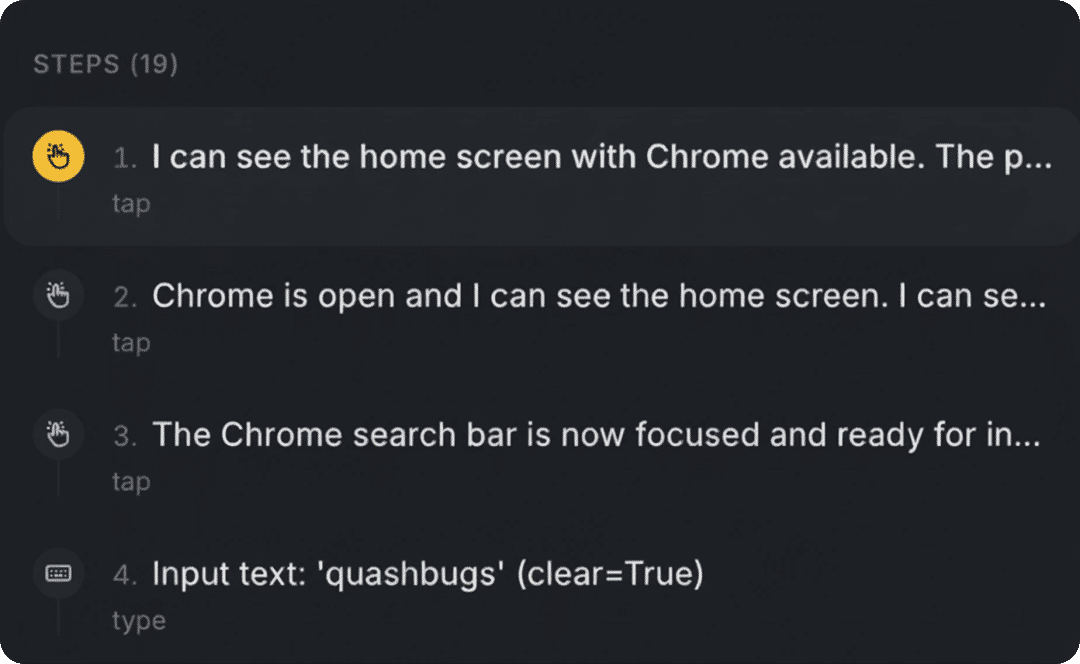
The agent reasons through the flow once, stores it as a Test Path, then executes that path directly on every subsequent run.
First run
Reasoning mode
Every run after
Path execution
The agent reads the live screen to understand what's visible and what to act on.
Test Paths vs retries vs reruns
Test Paths vs retries vs reruns
Test paths is not a retry feature. It is an execution intelligence system your test automation process needs. Here’s the difference every QA should know.
Retry
What it means
Re-runs a failed test immediately to rule out transient failures.
What it solves
Catches failures from network timeouts, timing issues, or unstable environments.
The gap
Addresses the symptom only — not the cost or root cause.
Rerun
What it means
Re-executes a previous run, in full or for failed tests only.
What it solves
Skips already-passed tests to reduce CI execution time.
The gap
Stateless, no memory. Every run costs the same.
Record & Play
What it means
Captures a manual session and plays it back automatically.
What it solves
Removes manual repetition via automated session playback.
The gap
Breaks on any UI change — remembers where to tap, not why.
Test Path
What it means
A stored execution map Mahoraga builds on the first run and follows on every run after.
What it solves
Cuts execution time, eliminates maintenance, and auto-recovers from UI changes.
The gap
Reduces cost, auto-updates paths, and handles deviations reliably.
Built to scale across teams, devices, and pipelines
Built to scale across teams, devices, and pipelines
Auto-path updating
Stored paths are updated in place when the agent resolves a UI change
Interruption recovery
Handles permission prompts, system dialogs, and notifications mid-flow
Device-adaptive paths
The same path logic adapts across different screen sizes and devices
CI/CD friendly
Faster runs mean PR feedback lands before the context has switched
Cost reduction
Stable suites become progressively cheaper as paths mature
Auto-path updating
Stored paths are updated in place when the agent resolves a UI change
Interruption recovery
Handles permission prompts, system dialogs, and notifications mid-flow
Device-adaptive paths
The same path logic adapts across different screen sizes and devices
CI/CD friendly
Faster runs mean PR feedback lands before the context has switched
Cost reduction
Stable suites become progressively cheaper as paths mature

Built for every role
Built for every role


Don't just take our word for it
Don't just take our word for it
Here's what people are saying about Quash













Satyam Rinayat
Symplr
As a developer, working with Quash was an amazing experience.


Arpit Kumar
Aatmunn
I was curious if Quash could select files or open the camera - something not possible with tools like Appium. When I ran the prompt, it actually did it! The ChatGPT-like UI where you just prompt and watch it execute is a standout feature.


Rohan Deora
Amazon
I tried sending an email with Quash using just 'Open Gmail and send an email to this id'. I didn't mention what to click - it used its intelligence for the entire flow. The UI is super friendly and it navigates like an actual user.

Satyam Rinayat
Symplr
As a developer, working with Quash was an amazing experience.
Arpit Kumar
Aatmunn
I was curious if Quash could select files or open the camera - something not possible with tools like Appium. When I ran the prompt, it actually did it! The ChatGPT-like UI where you just prompt and watch it execute is a standout feature.
Rohan Deora
Amazon
I tried sending an email with Quash using just 'Open Gmail and send an email to this id'. I didn't mention what to click - it used its intelligence for the entire flow. The UI is super friendly and it navigates like an actual user.
Need more info?
Need more info?
Need more info?


Your trust is our priority
Your trust is our priority
We blend AI-driven automation with stringent compliance measures, ensuring your data's confidentiality and security.



One run to learn. Every run after, on autopilot.
One run to learn. Every run after, on autopilot.