AI Testing: Statistics, Trends & Adoption Data (2026)

AI testing has moved from a niche capability to one of the fastest-changing parts of software engineering. Quality teams now use artificial intelligence to generate test cases, create automation scripts, analyze failures, produce synthetic data, prioritize regression suites, and maintain tests when interfaces change.
The headline numbers make adoption look nearly complete. The World Quality Report says roughly 89% of organizations are piloting or deploying generative AI in quality engineering. Katalon reports that 76% of QA professionals use AI-powered testing tools. Rainforest QA finds similar adoption among teams using code-based frameworks.
But only 15% of organizations report enterprise-wide implementation. That gap is the defining AI testing story of 2026: experimentation is widespread, but scaled, reliable deployment is still uncommon.
This report brings together current AI testing statistics, software testing trends, analyst projections, venture funding, hiring data, developer surveys, and mobile-specific evidence. It also separates measured findings from vendor claims and flags figures that are outdated, incomparable, or too weak to use without qualification.
That comparison is easier to make with the AI testing statistics report, which isolates QA-specific adoption evidence from economy-wide measures.
Key AI Testing Statistics for 2026
89% of organizations are piloting or deploying generative AI in quality engineering: 37% are in production and 52% remain in pilot programs.
Only 15% of organizations have reached enterprise-wide generative AI deployment in quality engineering.
76% of QA professionals report using AI-powered tools in testing activities.
Around 75% of teams using code-based automation frameworks have adopted AI testing tools.
Testing is the second most common AI use case across the software development lifecycle at 47%, narrowly behind coding at 48%.
70% of organizations use AI to develop test cases, 55% use it to generate or automate scripts, and 48% use it to analyze outcomes and recommend improvements.
Synthetic test-data usage rose from 14% in 2024 to about 25% in 2025.
Organizations reported an average 19% productivity gain from generative AI in quality engineering, but roughly one-third saw minimal gains.
Only about 36% of QA teams report positive ROI from AI, and 21% describe that ROI as significant.
GenAI is now ranked the top future skill for quality engineers by 63% of organizations; 58% are actively upskilling QA teams in AI.
Data privacy is the leading barrier to AI testing adoption at 67%, followed by integration complexity at 64% and hallucination or reliability concerns at 60%.
Gartner's current projection says 70% of enterprises will integrate AI-augmented testing tools into software engineering toolchains by 2028, up from about 20% in early 2025.
Tracxn tracks 203 companies in AI-powered software testing; only 58 have raised funding, 24 have reached Series A or later, and 16 have reached Series B or later.
The U.S. Bureau of Labor Statistics projects 15% growth from 2024 to 2034 for the combined category of software developers, QA analysts, and testers.
84% of developers use or plan to use AI tools, but only about one-third trust their accuracy and 45% say debugging AI-generated code is time-consuming.
Note: Adoption statistics are not directly comparable unless the survey definition is preserved. Piloting, individual tool usage, production deployment, and enterprise-wide rollout measure different stages of adoption.

Get the Mobile Testing Playbook Used by 800+ QA Teams
Discover 50+ battle-tested strategies to catch critical bugs before production and ship 5-star apps faster.
The Most Important AI Testing Insight: Adoption Is Not One Metric
The most-cited AI testing statistics often look contradictory because they answer different questions. One survey asks whether an organization is piloting or deploying generative AI. Another asks whether an individual tester uses any AI-powered tool. A third measures enterprise-wide implementation.
Treating these as interchangeable produces inflated claims. A QA engineer using ChatGPT to draft test cases can count as an AI user, but that is not equivalent to a company integrating AI test automation across products, environments, governance, and release workflows.
The honest synthesis is simple: AI in software testing is already mainstream at the experimentation level, but mature adoption remains limited.
Figure | What it measures | Source | Sample | Date |
~89% | Piloting or deploying GenAI in quality engineering | World Quality Report 2025-26 | Senior QE and IT leaders, global | Nov 2025 |
76% | Any use of AI-powered tools in testing | Katalon State of Software Quality 2025 | 1,500+ QA professionals | Mar 2025 |
~75% | AI tool adoption among code-based framework teams | Rainforest QA State of Test Automation | 600+ developers | Jan 2026 |
15% | Enterprise-wide GenAI implementation | World Quality Report 2025-26 | Same WQR population | Nov 2025 |

AI in Software Testing Adoption Statistics
AI experimentation is close to universal
The World Quality Report 2025-26 provides the strongest enterprise view. It found that around 89% of organizations were piloting or deploying generative AI in quality engineering. Of those, 37% had moved into production and 52% remained in pilot programs.
The same report found that only 15% had achieved enterprise-wide implementation. Another 43% were still experimenting, while 30% had restricted AI to limited use cases.
That distribution matters more than the top-line 89%. It shows that most companies have crossed the awareness threshold, but relatively few have solved integration, governance, reliability, and adoption across teams.
Some organizations are becoming more selective
Non-adoption increased from 4% in 2024 to 11% in 2025, although it remained far below the 31% reported in 2023. That does not necessarily indicate a collapse in interest. It suggests that some organizations pulled back after early pilots failed to produce clear value or created new risks.
The barriers also changed. In 2024, companies focused on strategy and capability gaps. By 2025, the leading concerns had become operational: data-privacy risk at 67%, integration complexity at 64%, and hallucination or reliability at 60%.
In other words, the question has shifted from 'Should we try AI testing?' to 'Can we deploy it safely and make it work inside real engineering systems?'
Testing is already a leading AI use case across the SDLC
Forrester's 2025 developer survey placed testing at 47% among AI use cases across the software development lifecycle, nearly tied with coding at 48%. Finding development insights ranked lower at 33%.
Google DORA's broader developer research shows the same direction. AI adoption among developers rose from roughly 76% in 2024 to about 90% in 2025. More than 80% reported productivity gains in the later study, while 59% reported improved code quality.
These figures are developer-wide rather than QA-specific, but they matter because AI test automation is increasingly embedded in the same tools developers use for coding, review, debugging, and delivery.
How QA Teams Actually Use AI Testing Tools
The most common AI testing use cases are practical rather than fully autonomous. Teams use AI to reduce repetitive work around test design, scripting, data preparation, failure analysis, and maintenance.

Applause's 2025 State of Digital Quality Report provides the clearest task-level breakdown.
AI testing use case | Reported usage |
Developing test cases | 70% |
Automating or generating test scripts | 55% |
Analyzing test outcomes and recommending improvements | 48% |
1. Test-case generation
Test-case generation is the most established use of generative AI in software testing. Teams can turn requirements, user stories, acceptance criteria, or plain-language workflows into candidate test scenarios.
The advantage is not that every generated test is correct. It is that AI can expand the initial set quickly, expose missing edge cases, and reduce the blank-page work that slows manual test design. Human review remains necessary to remove duplicates, correct assumptions, and align tests with actual product risk.
2. Test-script generation and AI test automation
AI-assisted scripting helps teams convert natural-language steps into Selenium, Playwright, Cypress, Appium, or platform-specific automation. Katalon separately reports that about 72% of respondents use AI for test generation or script optimization, though that figure comes from a differently worded survey question and should not be treated as identical to the 76% overall usage figure.
This distinction sharpens the impact of language statistics on AI testing choices since adoption metrics and implementation languages answer different questions.
Script generation can accelerate initial coverage, but it does not eliminate maintenance. Generated code still depends on stable selectors, reusable abstractions, environment setup, and review. The harder problem is keeping tests reliable after the application changes.
3. Synthetic test data
Synthetic data has become one of the fastest-growing applications of generative AI in quality engineering. The World Quality Report found usage rising from 14% in 2024 to roughly 25% in 2025.
This matters because many test environments are constrained by privacy, access, or insufficient data variety. Synthetic generation can help teams create edge cases, represent rare conditions, and avoid copying sensitive production records into testing systems. It also creates a new responsibility: teams must validate that generated data is realistic, representative, and safe.
To turn that caution into execution, How to roll out a hybrid testing model offers a practical path from adoption context to implementation choices.
4. Failure analysis and debugging
AI can cluster failures, summarize logs, identify likely root causes, and produce structured bug reports containing reproduction steps, screenshots, and environment details.
The value is strongest when AI reduces the time between a failed test and an actionable diagnosis. But debugging effort does not disappear. In the Stack Overflow 2025 Developer Survey, 45% of developers said debugging AI-generated code was time-consuming. AI can shift work from creation to verification rather than removing it entirely.
In that context, AI Testing: Statistics, Trends & Adoption Data (2026) helps distinguish testing adoption from the security assurance required before shipping AI-generated code.
5. Regression prioritization and coverage analysis
AI testing tools can rank tests based on code changes, historical failures, business risk, or production usage. This allows teams to run a smaller, more relevant regression set earlier while preserving broader suites for later stages.
Coverage-gap analysis is another practical use. Models can compare requirements, changed code, telemetry, and existing tests to suggest areas that lack validation. The output should be treated as a prioritization aid, not proof that the product is adequately tested.
6. Self-healing and locator repair
Self-healing is one of the most marketed AI test automation capabilities. When a selector breaks, a tool attempts to identify the same interface element using alternate attributes, surrounding context, visual similarity, or previous behavior.
This can reduce maintenance for cosmetic UI changes, but vendor-reported success rates vary widely by tool and scenario. A healed locator can also create false confidence by interacting with the wrong element. Reliable implementations preserve evidence, flag the change, and keep a human in the review loop.
AI Testing ROI and Productivity Statistics
AI testing ROI is positive for some teams, but current evidence does not support universal claims of dramatic cost reduction.
The World Quality Report found an average productivity gain of about 19% from generative AI in quality engineering. However, roughly one-third of organizations saw minimal gains. Katalon found that around 36% reported positive ROI, with 21% describing the return as significant.
Forrester's broader enterprise AI research is similarly cautious: fewer than one-third of decision-makers can connect AI investments to financial growth. This is why vendor claims such as 300% to 500% ROI, 90% cost reduction, or 740% first-year return should not be used as industry benchmarks without transparent customer data and methodology.
Use AI testing trends to frame adoption claims cautiously, because project-level evidence matters more than headline performance figures.
The same distinction applies to AI development and testing trends because activity metrics still need outcome-based evidence.

Self-reported speed is not the same as measured productivity
A randomized controlled trial by METR illustrates the measurement problem. Sixteen experienced open-source developers completed 246 real tasks in mature repositories using Cursor Pro and Claude 3.5 or 3.7 Sonnet.
Before the study, participants expected AI to make them 24% faster. Afterward, they still believed they had been about 20% faster. Objective measurement showed they were 19% slower.

The study was about coding rather than testing, used a small sample, and evaluated early-2025 tools in deliberately difficult conditions. METR now describes it as a historical snapshot. It should not be generalized into a claim that AI always slows engineers down.
Its relevance is methodological: perception can diverge sharply from measured performance. AI testing programs should track maintenance hours, escaped defects, flaky-test rates, execution time, coverage quality, and release outcomes rather than relying only on user sentiment.
DORA shows that team systems determine the outcome
Google DORA's two-year trend is more useful than either year in isolation. In 2024, a 25% increase in AI adoption was associated with a 1.5% reduction in delivery throughput and a 7.2% reduction in delivery stability.
In 2025, the throughput relationship reversed and became positive, but delivery instability persisted. Teams learned to ship AI-assisted code faster, while the surrounding systems for review, testing, and release control did not improve at the same pace.
For AI in QA, the implication is direct: generating more code and tests only creates value when validation, observability, test environments, and maintenance practices can absorb the increased output.
Gartner and Forrester AI Testing Projections
Gartner's widely quoted 80% forecast is outdated
Many AI testing articles still cite Gartner's 2024 prediction that 80% of enterprises would integrate AI-augmented testing tools by 2027, up from roughly 15% in early 2023.
Gartner revised that assumption in its 2025 Magic Quadrant for AI-Augmented Software Testing Tools. The current projection is that 70% of enterprises will integrate AI-augmented testing tools into their software engineering toolchains by 2028, up from about 20% in early 2025.
The revision is meaningful. Gartner pushed the target out by one year, lowered the expected adoption ceiling by 10 percentage points, and showed that the measured baseline had risen only about five points over two years. That is consistent with the broader evidence: interest is high, but deep integration is slower than early forecasts suggested.
The category is shifting toward agentic quality assurance
Gartner now describes the market as transitioning toward agentic software quality assurance platforms. Instead of using AI only to suggest code or repair selectors, agentic systems attempt to plan, generate, execute, evaluate, and adapt tests across a workflow.
Adjacent Gartner projections show both the opportunity and the risk. By 2028, 33% of enterprise applications are expected to include agentic AI, yet more than 40% of agentic AI projects are expected to be canceled by the end of 2027 because of cost, unclear value, or weak risk controls.
Those figures are not testing-specific, but they are relevant to the direction of AI-powered software testing tools. Autonomous execution increases the value of reliable guardrails, traceability, approval flows, and human oversight.
Forrester expects 'vibe engineering,' not just vibe coding
Forrester's 2026 outlook argues that software development will become the leading enterprise AI use case and that informal 'vibe coding' will evolve into engineering-grade workflows spanning requirements, implementation, testing, and delivery.
At the same time, Forrester expects an AI spending reckoning because fewer than one-third of decision-makers can connect AI investments to financial growth. The market is therefore likely to reward tools that demonstrate measurable quality outcomes rather than simply adding generative features.
The AI Testing Tools Landscape in 2026
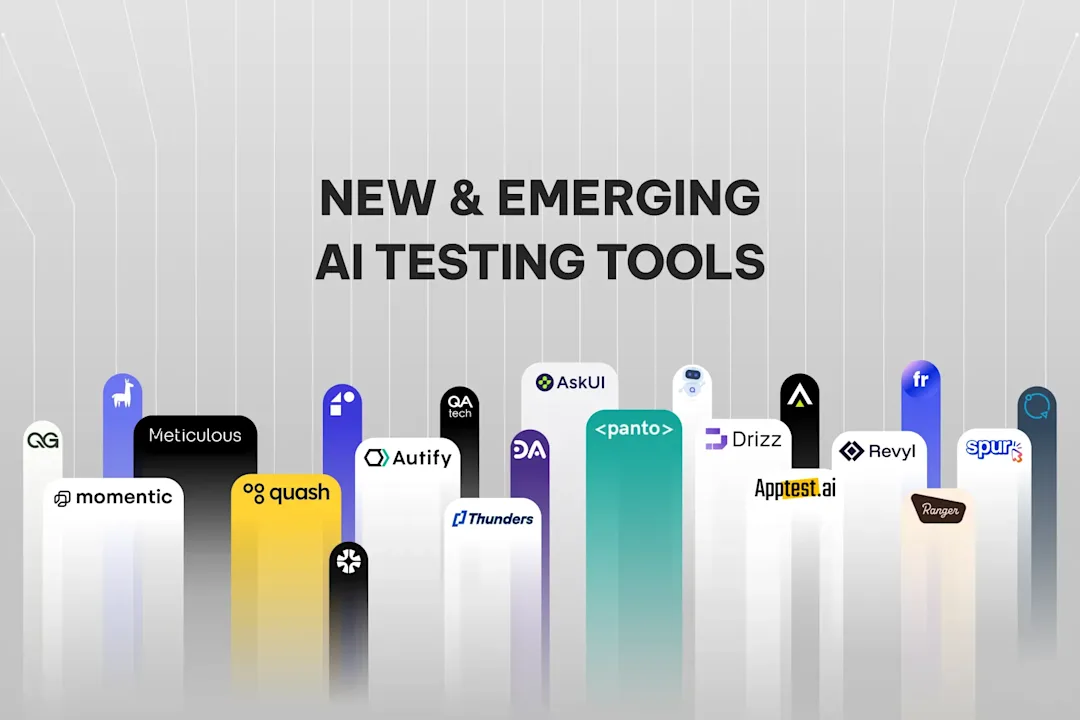
AI testing is no longer one product category. It now includes browser automation, mobile testing, API testing, visual validation, synthetic data, failure analysis, deterministic simulation, and autonomous agents.
Tracxn's AI-Powered Software Testing sector tracker listed 203 companies as of July 2026. Twenty-seven were founded in 2025, the highest annual count in the previous decade, with seven more founded in 2026 by the time of compilation.

The category is broad but shallowly funded. Only 58 of the 203 tracked companies had raised any capital, 24 had reached Series A or later, and 16 had reached Series B or later. That suggests a fragmented early-stage market with a thin group of scaled vendors.
Category | Representative tools | Primary focus |
Browser and web E2E | Momentic, QA Wolf, Stagehand, Browser Use | Natural-language and agentic browser testing |
Mobile AI testing | Quash, QualGent, Mobot, Sofy, Kobiton | Native Android and iOS workflows, devices, mobile UI change |
API testing | Keploy, EvoMaster, enterprise suite extensions | API validation, generation, contracts, and data |
Visual testing | Applitools and visual AI features in broader suites | Visual regression and UI comparison |
Agentic and autonomous QA | Antithesis, Autonoma, Magnitude, Skyvern | Planning, execution, adaptation, and maintenance |
Traditional, AI-assisted, and AI-native testing
A useful way to interpret the market is as a maturity ladder.
Traditional open-source frameworks such as Selenium, Playwright, Cypress, Appium, Robot Framework, k6, and JMeter remain script-first. AI-assisted layers add capabilities such as generation, selector repair, prioritization, or analysis. AI-native platforms begin with intent and use an agent to determine how the workflow should be tested.
That distinction matters when interpreting Gemini statistics because user scale can influence which AI capabilities testing teams encounter.
These approaches will coexist. Traditional frameworks provide control and ecosystem maturity. AI-assisted tools improve productivity without changing the operating model. AI-native tools attempt to reduce the scripting and maintenance burden more fundamentally.
Open-source agentic testing is expanding quickly
Browser Use grew to roughly 78,000 to 81,000 GitHub stars during 2025-26. Skyvern reached about 20,000 to 21,000 stars and reported more than 10 million workflows. Stagehand reached a similar star count while building on Playwright.
These counts change weekly and should always be date-stamped. Their significance is directional: agentic browser interaction has moved rapidly from research demos into mainstream developer tooling.
A key architectural split is emerging between vision-based agents and DOM or accessibility-based agents. Vision systems can adapt to interfaces without stable selectors but may be slower and more expensive. DOM-based systems are typically faster and cheaper, but can depend more heavily on page structure.
AI Testing Funding and M&A
Capital is flowing to both AI-native startups and established quality-engineering vendors. The pattern suggests investor confidence in the category, but not yet a settled market structure.
Verified rounds from 2024 and 2025 include the following.
Company | Round | Amount | Date / note |
Momentic | Pre-seed | $0.5M | Apr 2024 |
Momentic | Seed | $3.7M | Mar 2025 |
Momentic | Series A | $15M | Nov 2025; total about $19.2M |
QA Wolf | Series B | $36M | 2025; included native mobile testing |
Antithesis | Seed | $47M | Feb 2024; $215M post-money |
Antithesis | Series A | $30M | Early 2025 |
Thunder Code | Seed | $9M | Mid-2025 |
Tricentis | Private equity | $1.33B | Nov 2024 |
The startup rounds are still concentrated at seed and Series A. At the other end, the $1.33 billion Tricentis transaction shows that established enterprise testing platforms remain strategically valuable.
Private-market totals should be handled carefully. Trackers often disagree about undisclosed or secondary rounds. Specific dated rounds with named investors are more reliable than a single 'total funding' figure.
AI Testing Market Size: Why Published Estimates Differ by More Than 100x
There is no dependable single market-size figure for AI testing. Research firms define the category differently and rarely publish methods detailed enough for direct comparison.
That same caution is essential when using broader SaaS market-size benchmarking and how to cite them accurately because definitions and methodology determine whether estimates are comparable.

For 2025, estimates range from roughly $0.64 billion to more than $57 billion, with one estimate extending to $73 billion. That spread is too large to treat any single figure as an objective market value.
Research firm | Market label | 2025 estimate | Forecast / CAGR |
Fundamental Business Insights | AI-enabled testing | $0.64B | $3.43B by 2035; ~18% CAGR |
The Business Research Company | AI-enabled testing | $0.85-$0.86B | ~$2.0B by 2030; ~22% CAGR |
Fortune Business Insights | AI-enabled testing | $1.01B | $4.64B by 2034; 18.3% CAGR |
Future Market Insights | AI-powered testing tools | $3.4B | $6.4B by 2035; 6.6% CAGR |
MarketsandMarkets | AI test automation | $8.81B | $35.96B by 2032; 22.3% CAGR |
Market Research Future | AI-enabled testing | $57-$73B | $832B by 2035; 27.5% CAGR |
The useful conclusion is not that the market is worth a precise amount. It is that analyst firms expect continued growth while disagreeing radically about what belongs inside the category.
Any article citing an AI testing market size should preserve the research firm's exact label, base year, forecast period, and definition.
AI Testing Jobs and QA Hiring Trends
Current evidence does not support the claim that AI is eliminating software testing roles. It supports a shift toward hybrid roles combining QA judgment, automation, programming, and AI literacy.
The U.S. Bureau of Labor Statistics projects 15% growth from 2024 to 2034 for the combined occupational category of software developers, quality assurance analysts, and testers, with about 129,200 openings per year. This should not be misquoted as a QA-only forecast because software developers make up a large share of the category.
Upwork reported a 19% month-over-month rise in QA-testing demand in November 2025 and a 16% increase in AI and machine-learning skills. That is a useful marketplace signal, not a broad labor-market trend, because it reflects one month of freelance demand.
That distinction matters when interpreting AI testing statistics which separates testing-specific adoption signals from broader LLM market measurements.
The QA skill profile is changing
The World Quality Report ranked GenAI as the top future skill for quality engineers at 63%, slightly ahead of core quality-engineering skills at 60%. Half of organizations still report an AI or machine-learning expertise gap, and 58% are upskilling QA teams.
Katalon found that 82% of quality professionals expect AI skills to become critical within three to five years. At the same time, 68% still consider scripting and programming essential.
The direction is clear: manual-only roles are under pressure, but human testing expertise is not becoming irrelevant. Teams need people who can design risk-based coverage, review AI-generated output, diagnose failures, understand automation systems, and make release decisions.
AI anxiety exists, but use does not remove it
Katalon found that 20% of respondents were very concerned that AI would replace their role. Testers already using AI were roughly twice as likely to fear replacement, an apparent paradox that may reflect greater awareness of the technology's capabilities and limitations.
This reinforces a practical distinction: AI can automate testing tasks, but accountability for product quality remains organizational and human.
Mobile AI Testing: Why the Opportunity Is Different
Mobile testing combines the usual challenges of test automation with device fragmentation, operating-system differences, manufacturer customizations, screen variation, permissions, network changes, and system dialogs.
Statcounter data for May 2026 placed Android at roughly 68% of global mobile operating-system share and iOS at about 32%. Android traffic remained distributed across six or seven major versions, with Android 16, 15, 13, 14, 12, and 11 all carrying meaningful usage.

This fragmentation is why AI testing for mobile apps has a different value proposition from browser automation. The goal is not only to create tests faster. It is to keep tests functional across changing interfaces, devices, and environments.
Testing is a major mobile-development bottleneck
JetBrains' Developer Ecosystem Survey 2024 found that 43% of mobile developers considered testing their leading productivity bottleneck.
A LambdaTest survey of more than 1,600 QA professionals reported that engineers lose 7.8% of their time to flaky tests and 10.4% to maintaining test environments. Combined, that is roughly one working day per week spent on reliability and infrastructure rather than new validation.
Those figures are not limited to mobile testing, but the maintenance burden is amplified on mobile because the same flow may behave differently across devices, OS versions, keyboards, permissions, animations, and connectivity conditions.
Where AI can help mobile QA
Natural-language creation of native mobile test flows.
Visual or semantic interaction that reduces dependence on brittle selectors.
Adaptation to layout and device differences.
Automatic screenshots and evidence collection at each step.
Failure summarization with device, OS, network, and environment context.
Prioritization of device and OS combinations based on production usage.
Detection and triage of flaky behavior across repeated executions.
Reliable industry-wide adoption data for AI in mobile QA is still limited. That absence should be stated rather than filled with vendor percentages. What is visible is a funded mobile-testing cohort that includes Quash, QualGent, Mobot, Sofy, Kobiton, and QA Wolf's native mobile expansion.
For mobile teams, the most meaningful benchmark will be maintenance reduction and release confidence, not the number of tests generated.
Developer AI Tool Adoption and What It Means for Testing
This context also matters because AI testing statistics and adoption show how broader developer-tool adoption can shift testing requirements.
Broader context on the state of AI testing adoption helps teams calibrate QA coverage against evolving development practices.
To distinguish general developer-tool usage from quality workflows, AI testing statistics and adoption data isolate testing signals that broad adoption surveys can obscure.
For more detail, see AI coding assistant adoption and security benchmarks.
AI testing tools increasingly operate inside the broader developer-tool ecosystem. Stack Overflow's 2025 Developer Survey, based on more than 49,000 respondents across 177 countries, found that 84% use or plan to use AI tools and 51% of professional developers use them daily.
Among out-of-the-box assistants, ChatGPT was used by 82% and GitHub Copilot by 68%. AI-native development environments and agents also entered the survey, with Cursor at 18%, Claude Code at 10%, and Windsurf at 5%.
These are developer-wide figures, not QA-only market share. They show that testers and developers increasingly encounter AI through coding assistants and IDEs before adopting specialist AI testing platforms.
Usage is high, trust is not
Only about one-third of developers trusted AI output accuracy, while roughly 46% distrusted it. Just around 3% reported high trust. At the same time, 45% said debugging AI-generated code was time-consuming.
That trust gap is central to AI quality assurance. AI can produce tests, explanations, and actions at high speed, but teams still need evidence, deterministic checks, and review mechanisms before those outputs can influence release decisions.
AI Testing Trends Shaping 2026
1. Experimentation is no longer a differentiator
With close to nine in ten organizations piloting or deploying GenAI in quality engineering, simply trying an AI tool no longer signals maturity. The differentiator is whether the organization can connect AI to repeatable workflows and measurable quality outcomes.
2. Enterprise rollout is slower than early forecasts
Only 15% have reached enterprise-wide implementation, and Gartner revised its adoption forecast downward and outward. Governance, reliability, integration, and change management are now the limiting factors.
3. AI is moving earlier in the testing lifecycle
Use is shifting from summarizing test results toward requirements analysis, test design, data generation, and risk-based planning. This gives AI more influence over what gets tested, not just how failures are explained.
That task-level concentration matters when assessing whether AI testing statistics has reached the CI/CD workflow rather than isolated testing activities.
4. Maintenance is becoming more important than generation
Generating a test is increasingly easy. Keeping large suites stable across product changes remains expensive. Self-healing, semantic interaction, failure triage, and adaptive execution are becoming central product claims.
5. Agentic testing is emerging, but autonomy needs guardrails
Platforms are moving from suggestions to actions. As agents plan and execute workflows, teams need permissions, audit trails, deterministic assertions, approval controls, and clear failure evidence.
6. Human-in-the-loop testing remains the practical model
The strongest evidence supports augmentation rather than full replacement. Humans define risk, review generated tests, validate business logic, investigate ambiguity, and own release decisions.
7. AI-generated code increases the need for quality systems
This context matters because AI testing statistics show how teams can validate AI-assisted output before it compounds maintenance risk.
Faster code production can increase throughput while weakening stability if review and testing systems do not improve. This creates more demand for effective AI test automation, not less.
8. The market will consolidate around measurable outcomes
The ecosystem is crowded and mostly early-stage. Vendors that cannot demonstrate lower maintenance, faster diagnosis, stronger coverage, or improved release confidence will struggle once novelty fades.
AI Testing Statistics to Use Carefully
Several attractive figures circulate widely despite weak sourcing. They should not be repeated as established facts.
Gartner's '80% by 2027' projection is superseded by the newer 70% by 2028 forecast.
The claim that 'AI Test Engineer' postings grew 45% year over year is commonly attributed to a LinkedIn Emerging Jobs Report 2025 that does not appear to exist.
Single market-size figures are misleading unless the exact category definition and year are retained.
Vendor ROI claims such as 300% to 500% return, 90% cost reduction, or 740% first-year ROI are not industry benchmarks.
The claim that bugs cost 30 times more to fix after release is old, heavily distorted, and usually presented without traceable methodology.
The METR finding that developers were 19% slower must retain its small sample, coding context, early-2025 tool vintage, and historical-status caveat.
DORA's 2024 negative throughput result should be paired with the 2025 reversal rather than presented as current on its own.
Frequently Asked Questions About AI Testing
What is AI testing?
AI testing is the use of artificial intelligence in software testing workflows. It includes test-case generation, AI test automation, synthetic data, test prioritization, visual testing, failure analysis, self-healing, bug reporting, and autonomous execution.
How many companies use AI in software testing?
The percentage depends on the definition. Around 89% of organizations are piloting or deploying generative AI in quality engineering, 76% of QA professionals report using AI-powered testing tools, and only 15% report enterprise-wide implementation.
What are the most common AI testing use cases?
The leading use cases are test-case generation, script generation, test-data generation, failure analysis, regression prioritization, self-healing, coverage-gap analysis, and automated bug reporting.
Does AI testing deliver positive ROI?
Some teams report meaningful gains, but the results are mixed. The World Quality Report found a 19% average productivity gain while roughly one-third saw minimal gains. Katalon found about 36% reporting positive ROI, with 21% reporting significant ROI.
Will AI replace software testers?
Current evidence points to role change rather than wholesale replacement. AI automates repetitive tasks, but humans still define risk, validate outputs, investigate ambiguous behavior, perform exploratory testing, and own release decisions.
What is generative AI in software testing?
Generative AI in software testing uses large language or multimodal models to produce or transform testing artifacts, such as test cases, scripts, synthetic data, failure summaries, bug reports, and natural-language test flows.
What is agentic AI testing?
Agentic AI testing uses an AI system that can plan and carry out multiple testing steps, observe results, adapt its actions, and continue toward a goal with limited manual scripting. Reliable systems still require guardrails and traceability.
Why is mobile AI testing different?
Mobile testing must handle device diversity, Android and iOS differences, OS versions, manufacturer customizations, permissions, screen sizes, keyboards, system dialogs, and network variation. AI is especially valuable when it reduces the maintenance created by this fragmentation.
What are the biggest barriers to AI testing adoption?
The leading reported barriers are data privacy at 67%, integration complexity at 64%, and hallucination or reliability concerns at 60%. Skills and organizational readiness remain significant secondary constraints.
What is the future of AI in QA?
AI in QA is moving from isolated assistants toward integrated and agentic workflows. The likely near-term model is human-supervised automation: AI handles generation, execution, and analysis while engineers control risk, validation, and release decisions.
Conclusion: AI Testing Is Mainstream, but Maturity Is Still Rare
The 2026 Software Quality Statistics report helps distinguish widespread AI-testing adoption from the quality outcomes that indicate genuine maturity.
The data shows a category moving out of its experimental phase without yet reaching operational maturity.
AI adoption in software testing is widespread. Testing is one of the leading uses of AI across the development lifecycle. Quality teams are already generating cases, scripts, synthetic data, and failure analysis with AI. Funding and open-source activity continue to expand the market.
But the harder evidence is more restrained. Only 15% of organizations have scaled generative AI across the enterprise. ROI is positive for a minority of teams, not a universal result. Trust remains low. Integration, privacy, and reliability have replaced awareness as the main constraints.
The next stage of AI software testing will therefore be judged less by how many tests a tool can generate and more by whether it reduces maintenance, improves diagnosis, expands meaningful coverage, and helps teams release more reliable software.
That is the difference between adding AI to testing and building an effective AI quality-assurance system.
Methodology and Source Notes
This article synthesizes research compiled through July 2026 from the World Quality Report 2025-26, Katalon State of Software Quality 2025, Rainforest QA State of Test Automation, Forrester Developer Survey and Predictions 2026, Gartner's 2025 Magic Quadrant for AI-Augmented Software Testing Tools, Google DORA 2024 and 2025 research, Stack Overflow's 2025 Developer Survey, Applause's 2025 State of Digital Quality Report, U.S. Bureau of Labor Statistics data, Upwork's November 2025 Hiring Report, METR's 2025 randomized controlled trial, Tracxn's AI-powered software testing tracker, public funding announcements, and named market-research firms.
That context makes AI coding assistant market statistics for 2026 useful for separating reported adoption from vendor claims.
To distinguish testing adoption from earlier quality controls, AI code review statistics situate review workflows alongside the broader AI testing evidence.
Where surveys use different definitions of adoption, the wording and stage of adoption are retained. Vendor-reported metrics are identified as such. Fast-changing figures such as GitHub stars, funding rounds, analyst classifications, and operating-system share should be rechecked immediately before publication.
Continue reading
More articles from the Quash editorial desk.