Voice AI Testing: A Practical How-To for 2026

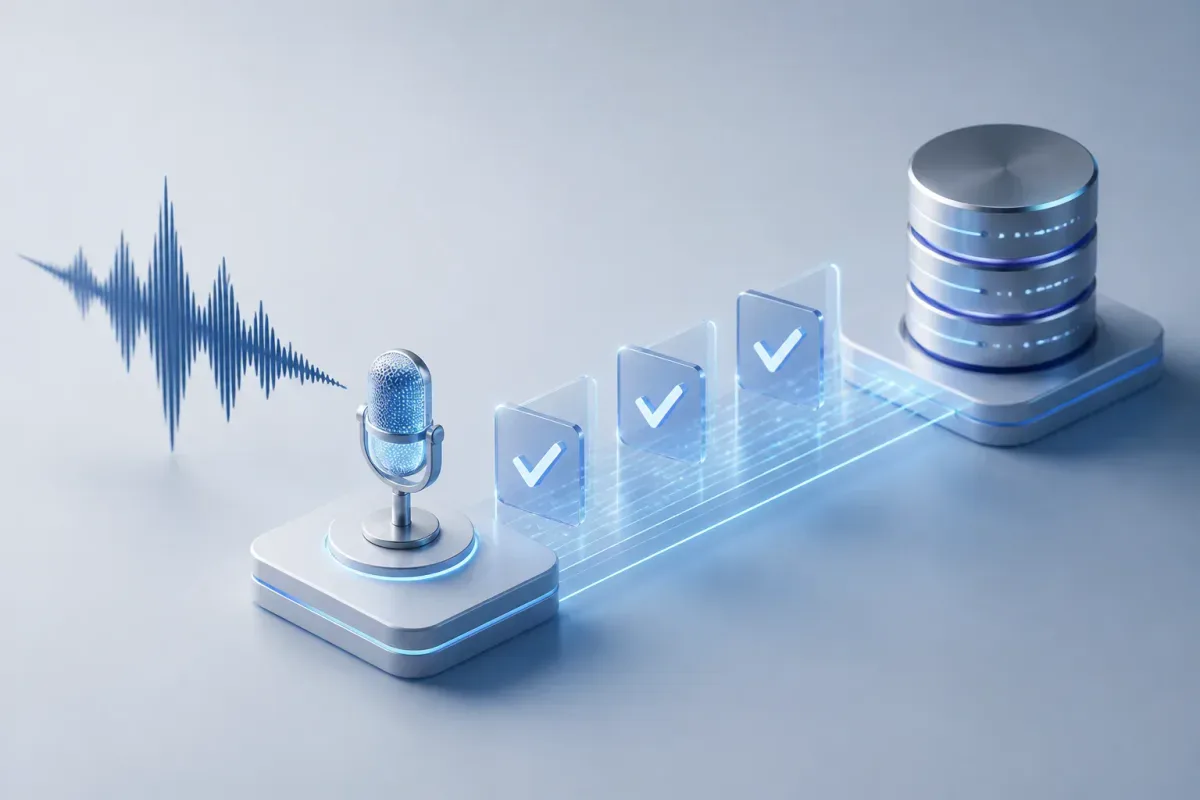
A voice agent can sound polished and still fail the caller. The transcript may look right while the booking never reaches the calendar, a transfer fails, or a long response gap makes the caller speak over the agent.
Voice AI testing should prove the conversation and the outcome. You need repeatable scenarios that check what the agent said, what the caller heard, which tools ran, and whether the downstream system reached the required state. Start with the copyable test-plan template below, then run it through the layers that can actually prove each risk.
Voice AI testing test-plan template
Create one record for every scenario. This makes a regression pass meaningful: you can see the exact build, channel, starting state, evidence, and release decision rather than relying on someone’s memory of a call.
Field | What to record |
Scenario ID | A stable identifier for regression runs |
Agent and build | Agent version, prompt bundle, model, voice, and configuration |
Date and test layer | Test date plus text unit test, audio replay, simulated phone call, load test, or production score |
Starting state | Records, permissions, feature flags, dependencies, and preloaded test data |
Channel | Browser/WebRTC, SIP/PSTN, inbound or outbound, codec, carrier, and routing setup where relevant |
Caller goal | The task the caller is trying to complete |
Allowed variation | Permitted paraphrases, corrections, silence, or alternate safe paths |
Required actions | Identity checks, questions, tool names and arguments, confirmations, handoffs, and order constraints |
Forbidden actions | Unauthorized or duplicate side effects, early confirmation, restricted-data disclosure, and prohibited tool calls |
Audio and network conditions | Noise, reverberation, compression, clipping, packet loss, jitter, degraded connection, or dropped-call risk |
Expected final state | The independently verifiable state required in the system of record |
Fallback and recovery | Timeout, malformed tool response, authorization failure, unavailable dependency, transfer failure, voicemail, or dropped call |
Evidence | Audio, transcript, trace, tool arguments, authorization context, retries, timestamps, response gap, latency, handoff, and downstream state |
Pass or fail rule | Exact assertion, bounded acceptable variation, and any mandatory human review |
Release disposition | Pass, revise, canary, rollback, or block release |
Worked example: reschedule an appointment
Field | Example |
Scenario ID | RSCH-BOOK-03 |
Agent and build | Booking assistant, |
Test layer | Simulated outbound phone call |
Starting state | Test customer exists; one Thursday-afternoon slot is open; confirmation messaging is enabled |
Caller goal | Move an appointment from Tuesday to Thursday afternoon |
Allowed variation | The caller may repeat the date, correct the time once, or ask for the final slot to be read back |
Required actions | Verify identity, confirm the new slot, update the record once, and read back the final time |
Forbidden actions | Changing the appointment before identity verification, double-booking, or claiming success before the update completes |
Expected final state | The appointment is moved in the scheduling system and the confirmation is logged |
Evidence | Call audio, transcript, tool trace, scheduling record, and timestamped confirmation |
Pass or fail rule | Pass only when one update exists and the stored time matches the caller’s request |
Human review | Required because the change is consequential and difficult to undo |
The important design choice is that this template permits conversational variation while keeping safety-critical behavior exact. A caller can phrase a request differently; identity verification must still precede an irreversible update.

Get the Mobile Testing Playbook Used by 800+ QA Teams
Discover 50+ battle-tested strategies to catch critical bugs before production and ship 5-star apps faster.
What should voice AI testing cover?
A voice assistant is a pipeline: audio capture and endpointing, speech recognition, dialogue and policy logic, tool calls, downstream systems, response generation, speech synthesis, playback, and sometimes a human handoff. Your test boundary should run from spoken input to a verified business outcome.
Dasha’s production guide recommends covering business rules, multi-turn conversations, tool calls, speech, turn-taking, interruptions, failures, transfers, and rollback. Hamming’s guide separately groups work into infrastructure, execution, user behavior, and business outcomes. These are useful vendor coverage maps, not universal testing standards.
For each scenario, test five distinct objects:
Conversation behavior: what the agent asks, says, refuses, confirms, or escalates.
System behavior: the actual downstream record, payment, booking, case, or transfer outcome.
Audio behavior: silence, noise, crosstalk, clipping, compression, and endpointing.
Channel behavior: the differences among browser, SIP, PSTN, inbound, and outbound calls.
Recovery behavior: the response to unavailable dependencies, failed authorization, bad tool data, and dropped calls.
Step 1: Define outcomes, risks, and decision points
Start at the end of the call. Write what must happen, what must never happen, and how you will observe both.
Name the caller’s goal. Use a concrete task such as verifying identity, rescheduling an appointment, or checking an order.
Describe acceptable variation. Include safe paraphrases and corrections so the scenario does not require one memorized sentence.
Mark behavior that must be exact. Authorization, disclosures, confirmation gates, and irreversible actions often require a fixed order.
Specify the observable final state. Identify the record or event you will inspect after the call.
List forbidden actions. Include duplicate updates, prohibited tool calls, restricted-data disclosures, and premature success messages.
Vapi distinguishes an Eval from a Simulation: an Eval checks a decision at a known point, while a Simulation checks the outcome of a full conversation. You need both when a voice agent makes consequential decisions.
Use a decision assertion to check an identity gate, a required question, a tool choice, tool arguments, a refusal, or a handoff destination. Use a complete-conversation assertion to check task completion, recovery, transfer, and the caller’s overall path through the interaction.
Step 2: Build representative voice scenarios
Begin with clean, single-intent calls. Confirm that the greeting, authentication, task, tool result, final state, and sign-off work before you introduce harder conditions.
Then add variation deliberately:
Paraphrases and corrections: Ask the same question in different words, then change a date, name, amount, or destination mid-call.
Silence and endpointing: Add long pauses, line noise, and delayed answers. Assert that non-speech does not create an intent, confirmation, tool call, or side effect.
Interruptions: Test barge-in, backchannel speech, crosstalk, and a caller who starts speaking before playback finishes.
Speech variation: Use disfluencies, false starts, different speaking rates, and relevant accents or dialects.
Acoustic variation: Add background noise, reverberation, clipping, compression, and degraded audio.
Unsafe requests: Attempt to bypass authorization, force a restricted action, or obtain data the caller should not receive.
Dependency failures: Return malformed tool data, make a dependency unavailable, or force a transfer failure.
LangWatch describes a workflow using simulated callers, traces, playback, and judge-based evaluation. That approach can scale scenario execution, but simulated callers are not a substitute for testing real audio and phone conditions.
Track critical entities separately from overall speech-recognition quality. A low blended word error rate can hide a wrong digit in an account number, date, amount, address, or ID. For tasks where those values change the outcome, make the entity itself a pass or fail assertion.
Step 3: Run the five testing layers
Use the least expensive layer that can prove a claim, then move up when the lower layer skips the risk you need to test. Evalgent’s voice-agent guide describes this five-layer sequence; use it as an operational model rather than a universal maturity standard.
1. Text unit tests
Exercise prompts, policies, and tool orchestration with controlled inputs and mocked dependencies. Run these frequently for relevant prompt, policy, tool, or application changes.
This layer finds wrong tool selection, invalid arguments, missing confirmations, unsafe refusals, and routing errors. It cannot prove speech recognition, voice activity detection, turn-taking, playback, telephony, or caller-heard latency.
2. Audio replay
Send recorded or synthetic caller audio through the production speech-recognition, voice-activity detection, and endpointing configuration without making a live call.
Use replay to test transcription, critical entities, noise, silence, and early or late endpointing. Keep the input audio with the failed case so you can reproduce the defect instead of retesting from an approximate transcript.
3. Simulated phone calls
Exercise the deployed browser, SIP, or PSTN path. HighLevel’s documentation makes an important channel distinction: a browser Web Call does not validate complete phone-number routing, and its Web Call trials do not support Call Transfer.
Use phone-path tests for codec and resampling defects, first-word clipping, dead air, barge-in, routing, voicemail, and transfer behavior. A browser pass is useful evidence for browser behavior, not proof that a PSTN call will work.
4. Load tests
Run the full stack at expected concurrency before launches and infrastructure changes. Observe tail latency, provider queueing, rate limits, worker starvation, retries, and dropped calls.
Measure component timing as well as end-to-end timing: speech recognition, model time to first token, text-to-speech, time to first audio, response gap, and dead air. Keep the channel, workload, provider or model, and metric definition beside every result.
5. Production scoring
Score live calls for task completion, correct tool result, escalation, disclosures, and dead air. Convert safe, reproducible production failures into earlier-layer regression cases with their original channel and audio conditions.
Production scoring shows what occurred in real use. It does not prove that a behavior will remain correct after the next prompt, model, or infrastructure change.
Step 4: Verify audio, traces, and side effects separately
A convincing transcript is not independent proof that a booking, refund, transfer, or record update happened. Check the evidence chain in separate assertions:
Conversation assertion: Did the agent reach the expected conversational state?
Audio assertion: Did the caller hear the greeting, response, confirmation, and handoff without harmful gaps or clipping?
Trace assertion: Did the agent select the permitted tools with the intended arguments and authorization context?
System assertion: Did the system of record contain the required final state after the call?
Vapi’s documentation warns that a tool reporting success does not independently establish that an external system changed. For consequential flows, treat the system assertion as mandatory and inspect retries, returned data, handoffs, and forbidden calls alongside the transcript.
This separation improves diagnosis. A wrong tool argument points toward orchestration or schema handling. A correct tool trace paired with a missing record points toward the downstream integration. A correct record paired with clipped audio is still a caller-facing defect.
Step 5: Test recovery, safety, and outbound calling
Recovery scenarios deserve the same structure as happy paths. Add explicit tests for timeouts, malformed tool responses, authorization failures, partial completion, unavailable dependencies, failed transfers, and dropped calls.
For outbound agents, also test the answer type and contact controls:
human pickup, voicemail, IVR, carrier message, busy signal, and no answer;
answering-machine detection false-human and false-machine outcomes;
dead air after “Hello?”;
short and long voicemail greetings, including clipped messages;
consent, required disclosures, and opt-out handling;
calling-hour rules in the callee’s time zone, including daylight-saving transitions; and
caller ID and carrier or spam-labeling behavior.
Compliance obligations vary by jurisdiction and use case. Treat them as scenario requirements supplied by your legal and policy owners, not as a generic checklist that makes a calling program compliant.
Avoid copying a universal latency threshold into your release gate. Daily’s February 2026 benchmark describes natural voice-to-voice response as under 1,500 milliseconds in its benchmark context, while vendor guidance from Famulor and Hamming uses different reference points. Measure P50, P95, and P99 for your own channel and use case, then version the gate with the scenario.
Step 6: Calibrate evaluators and set release gates
LLM judges can provide scalable regression signals, but a judge pass is not proof that the caller experience or downstream outcome was correct.
The study Catching One in Five: LLM-as-Judge Blind Spots in Production Multi-Turn Transaction Agents reports missed cross-turn state, guardrail, and recovery problems in one deployed transaction-agent setting. A separate study of voice-agent evaluation finds that LLM-judge reliability varies by metric and configuration, supporting calibration and human oversight rather than a single universal score. Read the voice-agent study.
Use automated evaluation for broad regression coverage and build-to-build comparisons. Require human review for safety-sensitive calls, high-impact side effects, recovery paths, evaluator disagreement, sampled passing calls, and any scenario where the transcript conflicts with the system record.
Version each scenario alongside the prompt, model, voice, transcriber, tools, telephony setup, and dependencies. Compare against a known-good bundle, run critical cases after relevant changes, canary when the consequence warrants it, and define rollback conditions before release.
For broader guidance on evaluating AI behavior beyond voice channels, see this guide to testing AI-powered features. The voice-specific evidence requirements in this article still apply: a text-only evaluation cannot establish phone-path behavior.
Voice AI testing checklist
Use this checklist before release and after a major prompt, model, telephony, or backend change.
Every scenario has a stable ID, version, channel, test layer, and starting state.
The caller goal and allowed conversational variation are defined.
Required actions, forbidden actions, and order-sensitive authorization checks are explicit.
The expected final state is independently observable in the system of record.
Critical names, dates, amounts, addresses, account numbers, and IDs have entity-level assertions.
Audio replay includes silence, interruption, noise, or degraded conditions relevant to the use case.
Browser, SIP, PSTN, inbound, and outbound coverage matches the production channel.
The test checks audio, transcript, traces, tool arguments, authorization context, and downstream state separately.
Recovery cases cover timeouts, malformed responses, unavailable dependencies, transfers, and dropped calls.
Outbound scenarios cover answer type, voicemail, consent, opt-out, and time-zone rules where applicable.
Human review is required for high-risk, irreversible, or disputed outcomes.
Release gates are versioned and tied to the actual business risk.
Safe, reproducible production failures have been promoted into regression scenarios.
Limits of automated voice testing
Automation makes variation and regression coverage practical, but it cannot replace real calls, real recordings, and production monitoring. Microphone quality, carrier routing, interruptions, caller behavior, and telephone audio can expose defects that a text test or browser simulation never sees.
The durable approach is simple: test the conversation, verify the system of record, and feed production failures back into a versioned scenario suite. When your release decision rests on those three forms of evidence, voice AI testing tells you whether the product worked for the caller—not merely whether the transcript sounded plausible.
Continue reading
More articles from the Quash editorial desk.