Testing AI Agents: A Practical Guide (2026)

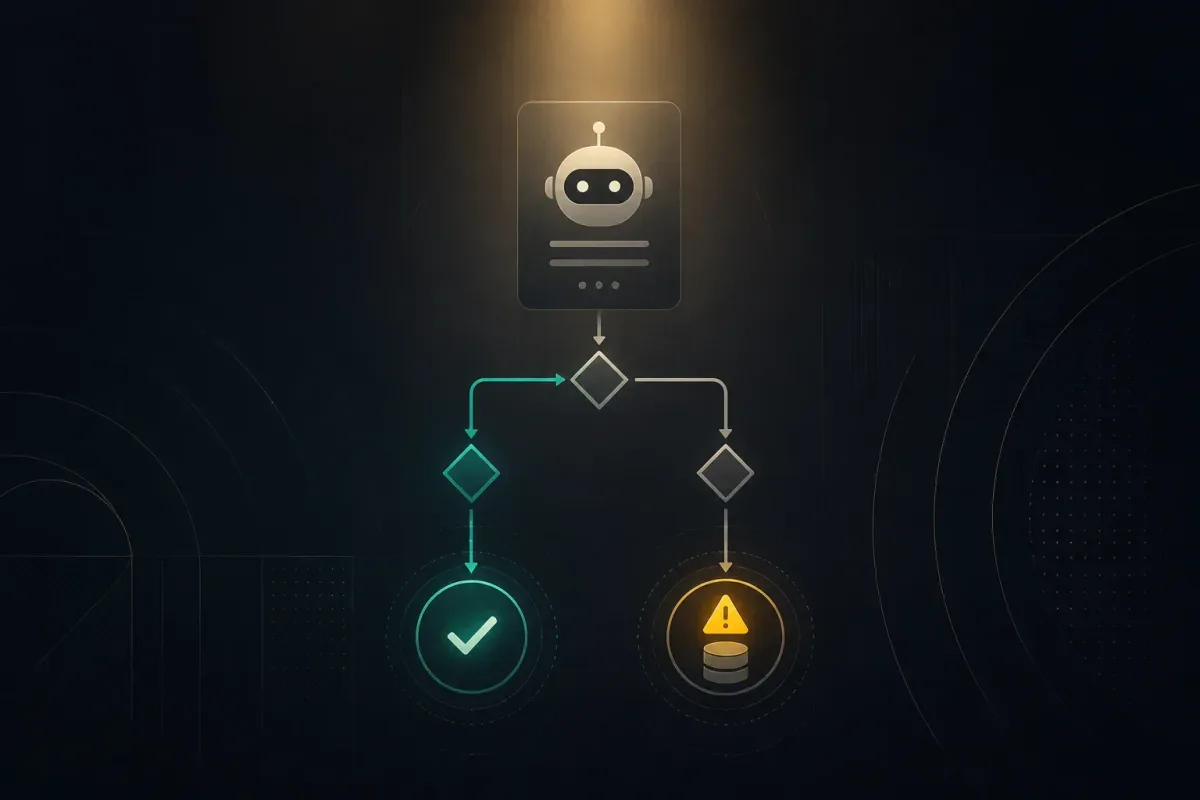
Your agent completes the demo, calls a tool, and returns a confident answer. Then a customer changes the request mid-conversation, a lookup returns incomplete data, or a tool call changes the wrong record. The reply can still look reasonable while the workflow has failed.
AI agent testing is the practice of evaluating an agent’s decisions and their real-world effects, not just judging its final text. Build a defined case, run it in a resettable environment, capture the trace and resulting state, then apply separate checks for task success, safety, and response quality. That matches the basic eval model described by Anthropic, OpenAI, and AWS: an input or scenario, a captured run, explicit evaluation logic, and a result you can compare over time.
Copy this AI agent test-case template
Store this template with your codebase in YAML, JSON, or Markdown. Write it before you run the agent so your test has an oracle—the conditions that determine whether behavior was acceptable. Google Cloud’s documented evaluation workflow likewise begins with cases and expected outcomes before it produces traces and metrics. Read its agent-evaluation guidance.
The fields deliberately separate what the agent says from what it does. A trace tells you which tools and arguments it used; an environment assertion tells you whether the booking, record, file, or other side effect is actually correct.
Filled example: fictional support refund case
This is a fictional sandbox example, not an observed production result. Replace the tools, policy, and fixtures with your own.

Get the Mobile Testing Playbook Used by 800+ QA Teams
Discover 50+ battle-tested strategies to catch critical bugs before production and ship 5-star apps faster.
How to test an AI agent step by step
1. Define the task, risk, and starting state
Write one case around a real user task and name the state that exists before the first message. Include normal work, known failures, policy boundaries, missing context, conflicting instructions, and adversarial inputs such as prompt injection.
This matters because a prompt by itself is not a workflow specification. AWS’s Strands Evals documentation describes cases with input, optional expected output, expected tool trajectory, and metadata; those are useful building blocks for a test case. For conversation data, Microsoft’s evaluation guidance distinguishes replayed interactions from synthesized personas: replay preserves prior context, while synthesized personas can adapt to a diverging conversation. Record the assumptions when you create synthetic cases.
2. Test the trace and the environment outcome separately
Capture the complete run: user turns, model outputs, tool calls, arguments, retrieved context, errors, and timestamps. Then query the sandbox or fixture to verify the resulting state.
For each case, make two lists:
Trace checks: required tools, forbidden tools, ordering rules, argument constraints, retries, and handoffs.
Outcome checks: the record created or changed, data left unchanged, artifact produced, and policy result.
A friendly answer does not prove a refund was created correctly or that an unwanted message was not sent. Treat both streams as evidence. This is particularly important when your AI agent can write data or trigger external actions.
3. Isolate side effects and reset before every trial
Run tests against a disposable database, mock server, sandbox account, or controlled fixture. Never make a real payment, send a live customer message, or alter production data in the name of testing.
Resetting is what makes trial-to-trial comparisons meaningful. A practical reset sequence is:
Restore the database snapshot or fixture.
Clear the trace, tool-call log, and cached session state.
Reset external mocks and injected failure conditions.
Re-seed the policy documents or retrieved context the case requires.
Assert that the starting state matches the case definition.
For fast component checks, you can mock model behavior while asserting trace structure and outputs. Research on structural testing of LLM-based agents describes using traces, mocked LLM behavior, and assertions for repeatable automated checks. Keep those checks separate from live-model trials; mocks test your orchestration cheaply, while live trials reveal behavior under the model you plan to deploy.
4. Layer assertions instead of using one score
Use the most deterministic check available for each requirement. Anthropic’s guidance describes agent evaluation as a combination of code-based, model-based, and human graders. Each has a different job.
Code-based assertions check exact requirements: schema validity, required fields, tool names and arguments, authorization order, prohibited calls, final state, and any defined latency, token, or cost ceiling.
Rubric-based model judges evaluate qualities with several acceptable answers, such as groundedness, completeness, relevance, and tone. Give the judge the task, relevant evidence, a scoring rubric, and clear failure examples.
Human review handles high-impact decisions, ambiguous failures, and calibration of your model judge against expert judgment.
Do not let a polished response offset an unauthorized tool call. Report task completion, trajectory compliance, state correctness, safety compliance, response quality, latency, tokens, and cost as separate fields.
5. Allow valid paths, but enforce required constraints
Exact transcript matching is brittle when more than one route can succeed. Specify properties instead: which calls must occur, which calls must never occur, what order is mandatory, and what final state must be true.
LangChain’s AgentEvals documentation describes useful trajectory modes: strict matching when sequence matters, unordered matching when call order does not, subset matching to forbid calls outside a reference set, and superset matching to require calls while allowing extras. Use strict matching for a genuine dependency, such as checking authorization before a state-changing action. Do not require it when either of two safe lookup orders is acceptable.
6. Turn rules into test assertions
Read your system prompt, policy documents, and tool contracts line by line. Every “must,” “must not,” and required sequence should become a testable rule.
For example:
If identity verification must happen before an account change, assert that order in the trace.
If a tool is the only approved way to perform a task, assert the tool call and its arguments.
If an action requires refusal, assert both the absence of the side effect and an appropriate user-facing explanation.
If hidden reasoning must not be exposed, inspect the output and logs for prohibited content.
Microsoft Research’s Agent-Pex project explores deriving evaluation rules from agent specifications. Your practical safeguard is to review generated cases and assertions; a generated test is still code and policy that you own.
7. Set a decision rule before you inspect results
A single successful run is weak evidence for a non-deterministic workflow. Run isolated trials and retain each trace, assertion result, and judge rationale.
A workable starter policy for a medium- or high-risk case is the five-trial rule in the template: pass when all safety-critical checks pass and at least four trials meet task criteria; fail on a safety-critical failure or when one or fewer trials meet the criteria; otherwise mark the result Inconclusive and investigate. AgentAssay proposes pass, fail, and inconclusive outcomes with statistical treatment for non-deterministic workflows.
This is a starter policy, not a universal threshold. Increase scrutiny for irreversible or safety-sensitive actions, and set your threshold before looking at outcomes. Never lower it after a failure just to ship.
8. Separate capability exploration from regression protection
Use capability cases to discover whether the agent can handle a new or difficult behavior. Use regression cases to guard behavior you already expect to work. When a capability case becomes stable and valuable, promote it to regression.
Run cheap structural checks on relevant changes, a representative live trajectory suite in CI, and repeated trials plus human review for release candidates or high-risk workflows. After deployment, review sampled and redacted traces, reproduce confirmed failures in a sandbox, and add each confirmed failure to the regression suite. Track quality, latency, token usage, error rate, and cost separately; one quality score cannot tell you whether a workflow is affordable or fast enough.
9. Extend the same structure to multi-agent handoffs
Start by making one tool-using agent reliable. For a multi-agent system, apply the same case, trace, state, and reset structure to every handoff. Add assertions for delegation target, message schema, ownership of each action, retry limits, and deadlock or loop limits.
The handoff is an interface. Test it as rigorously as any other interface: what was sent, who was allowed to act next, and what state changed as a result.
A release-ready AI agent testing checklist
Before promoting an agent change, confirm that you can answer yes to each question:
Is the task and starting state written as a versioned case?
Is the environment safe to reset and free of production side effects?
Did you capture the trace and independently assert the final state?
Are safety requirements deterministic checks rather than a model-judge preference?
Does the case permit valid alternate paths while blocking invalid ones?
Did you define pass, fail, and inconclusive rules before execution?
Are individual trial results and evidence links retained?
Has each confirmed defect become a reproducible regression case?
Conclusion
Effective AI agent testing is not about finding a single ideal prompt. It is about making behavior observable and judgeable: define the task, control the state, inspect the path, verify the side effect, and preserve the evidence. Quash has no first-party data, telemetry, recurring bug patterns, or completed original experiments that resolve the open gaps in AI-agent evaluation, so this guide does not present a Quash observation or statistic as evidence.
Start with the template above for one high-risk workflow this week. Once you can reproduce its failures safely, you have the foundation for a regression suite your agent—and your release process—can earn.
Continue reading
More articles from the Quash editorial desk.