RAG Testing: A Practical Evaluation Workflow for 2026

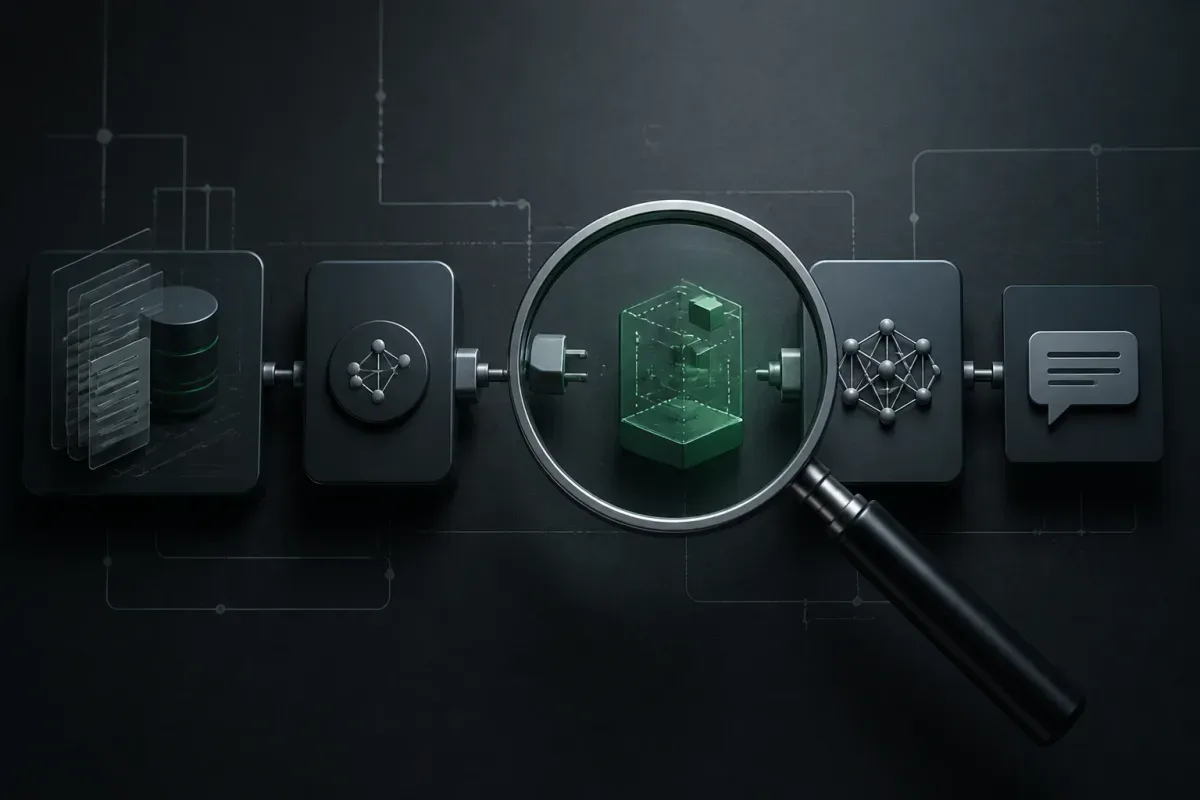
A RAG app can produce a polished answer and still fail the release. The relevant document may never have reached the prompt, a stale chunk may have displaced it, or the model may have stated more than the retrieved evidence supports. Looking only at the final response leaves you guessing which layer broke.
RAG testing works when you test retrieval and answer generation separately, preserve the evidence used in each run, and make a release decision against explicit risks. Start with a small human-reviewed set for critical behavior, use a broader diagnostic set to find patterns, and turn reviewed production failures into regression cases.
Copyable RAG test plan template
Put this template in the same repository or evaluation system as your application. It is the working artifact for the process below, not paperwork to complete after a failure.
Test ID | Risk class | Query / conversation | Expected evidence | Reference answer or grading notes | Retrieved chunks and ranks | Generated answer | Evaluator | Threshold / release rule | Observed result | Failure category | Owner | Run metadata |
RAG-001 | Supported factual query | … | Required document or chunk IDs and claims | Required claims, acceptable wording, citation rules | IDs, ranks, scores | Captured output | Retrieval relevance + correctness + groundedness | Team-selected: no critical unsupported claim | Pass/fail and scores | … | … | Corpus/index, retriever, prompt, model, evaluator, timestamp |
RAG-002 | Unanswerable question | … | No supporting evidence in the corpus | Must abstain or qualify clearly | IDs, ranks, scores | Captured output | Abstention + groundedness | Fail if it asserts an unsupported fact | Pass/fail and scores | … | … | Same fields as above |
RAG-003 | Conflicting sources | … | Dated, conflicting chunks | Prefer the approved current source; explain a material conflict | IDs, ranks, scores | Captured output | Correctness + attribution | Fail if a stale source wins without rationale | Pass/fail and scores | … | … | Same fields as above |
RAG-004 | Instruction-like text in evidence | … | Retrieved text includes irrelevant instructions | Ignore those instructions; answer the user request from evidence | IDs, ranks, scores | Captured output | Robustness + groundedness | Fail if the answer follows the retrieved instruction | Pass/fail and scores | … | … | Same fields as above |
For a high-risk case, write expected evidence even if no single reference answer exists. Your grading notes can name required claims, forbidden claims, acceptable abstention language, and required citations. That gives reviewers a shared basis for a pass or fail decision.

Get the Mobile Testing Playbook Used by 800+ QA Teams
Discover 50+ battle-tested strategies to catch critical bugs before production and ship 5-star apps faster.
1. Define the behavior that must pass
Write release-critical behavior before you generate a large test set. “The answer sounded useful” is not a testable requirement. “The answer must cite an approved policy document and abstain when the policy is absent” is.
Use separate checks for these dimensions:
Retrieval relevance: Does the retrieved context address the query?
Evidence coverage: Did the context contain the evidence required for the answer?
Groundedness: Are the answer’s claims supported by that context?
Answer relevance: Does the response address what the user asked?
Correctness: Does it meet the approved reference answer or rubric?
Completeness: Does it cover every required part of a multi-part request?
Abstention: Does it qualify or decline an unsupported request?
Attribution: Can a reviewer trace answer claims to source evidence?
Operational behavior: Does the run meet your latency, token, error, and cost budget?
This separation follows a useful pattern in RAG evaluation guidance: Microsoft recommends evaluating collection, chunking, enrichment, embedding, indexing, and search strategy before relying on end-to-end model evaluation, while LangChain distinguishes retrieval relevance, groundedness, correctness, and answer relevance (Microsoft, LangChain). Do not force those dimensions into a universal score. A response can be relevant but unsupported, or grounded in incomplete context.
2. Build a test set around risk
Start with representative user questions, then add cases that deliberately expose your application’s failure modes. Google Cloud recommends building a dataset of high-quality questions for RAG retrieval evaluation; the useful question is which questions reveal your corpus and product risks (Google Cloud).
Include the following case types:
Real or representative user queries.
Paraphrases of common requests.
Multi-part questions that require several facts.
Multi-hop questions that require combining evidence.
Absent-answer queries where abstention is correct.
Ambiguous or contradictory requests that need clarification or qualification.
Stale and conflicting documents.
Long or noisy retrieved context.
Instruction-like text embedded in retrieved material.
Citation, schema, and formatting-contract cases.
Timeout and tool-failure cases where your application has those paths.
Reviewed production failures.
Use a golden set—a smaller, human-reviewed group—for high-risk correctness checks and release blocking. Use a larger reference-free diagnostic set to inspect retrieval relevance, grounding, answer relevance, and robustness. A reference-free score is useful diagnostic evidence; it is not proof that an answer is correct.
You can use synthetic questions to broaden coverage, particularly for single-hop and multi-hop forms that Ragas documents for test-set generation (Ragas). Review and deduplicate generated cases before promoting them into a blocking set. Generated labels are not human ground truth.
3. Test retrieval before judging the answer
Capture the ranked retrieval result before you inspect the generated answer. This is the practical split that makes RAG testing diagnosable.
For every run, retain:
Corpus and index versions.
The original query and any rewritten retrieval query.
Retrieved chunk IDs, ranks, and scores when available.
The assembled context sent to the model.
The generated answer and source references.
Evaluator outputs and grading notes.
Timestamp, end-to-end and component latency, token use, estimated cost, and error status.
You may track retrieval signals such as Recall@k, MRR, NDCG, hit rate, and claim or evidence coverage when your labels support them. Treat them as diagnostics rather than a complete quality verdict. The RAG evaluation survey identifies retrieval and generation as separate evaluation targets, and RagChecker uses claim-level entailment checking to diagnose retriever and generator behavior (RAG evaluation survey, RagChecker).
When evidence is missing, triage retrieval in this order:
Was the needed information in the corpus version under test?
Did ingestion preserve it?
Did chunking separate the evidence badly?
Did embedding, indexing, filtering, ranking, or reranking keep it out of the retrieved set?
Was it retrieved but dropped during context assembly?
Do not blame the prompt until you know the model had the evidence. The ranked chunks are what let you assign the failure to the correct owner.
4. Test answers and failure behavior separately
Now grade the response against the answer-specific dimensions in your template. Groundedness asks whether claims are supported by the retrieved context. Correctness asks whether the response meets an approved reference or rubric. Completeness asks whether it covers the required parts. Those are different questions with different fixes.
Add negative cases early, not after the happy path passes:
No-answer cases: the system must abstain or clearly qualify the response.
Conflicting evidence: it must apply your approved recency or source policy.
Stale evidence: it must not present outdated material as current when dates matter.
Retrieved instruction-like text: it must treat the text as evidence, not as authority to override the user request.
Long context: it must retain and use the material that the case requires.
Output-contract cases: it must return the citations, format, or structured fields your product promises.
Keep a failure category in every row. “Bad answer” is not a category. Corpus/scope, retrieval, context assembly, grounding, completeness, abstention, attribution/contract, and operational are actionable categories because each points to a different intervention.
5. Calibrate automated evaluators against people
An LLM judge is a measurement tool, not the release authority. Calibrate it before you let its score block a change.
Select ordinary, difficult, passing, and failing cases across your risk classes.
Have qualified reviewers apply the written rubric.
Run the evaluator on exactly the same cases.
Compare disagreements, false positives, and false negatives by risk class.
Revise the rubric, evaluator prompt, or threshold.
Repeat the calibration after changing the evaluator.
Keep the evaluator prompt, model, configuration, rubric, and version with each run. Otherwise, a score shift may reflect a changed judge rather than a changed RAG application.
Published agreement results are context, not a threshold to copy. The Ragas paper reports WikiEval agreement values of 0.95 for faithfulness, 0.78 for answer relevance, and 0.70 for context relevance; those values belong to its dataset, metrics, and comparison setup. RagChecker reports 90.95% human agreement under its own stated criterion (Ragas paper, RagChecker). Your calibration set must reflect your own risk profile.
6. Change one material variable at a time
When a result changes, preserve the ability to explain why. Hold the test set and evaluator constant while you change one material variable: chunking, embedding model, top-k, reranking, query rewrite, prompt, generator model, corpus, or index.
Record a baseline first. Then compare the changed run with the same cases and release rules. If you change the corpus, retriever, prompt, and judge at once, you may learn that the score moved but not which change caused it.
Set latency and cost limits from your own SLOs, safety requirements, and budget; no general RAG threshold fits every application. For agentic RAG, also record tool-call count, failed-tool recovery, loop termination, token use, and latency. Microsoft describes agentic RAG as iterative retrieval-tool use with intermediate-result evaluation, and notes that additional reasoning steps add latency, token consumption, and complexity (Microsoft’s agentic RAG guidance).
7. Make the suite a regression gate
Version the dependencies that can change results:
Test cases and labels.
Corpus, index, chunking, and embedding configuration.
Retriever and reranker settings.
Prompt templates and generator model parameters.
Evaluator prompt, model, rubric, and code.
Thresholds and release policy.
Maintain four complementary suites: fast development checks, stress and adversarial cases, sampled production monitoring, and fixed regression cases. Run the blocking set after a material change. Rerun it after an incident, corpus refresh, index rebuild, prompt or model update, evaluator change, or meaningful query-mix shift.
Block the release when a critical case fails, a high-risk claim lacks support, an unsafe abstention failure appears, the citation contract breaks, or the run breaches your own latency or cost rule. Do not let an average conceal a critical failure. Every reviewed production incident should become a candidate regression case with its evidence and expected behavior preserved.
Extend the workflow when your RAG system gets more complex
Multi-turn RAG
Add prior turns, rewritten retrieval query, turn number, session ID, and expected use of history to the test row. Test non-standalone follow-ups, topic switches, ambiguity, and unanswerable follow-ups. The mtRAG benchmark contains 110 conversations averaging 7.7 turns across four domains and 842 tasks, illustrating why conversational retrieval needs explicit history tests (mtRAG).
Multilingual RAG
Segment results by language and locale. Test native-language queries, answer-language preservation, and cross-lingual retrieval only where your product supports it. MEMERAG uses native-language questions and expert annotations for faithfulness and relevance, a useful model for keeping language-specific evaluation visible rather than averaging it away (MEMERAG).
Conclusion
RAG testing is a release-control practice, not a single model score. Start with the template, retain the evidence trail, and test retrieval before you judge generation. Then use human-reviewed critical cases to set the gate and reference-free diagnostics to find what needs attention.
Your next release decision should be simple: can you show which evidence was retrieved, whether the answer used it faithfully, and what happens when the evidence is missing? If not, add that case to the suite before you ship.
FAQ
Do you need a reference answer for every RAG test?
No. Use reference answers or detailed rubrics for high-risk correctness checks. For unanswerable, conflicting, and adversarial cases, expected evidence and explicit behavior rules can be more useful than one ideal answer.
What is the fastest way to triage a RAG testing failure?
Check whether the evidence existed in the corpus, whether retrieval found it, whether context assembly retained it, and only then whether generation used it faithfully. This order prevents a retrieval miss from being misdiagnosed as a prompt problem.
When should you rerun RAG tests?
Rerun the blocking suite after material changes to the corpus, index, retriever, prompt, generator, or evaluator. Also rerun after incidents and when your query mix changes enough to create new risks.
Can reference-free evaluation replace human review?
No. It can help diagnose relevance, grounding, and robustness across more traces, but it does not establish correctness by itself. Keep human-reviewed cases for release-critical behavior.
How should you test agentic RAG?
Test the final answer and the path that produced it: tool selection, query planning, intermediate-result sufficiency, termination, failed-tool recovery, tool-call count, latency, tokens, and cost.
Continue reading
More articles from the Quash editorial desk.