Data-Driven vs. Keyword-Driven Testing: Which Should You Use in 2026?

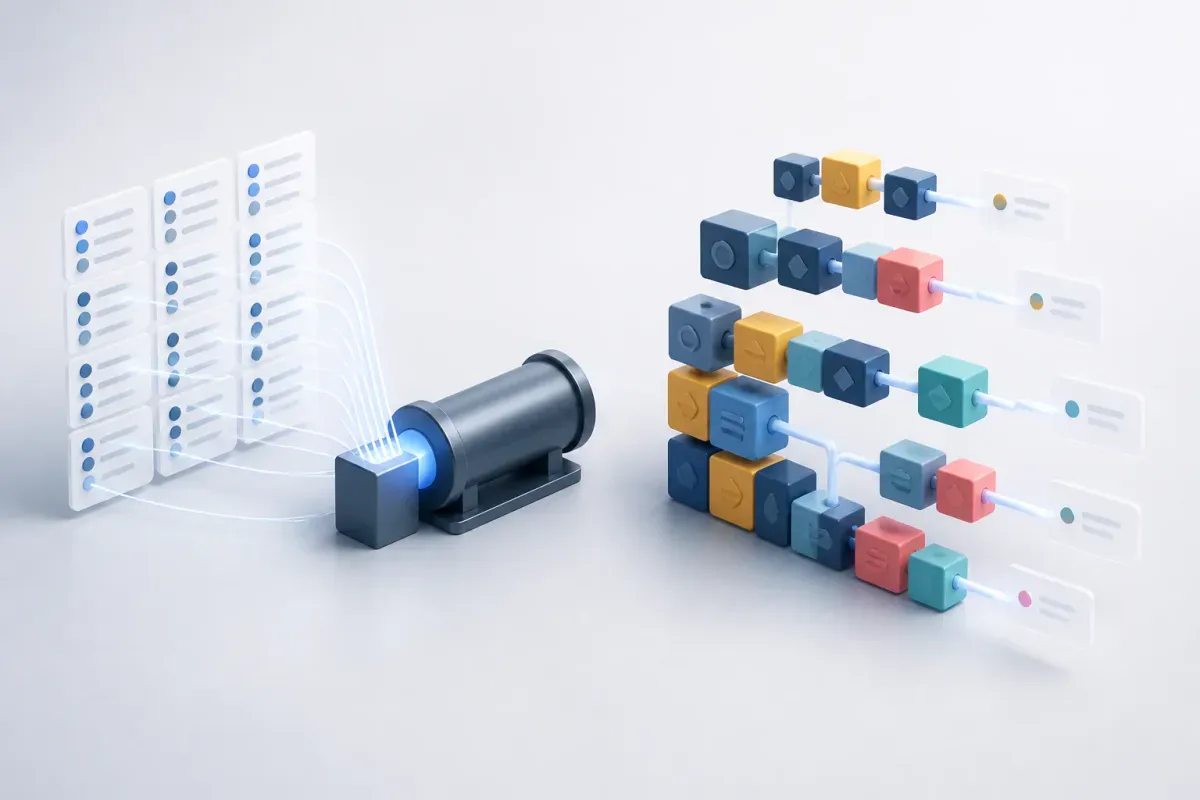
Your regression suite can become difficult to change long before it becomes difficult to run. You may be copying the same login flow for every new credential combination, or following a table of reusable steps so indirect that a failed test sends you through several layers before you find the cause.
The short answer is that data-driven testing fits a stable flow with changing inputs or expected results. Keyword-driven testing fits a suite where reusable application actions and workflow composition are the main need. Neither is a universal winner: choose the abstraction that isolates the part of your tests that changes most often. If data and workflows vary independently, combine them only when you can support the extra layer.
Data-driven vs. keyword-driven testing at a glance
Dimension | Data-driven testing | Keyword-driven testing |
Primary abstraction | Test data and expected results are separated from a stable flow | Application actions are represented as reusable keywords or functions |
What usually changes | Inputs, expected outputs, or selected data rows | Action sequence, keyword arguments, composed workflow, or action implementation |
Main reusable asset | Control flow and its data contract | Keyword vocabulary, action implementations, argument conventions, and driver |
Best-fit problem | One scenario must run against multiple meaningful datasets | Tests need to compose repeatable application actions or workflows |
First maintenance question | Can you change a data row without changing the flow? | Can you change an action in the keyword layer without rewriting every test? |
Can you combine it with the other approach? | Yes, by supplying data to a reusable flow | Yes, by using keywords as the reusable flow |
This comparison is an architectural guide, not a benchmark. It helps you locate change ownership in a test suite; it does not prove that either approach automatically improves coverage, execution speed, or maintenance outcomes.

Get the Mobile Testing Playbook Used by 800+ QA Teams
Discover 50+ battle-tested strategies to catch critical bugs before production and ship 5-star apps faster.
What is data-driven testing?
Data-driven testing separates test commands from the data used to run them. In its documentation, TestComplete describes running tests with different sets of input values after separating the commands from that data. The Robot Framework Certified Professional syllabus similarly describes a data-driven style that runs the same sequence with different inputs or expected outputs (TestComplete documentation; Robot Framework syllabus).
In practical terms, you keep the interaction path stable and vary the case data. A sign-in scenario might use the same steps for valid accounts, invalid passwords, locked accounts, locale-specific values, or validation messages. The point is not that every variation belongs in one table. The point is that the flow does not have to be copied merely because its values change.
A useful data row is more than a spreadsheet line. It should identify the inputs, the expected result or another test oracle, and enough relevant context for you to reproduce and judge the run. That is a design recommendation: your data contract should make the purpose of each row clear to the person reviewing a failure.
Where data-driven testing is strong
Data-driven testing is a strong starting point when you can state the scenario once and vary the conditions around it. It gives you a focused place to review inputs and expected outcomes, and it lets you add boundary or negative cases without cloning the interaction flow.
For example, an address-validation flow may be stable while postal codes, required-field combinations, and expected error messages change. Keeping those variations as data can make the scenario easier to inspect than a set of nearly identical scripts.
It also creates a useful review boundary. If a new business rule changes an expected message or valid range, you can examine the relevant row and its oracle before changing the flow itself.
Where data-driven testing becomes awkward
Data-driven testing is less comfortable when the steps change substantially from case to case. A table cannot make fundamentally different workflows into one stable scenario just by adding columns. When the meaning of a row becomes “sometimes do these extra steps,” the design may be hiding workflow variation in data.
More rows do not automatically mean better testing. NIST’s Practical Combinatorial Testing, published in 2010 and updated in 2018, explains why faults can depend on interactions among parameter values rather than on individual values in isolation (NIST). Use that as a reminder to select meaningful combinations; it is not a comparison study of data-driven and keyword-driven testing.
Poor data governance can cause a different problem: your suite may run many cases without making clear why each case exists. Give columns stable names, record expected outcomes, and retire redundant rows. Otherwise, a dataset becomes a large inventory rather than a readable specification.
What is keyword-driven testing?
Keyword-driven testing expresses application actions as reusable keywords or application-specific functions. Squish documents a design in which a keyword table contains application-under-test-specific function names and their arguments, and a generic driver executes those entries (Squish documentation).
Instead of writing each test entirely as low-level interactions, you define operations with names that fit your application. A mobile flow, for example, might use Launch app, Sign in, Open settings, and Verify text. The visible test describes the operations to perform; the function behind each keyword handles the application interaction.
That distinction matters. A keyword is not simply a nicer label for a script. Squish’s documented model includes application-specific support functions, a generic driver, test cases, and tables that invoke the functions. The keyword vocabulary, its arguments, and the driver are all parts of the design you must own.
Where keyword-driven testing is strong
Keyword-driven testing helps when reusable actions or workflow fragments recur across many scenarios. A shared vocabulary can make a test specification easier to scan when the same application operations appear repeatedly.
It also separates the test description from the lower-level implementation. If the implementation of Sign in changes, you can update the action behind that keyword rather than edit every specification that invokes it—provided the keyword’s contract remains valid.
This approach can work well when you need to compose longer workflows from consistent operations. You are reusing the behavior of the test, not merely rerunning one flow with different values.
Where keyword-driven testing adds cost
The added abstraction has an operating cost. You need to design, name, document, and maintain the keyword vocabulary. You also need argument conventions, application-specific functions, and a driver that makes failures understandable.
A failure can require tracing from a test row to a keyword, its arguments, the driver, and the underlying implementation. That trace is not inherently bad; it is the price of separating the test description from the interaction code. It becomes a problem when keywords are vague, overlap in purpose, or behave inconsistently.
Do not assume that keyword-driven testing is automatically no-code or that it is inherently better for nontechnical authors. The documented architecture still requires someone to build and maintain its application-specific functions and driver.
Compare the change your suite is actually experiencing
The labels matter less than the location of the recurring change. Use the following questions to compare data-driven and keyword-driven testing against the suite in front of you.
Is the flow stable while values change?
If the steps are stable but the inputs or expected outcomes change, start with data-driven testing. You can use a stable checkout flow, for example, with selected payment data, cart states, and expected validation outcomes.
The design works when a change to a case can remain a change to the data. If adding a row regularly forces you to alter the interaction sequence, your “stable” flow may not actually be stable.
Are reusable actions the recurring unit?
If the same application actions recur in different workflows, keyword-driven testing is often the more natural fit. The reusable unit is an operation such as authentication, navigation, search, or a verification, rather than one set of inputs.
Ask whether you can give the operation a precise name and a stable argument contract. A keyword called Handle user stuff hides intent. A keyword called Select delivery address with documented inputs gives a reviewer a clearer starting point.
Who should own the change?
In a data-driven design, an input or expected-outcome change should normally be reviewed in the dataset and its data contract. In a keyword-driven design, an interaction change should normally be reviewed in a keyword implementation or the driver layer.
This is a practical maintenance heuristic, not measured evidence that either structure reduces maintenance. Its value is diagnostic: you should be able to explain where a change belongs before you add another abstraction.
What should a failure tell you?
For a data-driven failure, first inspect the row, its expected result, the environment, and the stable flow. You are asking whether the selected data or its oracle no longer matches the observed behavior.
For a keyword-driven failure, trace the specification to the keyword, arguments, driver, and application-specific implementation. You are asking which layer no longer matches the application or the intended workflow.
A good report identifies the relevant row and keyword rather than forcing you to infer them from a generic failure. If your reports cannot identify the changed layer, improve the reporting or simplify the design before scaling the suite.
How should you judge scale?
Do not use row count as a proxy for coverage, and do not use keyword count as a proxy for reuse. Review the design instead:
Is there a clear data contract for each dataset?
Are parameter combinations selected for a reason?
Is the keyword vocabulary bounded and specific?
Do keyword arguments follow consistent conventions?
Can a failure identify the data, action, or implementation layer that needs attention?
Those questions give you a more useful definition of scale: not more artifacts, but artifacts that remain understandable when the suite changes.
What does this look like in mobile QA?
Mobile scenarios can vary in both values and interaction state. Permissions, backgrounding, navigation state, device configuration, and network conditions may change the path as well as the input. That does not establish that one design catches more mobile defects; it means you should be explicit about what varies in your own scenario.
A stable sign-in path with several account states can be a data-driven case. A repeated sequence for opening a feature and confirming a setting can fit a keyword-driven layer. When state changes alter both the path and the values, a hybrid may be warranted.
If you are making this decision as part of a broader tooling decision, review how to choose a test automation framework after you have identified the testing structure you need. A framework choice cannot fix an unclear data contract or an incoherent keyword vocabulary.
When should you choose data-driven testing?
Choose data-driven testing when your central question is: “Does this same flow behave correctly across these meaningful inputs or expected outcomes?”
Typical candidates include:
credential validation with selected account states;
form and checkout scenarios with changing field values;
locale, currency, or regional data variations;
boundary and negative cases for a stable business rule; and
repeated checks where only the inputs and oracle differ.
Start here when the flow is genuinely stable and you want the least additional abstraction. You can add a reusable action layer later if recurring workflows become the dominant maintenance issue.
Avoid forcing this approach onto cases with materially different paths. Encoding workflow branches as increasingly complicated data columns can make the test harder to understand than a direct specification.
When should you choose keyword-driven testing?
Choose keyword-driven testing when your central question is: “Can I express a recurring application operation once and compose it across several workflows?”
It is a fit when your suite has repeated actions across scenarios, needs a consistent high-level vocabulary, or benefits from separating a readable test description from lower-level interaction details.
Before creating keywords, decide what each one owns. Define its purpose, required arguments, expected outcome, and failure behavior. That discipline keeps a keyword layer from turning into an unsearchable collection of aliases for UI steps.
Avoid introducing keywords merely to make every test look abstract. A small suite with little repeated behavior may be clearer with direct test code or a simple data-driven design. The layer earns its place when it removes genuine repeated workflow work.
When does a hybrid approach make sense?
A hybrid combines two separate forms of reuse. The keyword-driven layer describes reusable actions or workflows, while the data-driven layer provides multiple inputs and expected results for that flow. Robot Framework’s style guidance allows data-driven specification alongside other styles, and TestComplete demonstrates data-driven execution with keyword tests (Robot Framework syllabus; TestComplete documentation).
For instance, a suite might express a reusable Create account workflow as keywords, then execute it against selected registration data and expected validation results. The hybrid is useful only if both the workflow and the data vary often enough to justify independent layers.
A hybrid is not a default best practice. It adds a debugging path that includes data rows, keywords, argument conventions, a driver, and implementation functions. Before adopting it, define which owner investigates a failure at each layer. If you cannot do that clearly, start with the simpler abstraction.
Use this 2026 decision framework
Treat these questions as editorial guidance drawn from the documented architectures, not as an experimentally validated industry rule.
Does the flow stay mostly the same while values change? Start with data-driven testing.
Do the same application actions recur across different workflows? Consider keyword-driven testing.
Do the action sequence and data vary independently? Consider a hybrid only if you can operate both layers.
Can you explain every dataset row and keyword? If not, strengthen the data contract or vocabulary before scaling.
Can a failed run identify the changed layer? If not, simplify the abstraction or improve the failure report.
Are data combinations selected intentionally? If not, improve selection before adding more rows.
The framework keeps the decision grounded in change ownership. It also prevents a common mistake: treating data-driven testing as a way to add volume, or keyword-driven testing as a way to make a suite look more sophisticated.
Conclusion
Data-driven testing is the better starting point when a stable flow must be evaluated against changing inputs or expected results. Keyword-driven testing is the better fit when reusable application actions and workflow composition are the real source of repetition.
Choose a hybrid only when both kinds of variation are independently valuable and your suite can reveal whether a failure belongs to the data, a keyword, the driver, or the implementation. Your decision should follow the change you need to manage—not the label that sounds more advanced.
Continue reading
More articles from the Quash editorial desk.